If you are wondering about beloved vs loved, you are probably trying to understand why these two words, which both express affection, do not always feel interchangeable. Both words describe someone or something that is deeply cared for, but they carry different levels of emotional tone, emphasis, and usage.
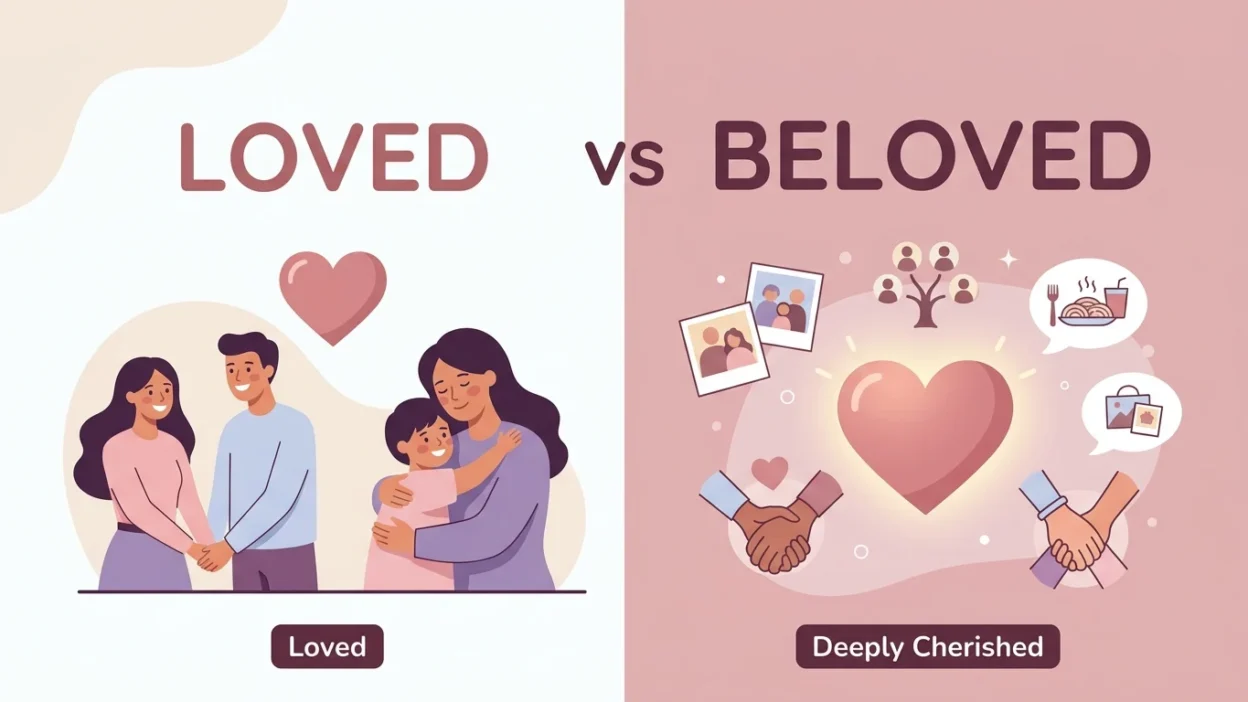
Loved is the common past tense and past participle of love, while beloved is a more expressive word meaning deeply loved, greatly cherished, or dearly valued. The difference is not simply grammatical. Beloved often carries a stronger sense of affection, devotion, respect, or emotional importance, while loved is broader and more natural for everyday situations.
Quick Answer: Beloved vs Loved
Loved means having received love or affection from someone.
Beloved means deeply or dearly loved and often suggests that the person or thing is especially cherished.
In simple terms:
- Loved = cared for or felt affection toward
- Beloved = deeply, dearly, or greatly loved
- Loved = common and neutral
- Beloved = more emotional, affectionate, or literary
Examples:
She was loved by her family.
She was beloved by her family and community.
Both sentences are correct, but beloved gives the second sentence a stronger emotional feeling.
What Does “Loved” Mean?
Loved is the past tense and past participle of the verb love.
The verb love means to have deep affection, care, or strong positive feelings toward someone or something.
For example:
I loved my childhood home.
This means the speaker felt strong affection for the home.
Loved can describe many kinds of affection, including romantic love, family love, friendship, appreciation, and enjoyment.
For example:
- She loved her children.
- He loved his wife.
- We loved the movie.
- They loved their new home.
- I loved spending time with my grandparents.
Because the word is broad, its meaning depends heavily on context.
What Does “Beloved” Mean?
Beloved means dearly loved, greatly cherished, or deeply valued.
It is an adjective and can also function as a noun in certain contexts.
For example:
She was a beloved teacher.
This means that many people deeply loved, respected, and appreciated her.
You can also say:
He returned to his beloved hometown.
Here, beloved expresses a strong emotional attachment to the hometown.
The word often appears when the speaker wants to emphasize how special someone or something is.
Common expressions include:
- beloved family member
- beloved friend
- beloved teacher
- beloved pet
- beloved hometown
- beloved character
- beloved leader
- dearly beloved
Beloved vs Loved: Main Difference
The key difference between beloved vs loved is the strength and emotional tone of the words.
| Word | Meaning | Tone | Common Use |
| Loved | Received or experienced love | Neutral, natural | Everyday speech and writing |
| Beloved | Deeply or dearly loved | Warm, emotional, affectionate | Formal, literary, heartfelt contexts |
Loved simply tells us that love exists or existed.
Beloved emphasizes that the person or thing is particularly cherished.
Compare:
He was loved by his family.
This is a straightforward statement of affection.
He was beloved by his family.
This sounds warmer and suggests that he was especially cherished.
Neither sentence is necessarily better. The appropriate choice depends on the emotion and context you want to communicate.
Examples of “Loved”
Here are some natural examples of loved:
- She loved her grandmother deeply.
- He loved playing football as a child.
- They loved their new house.
- I loved the book you recommended.
- The children loved their teacher.
- She has always loved animals.
- He loved spending weekends with his family.
- We loved every moment of the trip.
- They loved each other for many years.
- I knew I was loved and supported.
Notice how flexible loved is. It can describe emotional relationships as well as strong enjoyment or appreciation.
Examples of “Beloved”
Now consider these examples:
- She was a beloved teacher.
- The community mourned its beloved leader.
- He returned to his beloved hometown.
- Their beloved dog passed away peacefully.
- The author created a beloved fictional character.
- She remembered her beloved grandmother fondly.
- The restaurant was a beloved local institution.
- The team honored its beloved former coach.
- He kept photographs of his beloved family.
- The park remains a beloved place for local residents.
These examples show that beloved often appears when someone or something has a special place in people’s hearts.
When Should You Use “Loved”?
Use loved when you simply want to say that someone or something received love or that someone experienced strong affection.
It is usually the more natural choice in everyday conversation.
For example:
My parents loved me very much.
She loved her dog.
I loved that movie.
We loved our vacation.
The word does not necessarily imply that the subject was admired by a large group of people. It can describe a very personal relationship.
For example:
My grandfather was deeply loved by our family.
This focuses on the family’s affection toward him.
When Should You Use “Beloved”?
Use beloved when you want to emphasize that someone or something is dearly loved, treasured, or especially cherished.
It is particularly effective in:
- Eulogies
- Tributes
- Memorials
- Literature
- Emotional writing
- Formal speeches
- Personal reflections
- Descriptions of highly cherished people or places
For example:
She was a beloved member of the community.
This suggests not only that people loved her but that she held a special place in the community.
Similarly:
He returned to his beloved hometown.
sounds more emotional than:
He returned to his hometown, which he loved.
Is “Beloved” Stronger Than “Loved”?
Generally, yes.
Beloved usually communicates a stronger or more elevated sense of affection than loved.
However, strength of emotion ultimately depends on context.
For example:
I loved my mother deeply.
can express an extremely powerful emotional connection.
Meanwhile:
She was a beloved teacher.
may indicate that many students admired and cherished her, but it does not necessarily describe a romantic or intimate relationship.
So, beloved often sounds stronger or more affectionate, but it does not automatically mean that the underlying love is deeper in every situation.
Beloved vs Loved in Romantic Relationships
Both words can describe romantic relationships, but they create different impressions.
Loved is direct and personal:
She was deeply loved by her husband.
Beloved can sound more poetic or formal:
She was his beloved wife.
The phrase beloved wife is especially common in heartfelt writing, memorial inscriptions, biographies, and formal tributes.
However, in ordinary conversation, people are much more likely to say:
I love my wife.
rather than:
My wife is my beloved.
The second sounds poetic, old-fashioned, or deliberately romantic.
“Beloved” as a Noun
Beloved can also be used as a noun meaning a person who is dearly loved.
For example:
She wrote a letter to her beloved.
This usage is more literary or romantic.
You may encounter it in poetry, classic literature, songs, or highly emotional writing.
In everyday modern conversation, people usually use alternatives such as:
- my love
- my partner
- my loved one
- the person I love
The noun use of beloved therefore tends to carry a more poetic tone.
Common Mistakes With Beloved and Loved
Mistake 1: Assuming they are completely interchangeable
Although the words are closely related, their tone differs.
She was loved by everyone.
is natural and broad.
She was beloved by everyone.
sounds more heartfelt and emphasizes special affection.
Choose based on the emotional tone you want.
Mistake 2: Using “beloved” in casual situations
Calling every favorite object beloved can sound overly dramatic.
For example:
My beloved sandwich.
is grammatically possible, but it may sound humorous or exaggerated.
In ordinary conversation, favorite or loved may be more natural.
Mistake 3: Thinking “beloved” always means romantic love
It does not.
A beloved teacher, beloved grandmother, beloved pet, or beloved hometown does not imply romantic love.
The word simply means deeply cherished.
Mistake 4: Assuming “loved” is weaker in every context
Loved can express extremely powerful emotion.
For example:
She was deeply loved by her family.
This can be just as emotionally meaningful as saying she was beloved.
The difference often comes from style and emphasis rather than a strict measurement of emotional intensity.
American vs British English
There is no major difference between American and British English in the meaning or spelling of beloved and loved.
Both varieties use these words in essentially the same way.
The main variation is stylistic. Beloved can sound somewhat formal, literary, poetic, or old-fashioned in both varieties, while loved is much more common in ordinary conversation.
Pronunciation can vary slightly depending on whether beloved is used as an adjective or noun, and speakers may pronounce it with different syllable patterns. However, the meaning remains the same.
Synonyms for Beloved
Depending on context, synonyms for beloved include:
- Dear
- Dearly loved
- Cherished
- Treasured
- Adored
- Precious
- Valued
- Favorite
- Much-loved
- Well-loved
For example:
She was a cherished member of the family.
has a similar emotional meaning to:
She was a beloved member of the family.
The best synonym depends on how formal, emotional, or personal you want your writing to sound.
Beloved vs Loved: Which One Should You Choose?
Choose loved when you want a natural, everyday expression of affection.
Choose beloved when you want to emphasize that someone or something is deeply cherished or dearly loved, especially in emotional or formal writing.
A simple rule is:
Loved = affection
Beloved = deeply cherished affection
For everyday conversation:
I loved the movie.
For heartfelt description:
It became a beloved classic.
This distinction can help you make your writing more precise without making it unnecessarily complicated.
FAQs
What is the difference between beloved and loved?
Loved means having received or experienced love, while beloved means dearly, deeply, or especially loved. Beloved usually has a warmer or more emotional tone.
Is beloved stronger than loved?
Generally, beloved emphasizes deep or special affection more strongly than the neutral word loved. However, context can make “loved” equally powerful emotionally.
Is beloved a romantic word?
It can be romantic, especially when used as a noun, but it is not exclusively romantic. You can have a beloved teacher, pet, family member, hometown, or fictional character.
Can I say “my beloved”?
Yes. My beloved can refer to someone you love deeply. It is usually poetic, romantic, literary, or formal rather than casual.
Is beloved formal or informal?
Beloved is grammatically standard but often sounds more formal, literary, poetic, or heartfelt than loved.
Is beloved used in American and British English?
Yes. Beloved is used in both American and British English with essentially the same meaning.
What is another word for beloved?
Common alternatives include cherished, adored, treasured, dearly loved, precious, and much-loved.
Can “beloved” describe a place?
Yes. For example, you can say “her beloved hometown” or “their beloved vacation spot.” It means the place is deeply cherished or loved.
Summary
The difference between beloved vs loved is mainly one of emotional emphasis and style. Loved is the common past tense and past participle of love, and it can describe affection toward people, animals, places, activities, or things. It is flexible, natural, and appropriate for everyday English.
Beloved means dearly, deeply, or greatly loved. It often suggests that someone or something is especially cherished and can sound more emotional, literary, formal, or poetic. While both words can describe strong affection, beloved is often chosen when the writer wants to highlight a special emotional connection.
Actionable Takeaway
Use loved when you want a straightforward and natural expression of affection:
“She was deeply loved by her family.”
Use beloved when you want to emphasize that someone or something is especially cherished:
“She was a beloved member of the community.”
Remember that beloved does not always mean romantic love. It can describe family members, friends, teachers, pets, places, characters, and even institutions. Choose the word that matches both your meaning and the emotional tone you want your reader to feel.