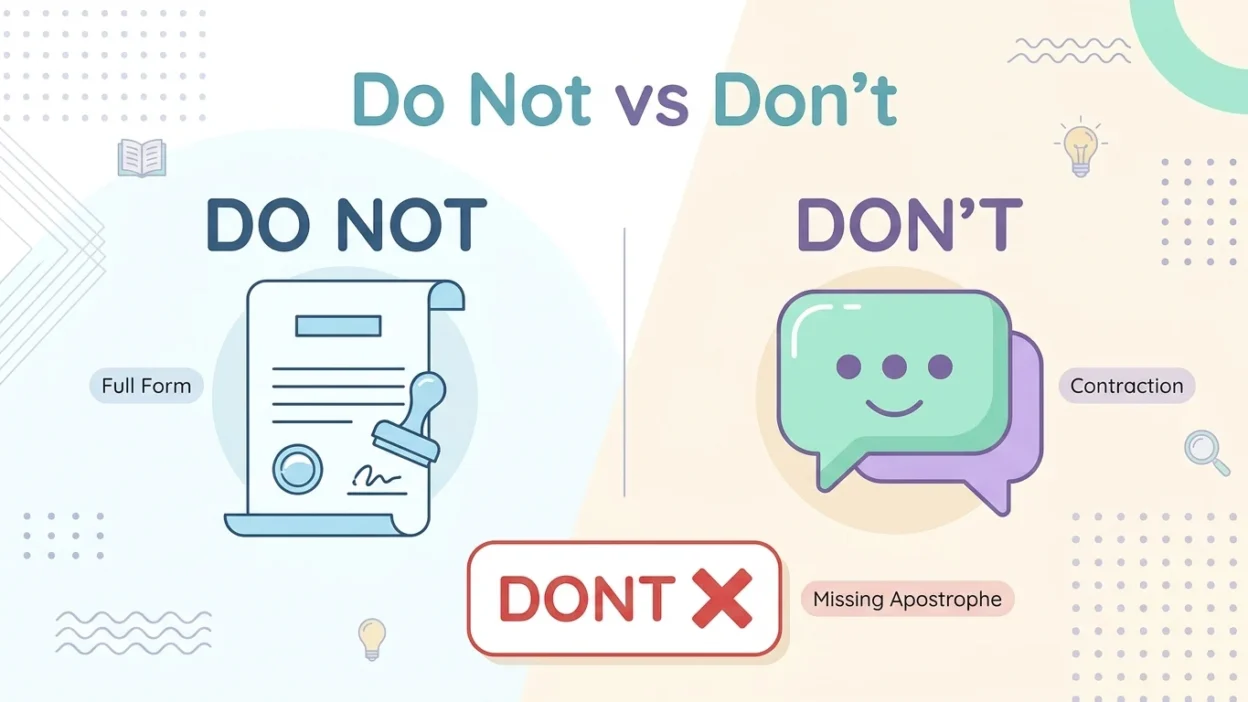
If you have ever wondered whether to write do not vs dont, the answer is quite simple: “do not” and “don’t” are both correct, but “dont” without an apostrophe is generally incorrect in standard English. The apostrophe matters because it shows that letters have been omitted to create a contraction.
The real choice in most situations is therefore between do not and don’t. Both express a negative command, instruction, request, or statement, but they differ in tone and formality. Learning when to use each one can make your writing clearer and help you sound more natural in both everyday conversations and professional communication.
Quick Answer: Do Not vs Dont
The standard forms are:
- Do not — the full form
- Don’t — the contraction of “do not”
- Dont — generally incorrect in standard English
Examples:
Do not touch the equipment.
Don’t touch the equipment.
Both sentences have the same basic meaning. The first sounds more formal or emphatic, while the second sounds more conversational.
The important point is that don’t needs an apostrophe. Writing dont without the apostrophe is a common spelling error.
What Does “Do Not” Mean?
Do not is the full negative form of the auxiliary verb do plus not.
It is used to make negative statements and negative commands.
For example:
I do not understand the question.
Here, “do not” makes the statement negative.
It can also be used for instructions:
Do not enter this room.
In this sentence, do not tells someone not to perform an action.
Because it is the complete form, do not often sounds more formal, serious, direct, or emphatic than don’t.
You are more likely to see it in:
- Formal writing
- Official notices
- Instructions
- Academic writing
- Legal or policy documents
- Professional communication
- Warnings
What Does “Don’t” Mean?
Don’t is the contraction of do not.
A contraction combines two words and replaces one or more omitted letters with an apostrophe.
Do not → don’t
For example:
I don’t know the answer.
means:
I do not know the answer.
Similarly:
Don’t worry.
means:
Do not worry.
Don’t is extremely common in spoken English and informal writing. It sounds natural in conversations, text messages, emails between people who know each other, and casual online communication.
Is “Dont” Correct?
In standard English, dont without an apostrophe is generally considered incorrect.
The correct contraction is:
don’t
not:
dont
The apostrophe is important because it indicates the missing letters from do not.
For example:
❌ I dont understand.
✅ I don’t understand.
❌ Dont forget your keys.
✅ Don’t forget your keys.
This is a small punctuation mistake, but it is worth correcting because dont is not the standard spelling of the contraction.
Do Not vs Don’t: Main Difference
The biggest difference between do not and don’t is not meaning but formality, emphasis, and style.
| Form | Meaning | Tone | Example |
| Do not | Negative form of “do” | Formal, emphatic | Do not open the door. |
| Don’t | Contraction of “do not” | Casual, conversational | Don’t open the door. |
| Dont | Incorrect standard spelling | Not recommended | ❌ Dont open the door. |
In most situations, you can replace do not with don’t without changing the basic meaning.
However, the tone can change.
Compare:
Do not forget to submit the form.
This sounds firm and possibly official.
Don’t forget to submit the form.
This sounds friendlier and more conversational.
When Should You Use “Do Not”?
Use do not when you want your writing to sound formal, serious, official, or emphatic.
For example:
Do not share your password with anyone.
Do not remove the protective cover.
We do not accept returns without a receipt.
I do not agree with that conclusion.
Please do not disturb the speaker.
The full form is particularly useful when a warning or instruction needs to stand out.
It can also add emphasis in a sentence:
I do not want you to worry.
Compared with:
I don’t want you to worry.
The first can sound slightly more deliberate or emphatic.
When Should You Use “Don’t”?
Use don’t when you want a natural, conversational tone.
For example:
Don’t worry about it.
I don’t know what happened.
Don’t forget your appointment.
We don’t need anything else.
They don’t agree with the decision.
You will commonly find don’t in:
- Everyday conversation
- Text messages
- Social media
- Informal emails
- Friendly advice
- Casual storytelling
- Dialogue in fiction
In these contexts, using do not everywhere can sound unnecessarily formal.
Examples of “Do Not”
Here are some examples of correct do not usage:
- Do not enter without permission.
- I do not believe that is the best solution.
- Do not leave your belongings unattended.
- We do not currently offer this service.
- Please do not interrupt the presentation.
- They do not understand the instructions.
- Do not use this product near an open flame.
- I do not agree with your suggestion.
- Employees do not need to complete the form twice.
- Do not make assumptions without checking the facts.
These sentences show why the full form works particularly well for formal statements and instructions.
Examples of “Don’t”
Now consider the contracted form:
- Don’t worry about the mistake.
- I don’t know the answer.
- Don’t forget your phone.
- We don’t have enough time.
- They don’t want to leave yet.
- Don’t touch that button.
- I don’t think that’s necessary.
- Don’t be afraid to ask questions.
- You don’t need to explain everything.
- Don’t give up just because the first attempt failed.
These examples sound natural in everyday English.
Do Not vs Don’t in Formal Writing
A common question is whether contractions such as don’t are allowed in formal writing.
There is no universal rule saying contractions are always grammatically wrong in formal English. However, many academic, legal, business, and official writing styles prefer fewer contractions because the full forms can create a more formal tone.
For example, in a formal report:
The company does not currently provide this service.
may sound more appropriate than:
The company doesn’t currently provide this service.
In a friendly business email, however, doesn’t or don’t may be perfectly natural.
The best choice depends on the publication, organization, audience, and desired tone.
Common Mistakes With Do Not and Don’t
Mistake 1: Writing “dont”
This is the most obvious mistake.
❌ Dont worry.
✅ Don’t worry.
Always use the apostrophe in the standard contraction.
Mistake 2: Using “do not” when a contraction sounds more natural
A sentence such as:
I do not know what you mean.
is grammatically correct, but in casual conversation:
I don’t know what you mean.
usually sounds more natural.
Mistake 3: Using “don’t” when strong emphasis is needed
Sometimes the full form is useful because you want to emphasize the negative.
Compare:
Don’t touch that.
with:
Do not touch that.
The second version can sound more serious, official, or forceful.
Mistake 4: Forgetting that “don’t” contains an apostrophe
The apostrophe is not decorative. It represents omitted letters.
do not → don’t
This is why dont is not the standard contraction.
Do Not vs Don’t in Questions
Both forms can occur in questions, although the structure depends on the sentence.
For example:
Why don’t you call her?
The full version is:
Why do not you call her?
However, this full form is not normally used in ordinary modern English. The contracted form don’t is the natural choice here.
For example:
Why don’t you come with us?
sounds completely natural.
The full form can appear in special emphatic or formal constructions, but learners should generally use the natural contraction in everyday questions.
American vs British English
There is no major difference between American and British English regarding the spelling or basic meaning of do not and don’t.
Both varieties use:
do not
and:
don’t
The apostrophe is required in the standard contraction in both forms of English.
The main difference is stylistic rather than regional. Formal writing in either variety may favor do not, while everyday speech commonly uses don’t.
So whether you are writing for an American or British audience, dont without the apostrophe should generally be avoided.
Do Not vs Don’t: Which Is More Polite?
Neither form is automatically more polite.
Politeness depends heavily on the wording and context.
For example:
Don’t forget to send the document.
can sound friendly.
Do not forget to send the document.
can sound more formal or firm.
A particularly polite alternative is:
Please don’t forget to send the document.
The addition of please often has a greater effect on politeness than choosing between do not and don’t.
How to Remember the Correct Spelling
Use this simple rule:
Do not = full form
Don’t = contraction
Dont = incorrect standard spelling
Think of the apostrophe as a small sign showing that letters have been removed:
do not → don’t
Whenever you shorten do not, keep the apostrophe.
A useful proofreading trick is to search your writing for “dont.” If you find it, change it to “don’t” unless you have a very unusual context where “dont” is intentionally being used as something other than the English contraction.
FAQs
Is “dont” correct English?
No. Dont without an apostrophe is generally not the standard spelling of the contraction. The correct form is don’t.
What is the difference between “do not” and “don’t”?
There is little difference in basic meaning. Do not is the full form, while don’t is its contraction. The full form often sounds more formal or emphatic.
Is “don’t” formal or informal?
Don’t is more conversational and is common in informal writing. It can still appear in professional communication when a conversational tone is appropriate.
Should I use “do not” in academic writing?
Do not can be a good choice in formal academic writing, especially when your institution or style guide prefers avoiding contractions. However, the rules can vary by discipline and publication.
Why does “don’t” have an apostrophe?
The apostrophe shows that letters have been omitted when do not is shortened to don’t.
Is “do not” more polite than “don’t”?
Not necessarily. Do not can sound more formal or firm, while don’t can sound more conversational. Politeness depends on the complete sentence and context.
Are “do not” and “don’t” used in both American and British English?
Yes. Both are standard in American and British English. The basic meaning and spelling are the same.
Can “don’t” be used in formal English?
Yes. Don’t is grammatically correct English, although some formal writing styles prefer the full form do not.
Summary
The difference between do not vs dont is mainly a matter of spelling and style. Do not is the complete form, while don’t is the correct contraction. The form dont, without an apostrophe, is generally considered a spelling or punctuation error in standard English. Both do not and don’t express negation, but their tone can differ depending on the context.
Use do not when you want a more formal, official, serious, or emphatic tone, particularly in instructions, notices, policies, and formal writing. Use don’t when you want a natural, conversational style, especially in speech, informal messages, friendly emails, and everyday communication. Remember that the apostrophe in don’t is essential.
Actionable Takeaway
When choosing between do not vs dont, remember that the real standard-English choice is do not vs don’t.
- Do not = full and often more formal
- Don’t = contraction and more conversational
- Dont = incorrect standard spelling
If you are unsure, check the tone of your sentence. For formal or emphatic writing, do not is often the safer choice. For natural everyday communication, don’t usually sounds more comfortable and fluent.
Most importantly, never drop the apostrophe when writing the contraction. Do not → don’t, not dont.