If you have ever wondered about savor vs saver, you are not alone. These two words look and sound somewhat similar, but they have completely different meanings and grammatical uses. Choosing the right one depends on what you are trying to say.
Savor is a verb or noun related to enjoying a taste, smell, experience, or moment. Saver, on the other hand, is a noun that generally refers to a person or thing that saves something. Once you understand this basic distinction, the difference between savor and saver becomes much easier to remember and apply in everyday English.
Quick Answer: Savor vs Saver
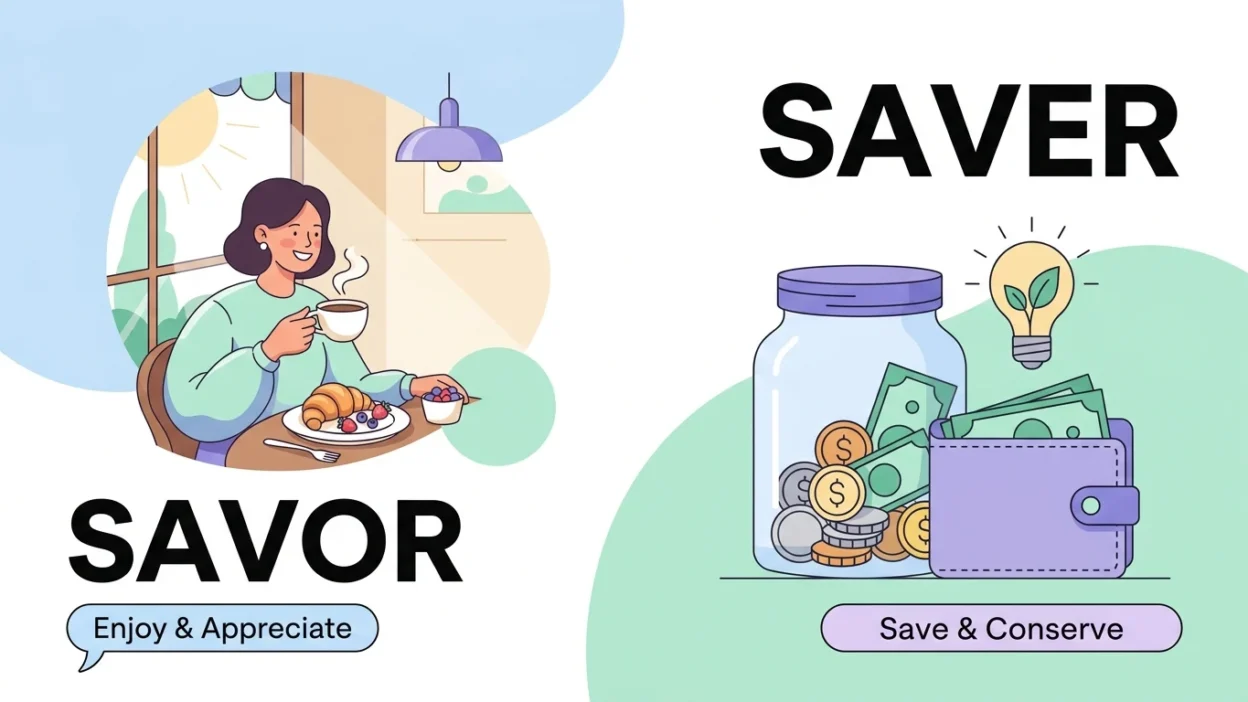
Savor means to enjoy or appreciate something deeply, especially a taste, smell, experience, or moment.
Saver usually means a person or thing that saves something.
- Savor = enjoy, appreciate, relish
- Saver = someone or something that saves
Examples:
I like to savor every bite of a delicious meal.
She is a careful saver who puts money aside every month.
So, savor and saver are not interchangeable. The first is mainly associated with enjoyment and appreciation, while the second is associated with saving, protecting, or preserving something.
What Does “Savor” Mean?
Savor is a verb meaning to enjoy something slowly and fully, especially a pleasant taste, smell, feeling, experience, or moment.
For example:
She stopped to savor the delicious dessert.
The sentence means that she took time to enjoy the dessert rather than eating it quickly.
The word can also describe appreciating an experience:
We savored our final evening at the beach.
Here, savored means the people deliberately enjoyed and appreciated the moment.
As a noun, savor can refer to the taste or quality of something. In this sense, it is closely related to flavor or taste.
For example:
The soup had a rich, spicy savor.
However, the noun usage is less common in everyday modern English than the verb.
What Does “Saver” Mean?
Saver is a noun formed from the verb save. It generally refers to a person or thing that saves something.
A person who regularly puts money aside can be called a saver:
My brother is a disciplined saver.
The word can also describe something designed to save resources, time, money, or energy.
For example:
This energy saver helps reduce electricity use.
A saver can therefore refer to:
- A person who saves money
- A device that reduces resource use
- Something that prevents waste
- A person or thing that rescues or preserves something
The exact meaning depends on the context.
Savor vs Saver: Main Difference
The easiest way to understand savor vs saver is to focus on their root words.
| Word | Part of Speech | Meaning | Example |
| Savor | Verb / noun | Enjoy or appreciate something; taste or quality | We savor every moment together. |
| Saver | Noun | A person or thing that saves | She is a careful saver. |
The words are related to completely different ideas:
Savor → enjoyment and appreciation
Saver → saving or preserving
If you are talking about enjoying a meal, memory, experience, or moment, you probably need savor.
If you are talking about someone who saves money or something that saves time or energy, you probably need saver.
Examples of “Savor”
Here are some natural examples of savor:
- I like to savor my coffee in the morning.
- She took her time to savor every bite.
- We should savor this beautiful moment.
- He sat quietly to savor the peaceful atmosphere.
- They savored their victory after months of hard work.
- I want to savor the memories of our trip.
- She closed her eyes to savor the rich chocolate flavor.
- Take a moment to savor the experience.
- He savored the opportunity to work with the team.
- We should savor these precious family moments.
Notice that savor often carries an emotional sense. It suggests slowing down and appreciating something rather than simply experiencing it.
Examples of “Saver”
Now consider examples of saver:
- She is a careful saver and rarely spends unnecessarily.
- My brother became a better saver after creating a monthly budget.
- This appliance is an excellent energy saver.
- The program is a real time saver for busy employees.
- A fuel saver can help reduce unnecessary consumption.
- He is a regular saver who deposits money every month.
- The new shortcut is a major time saver.
- The emergency fund can be a financial saver during difficult times.
In these examples, saver refers to someone or something that saves.
Savor as a Verb
The most common use of savor is as a verb.
It means to deliberately enjoy something, often by paying close attention to it.
For example:
Don’t rush your meal. Savor it.
This means you should enjoy the taste and experience.
The word can also be used metaphorically:
She savored the feeling of finally achieving her goal.
Nobody is literally tasting the feeling. Instead, savored means she deeply enjoyed and appreciated it.
Common phrases include:
- savor the moment
- savor every bite
- savor the experience
- savor the flavor
- savor the memories
- savor the opportunity
- savor the taste
These expressions are useful in both everyday and descriptive writing.
Saver as a Noun
Saver is usually a noun because it identifies a person or thing that saves.
One common meaning is a person who saves money:
He is a responsible saver.
Another meaning involves something that helps conserve resources:
This device is a powerful energy saver.
The word can also describe something that prevents a difficult situation:
The backup file was a real saver after the computer crashed.
In each case, the underlying idea is saving, protecting, conserving, or preventing loss.
Common Mistakes With Savor and Saver
Mistake 1: Using “saver” when you mean “savor”
Incorrect:
I want to saver this delicious meal.
Correct:
I want to savor this delicious meal.
The sentence is about enjoying the meal, so savor is required.
Mistake 2: Using “savor” for someone who saves money
Incorrect:
She is a very careful savor.
Correct:
She is a very careful saver.
A person who saves money is a saver, not a savor.
Mistake 3: Confusing the words because they sound similar
The similar pronunciation can make these words confusing, particularly for English learners.
Instead of relying only on sound, identify the meaning:
Enjoy something → savor
Save something → saver
This simple distinction prevents most mistakes.
Mistake 4: Confusing “savor” with “savour”
There is another spelling difference worth knowing. Savor is the standard American English spelling, while savour is traditionally used in British English.
However, savor vs saver is a different issue. Saver remains spelled with an e in both American and British English.
Savor vs Savour
Because spelling differences can create additional confusion, it is useful to distinguish these words.
| American English | British English | Meaning |
| savor | savour | Enjoy or appreciate deeply |
| saver | saver | A person or thing that saves |
For example:
American English:
I want to savor every moment.
British English:
I want to savour every moment.
But:
She is a careful saver.
remains saver in both varieties.
American vs British English: Savor vs Saver
The main regional difference concerns savor/savour, not savor/saver.
In American English, the spelling is:
savor
In British English, the traditional spelling is:
savour
The noun saver has the same spelling in both varieties.
Therefore, if you are writing for an American audience, use savor. If you are following British spelling conventions, savour may be preferred.
Neither spelling changes the fundamental meaning.
Savor vs Enjoy
Savor and enjoy are synonyms in many contexts, but savor is more specific.
Enjoy simply means to take pleasure in something.
Savor suggests taking time to appreciate something deeply or deliberately.
Compare:
I enjoyed the meal.
This simply tells us that the meal was pleasant.
I savored every bite of the meal.
This suggests that the person consciously appreciated the taste and experience.
This makes savor particularly useful when you want your writing to sound vivid, thoughtful, or descriptive.
Savor vs Taste
These words are also related but not identical.
Taste can mean to experience the flavor of something.
Savor means to enjoy or appreciate that flavor, often slowly and carefully.
For example:
I tasted the soup.
This simply means you experienced its flavor.
I savored the soup.
This suggests that you really enjoyed and appreciated it.
The distinction becomes especially useful when writing about food, travel, celebrations, memories, and meaningful experiences.
FAQs
What is the difference between savor and saver?
Savor means to enjoy or appreciate something deeply, while saver usually means a person or thing that saves something.
Is “savor” a verb or a noun?
Savor can be both a verb and a noun. As a verb, it means to enjoy or appreciate something deeply. As a noun, it can refer to taste or flavor, although this use is less common.
What does “savor the moment” mean?
Savor the moment means to slow down and fully enjoy or appreciate the present experience because it may be special or temporary.
Is “saver” a real English word?
Yes. Saver is a standard English noun. It can refer to someone who saves money or something that saves time, energy, resources, or other things.
Is savor American or British English?
Savor is the standard American spelling. In British English, savour is traditionally preferred. Both forms have the same basic meaning.
Is “savour” the same as “savor”?
Yes. Savor and savour have the same meaning. The difference is primarily a spelling convention between American and British English.
Which is correct: savor or saver?
Both are correct words, but they have different meanings. Use savor for enjoying or appreciating something and saver for someone or something that saves.
How can I remember savor vs saver?
Think of the root words: savor is associated with enjoyment and taste, while saver comes from save. If something is being saved, use saver; if something is being enjoyed deeply, use savor.
Summary
The difference between savor vs saver is straightforward once you connect each word to its meaning. Savor means to enjoy, appreciate, or relish something deeply, especially a taste, experience, moment, or memory. Saver is a noun for someone or something that saves, conserves, protects, or prevents waste. They may look similar, but they belong to different meaning groups.
It is also helpful to remember the related spelling savour, which is commonly used in British English. American English generally uses savor, while saver is spelled the same in both varieties. Whether you are writing about food, finances, experiences, or everyday situations, focusing on the meaning of the word will help you select the correct spelling confidently.
Actionable Takeaway
Use this quick memory rule:
- Savor = enjoy or appreciate
- Saver = someone or something that saves
- Savour = British spelling of savor
If you are describing a delicious meal, a special memory, or a meaningful experience, choose savor. If you are describing a person who saves money or something that conserves time or energy, choose saver.
When you pause over savor vs saver, don’t just listen to how the words sound. Ask what the sentence is actually trying to say. Meaning will usually give you the answer.