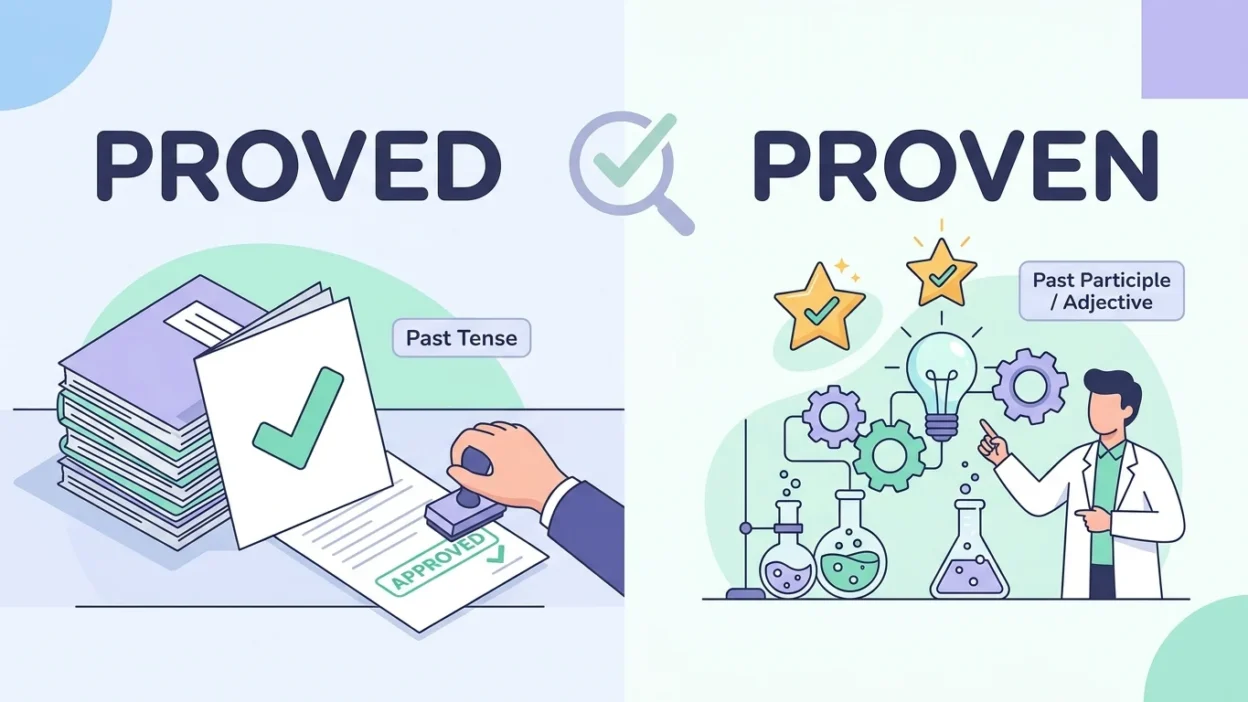
If you have ever wondered whether to write proved vs proven, you are dealing with one of those English grammar questions that can make even confident writers pause. Both proved and proven are correct forms of the verb prove, but they are not always used in exactly the same way.
The confusion mainly comes from the fact that proved and proven can both function as the past participle of prove. In modern English, however, proved is the simple past form and is also widely accepted as a past participle, while proven is especially common as a past participle, particularly before a noun and in phrases such as “has proven effective.” Understanding these patterns will help you choose the form that sounds natural and grammatically appropriate.
Quick Answer: Proved vs Proven
Both proved and proven are correct.
- Proved is the simple past tense of prove and can also be used as a past participle.
- Proven is an alternative past participle of prove and is especially common in modern English.
- Proven is frequently used before nouns as an adjective.
- Proved is also correct in many past-participle constructions.
For example:
The scientist proved the theory was incorrect.
The method has proven effective.
She has proved her point.
This is a proven method.
So, neither word is simply “wrong.” The best choice depends on the grammatical structure and style of the sentence.
What Does “Proved” Mean?
Proved is the simple past form of the verb prove.
To prove something means to demonstrate that it is true, correct, valid, or genuine through evidence, reasoning, testing, or experience.
For example:
The lawyer proved that the document was authentic.
The action of proving happened in the past, so proved is the simple past tense.
Proved can also function as a past participle:
She has proved her ability to lead the team.
Here, “has proved” uses the present perfect tense. The word proved is the past participle in this construction.
Therefore, it would be inaccurate to say that proved can only be used as a simple past verb.
What Does “Proven” Mean?
Proven is another past participle of prove.
It is particularly common after auxiliary verbs such as has, have, and had, and it is very common when describing something that has been demonstrated to work or be effective.
For example:
The new treatment has proven successful.
The strategy had proven ineffective.
Proven is also frequently used as an adjective before a noun:
We need a proven strategy.
She used a proven technique.
The company has a proven track record.
In these examples, proven describes the noun that follows it.
Proved vs Proven: Main Difference
The most important thing to remember is that proved and proven are both forms of the verb prove, but their typical usage differs.
| Word | Grammatical Role | Common Use | Example |
| Proved | Simple past / past participle | Completed past action; also used with auxiliary verbs | She proved her point. |
| Proven | Past participle / adjective | Perfect constructions and descriptive phrases | The method has proven effective. |
| Proven | Adjective | Before a noun | It is a proven solution. |
A useful pattern is:
Prove → proved → proved/proven
Unlike many irregular verbs, prove has more than one accepted past-participle form.
When Should You Use “Proved”?
Use proved when you are talking about a completed action in the past.
For example:
The experiment proved that the hypothesis was incorrect.
She proved her innocence.
His research proved the theory was possible.
The evidence proved that the accusation was false.
You can also use proved after auxiliary verbs:
He has proved himself to be a capable manager.
They had proved their ability to solve the problem.
This usage is grammatically correct, although some speakers may prefer proven in certain constructions.
When Should You Use “Proven”?
Use proven when you need the past participle of prove, particularly in contexts where something has been demonstrated through evidence, testing, experience, or results.
Examples include:
The approach has proven successful.
The technology has proven reliable.
The strategy has proven effective.
Proven is also especially natural when it comes before a noun:
We need a proven solution.
He has a proven record of success.
This is a proven technique for improving productivity.
In these situations, proven often sounds more natural to modern English speakers.
Examples of “Proved”
Here are several examples showing how proved works:
- The evidence proved that he was telling the truth.
- She proved her ability through years of hard work.
- The experiment proved the original assumption wrong.
- His argument proved difficult to challenge.
- The test proved that the machine was safe.
- They proved their case in court.
- The results proved that the method was effective.
- He proved himself to be a reliable employee.
Notice that proved is particularly natural when describing a definite action that took place in the past.
Examples of “Proven”
Now consider these examples:
- The new system has proven highly effective.
- This is a proven method for reducing errors.
- The treatment has proven successful in many cases.
- She has a proven ability to manage complex projects.
- The strategy has proven useful over time.
- The product is based on a proven technology.
- His leadership skills have proven valuable.
- They chose a proven approach instead of an experimental one.
These examples show why proven is extremely common in professional, academic, technical, and business writing.
Is “Proven” More Correct Than “Proved”?
No. It would be misleading to say that proven is always more correct.
Proved is completely correct as the past tense of prove and is also accepted as a past participle.
Proven is another accepted past participle and has become especially common in modern English.
For example, both of these can be grammatical:
She has proved her point.
She has proven her point.
However, some combinations sound more natural with one form than the other. In particular, proven is strongly established as an adjective:
a proven method
You would not normally replace this with “a proved method” in everyday modern English.
Common Mistakes With Proved and Proven
Mistake 1: Thinking “proved” is always the only correct form
Some learners memorize:
prove → proved → proved
and assume proven is incorrect.
That is not the case. Proven is a standard past participle and is widely used.
Mistake 2: Thinking “proven” can replace “proved” everywhere
The opposite mistake is also possible.
Proven is not normally used as the simple past tense.
Incorrect:
She proven that the theory was wrong.
Correct:
She proved that the theory was wrong.
The simple past requires proved.
Mistake 3: Writing “a proved method”
Although proved can function as a past participle, a proven method is the standard and natural expression.
Prefer:
This is a proven method.
rather than:
This is a proved method.
Mistake 4: Treating them as completely interchangeable
While both words are forms of prove, their typical patterns differ. Paying attention to whether you need a simple past verb, a past participle, or an adjective will make your writing much more natural.
Proved or Proven in Passive Voice
The passive voice is another area where writers sometimes hesitate.
For example:
The theory was proved correct.
This is grammatically possible, although proven may also occur depending on the construction and style:
The theory was proven correct.
Both forms can be found in English.
However, passive constructions involving prove can sometimes sound more natural when rewritten:
Researchers proved the theory correct.
Choosing an active construction can make the sentence clearer and more direct.
American vs British English: Proved vs Proven
There is some variation between American and British English, but both varieties recognize proved and proven.
Proven is very common in both American and British English, especially as an adjective:
- proven method
- proven technology
- proven solution
- proven ability
Proved is also widely accepted in both varieties, especially as the simple past:
He proved his point.
There can be stylistic preferences regarding the past participle, but this is not a simple rule where one variety uses proved and the other always uses proven.
A Simple Memory Trick
Use this easy rule:
Proved = past action.
She proved her point yesterday.
Proven = past participle or adjective.
The method has proven effective.
It is a proven method.
And remember the verb forms:
Prove → Proved → Proven/Proved
When you are writing a sentence, first identify the role of the word. This is much more reliable than trying to decide based only on which spelling “looks right.”
FAQs
Is proved or proven correct?
Both proved and proven are correct. Proved is the simple past form of prove, while proven is a common past participle and adjective.
Is “proven” grammatically correct?
Yes. Proven is a standard past participle of prove and is also widely used as an adjective, as in “a proven method.”
Is “proved” the past tense of prove?
Yes. The simple past tense of prove is proved.
For example:
The experiment proved the theory wrong.
Can I say “has proved” and “has proven”?
Yes. Both has proved and has proven are grammatical. Usage can depend on regional or stylistic preference, although has proven is especially common in modern English.
Which is better: “proven effective” or “proved effective”?
Proven effective is generally the more natural and widely used choice, especially in contemporary professional and academic writing.
Is “a proved method” correct?
Although proved can be a past participle, a proven method is the standard and more natural expression when describing an established method.
Is proven American or British English?
Proven is used in both American and British English. There is no major regional restriction on the word.
What is the past participle of prove?
Both proved and proven can function as past participles. However, proven is particularly common in phrases such as “has proven effective” and “a proven solution.”
Summary
The choice between proved vs proven becomes much easier once you understand their grammatical roles. Proved is the simple past tense of prove and is also an accepted past participle. Proven is another past participle and is particularly common in perfect constructions and as an adjective before a noun.
In everyday, professional, academic, and technical writing, you will frequently see expressions such as “has proven effective,” “a proven method,” and “a proven track record.” At the same time, “she proved her point” is the natural choice when describing a completed action in the past. Both forms are correct, so the key is not to treat one as universally right and the other as universally wrong.
Actionable Takeaway
Remember this simple pattern:
Prove → proved → proven/proved
Use proved for the simple past:
“The evidence proved his claim.”
Use proven when it works as a past participle or adjective, especially in familiar phrases:
“The method has proven effective.”
“This is a proven solution.”
When in doubt, look at the sentence structure rather than the spelling alone. That small habit will help you use proved and proven confidently and naturally.