Have you ever been offered something with no room for negotiation and heard someone say, “Take it or leave it”? This common English expression can sound a little strong at first, but its meaning is actually quite simple. It means you can accept what is being offered, or refuse it, but you should not expect the offer to change.
Take it or leave it is an idiomatic expression often used when someone gives another person a final choice. It can describe a price, deal, offer, suggestion, arrangement, or condition. Depending on the situation and tone, it can sound confident, firm, casual, or even slightly rude. Understanding the context helps you use this phrase naturally and appropriately.
Quick Answer: What Does “Take It or Leave It” Mean?
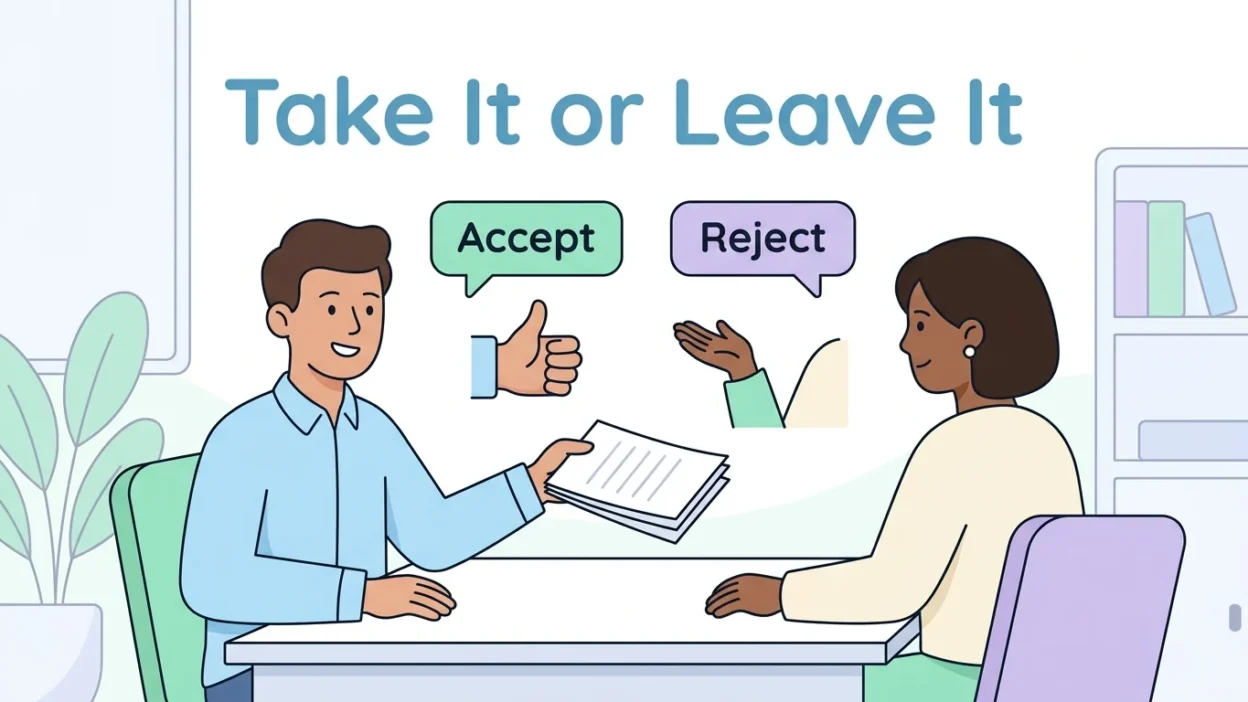
“Take it or leave it” means you can accept an offer as it is or refuse it, but there will be no negotiation or change to the offer.
For example:
“I can sell you the laptop for $500. Take it or leave it.”
This means the seller is offering the laptop for $500 and is not willing to negotiate the price.
In simple words:
Take it = accept the offer.
Leave it = reject the offer.
The phrase often communicates that the decision is entirely up to the other person, but the terms are final.
Meaning of “Take It or Leave It”
The expression take it or leave it is an idiom made up of two contrasting choices.
- Take it means accept the offer or situation.
- Leave it means reject the offer or walk away.
- Together, take it or leave it means there is no third option or opportunity for negotiation.
The phrase is commonly associated with final offers. Someone might use it during a negotiation to make it clear that they are not prepared to change their position.
For example:
“This is my final price. Take it or leave it.”
The speaker is saying that the buyer can either pay the stated price or refuse to make the purchase.
When Should You Use “Take It or Leave It”?
You can use take it or leave it when an offer or arrangement is firm and you are willing to let the other person accept or reject it.
Common situations include:
- Negotiating a price
- Making a business offer
- Discussing a salary or contract
- Offering a deal
- Setting conditions
- Making a proposal
- Giving someone a choice
- Offering a fixed arrangement
For example:
“I can finish the project by Friday, but I can’t work over the weekend. Take it or leave it.”
Here, the speaker is establishing a firm condition.
However, because the phrase can sound blunt, it is important to consider your relationship with the listener. In a friendly conversation, it may sound playful. In a professional conversation, it can sound demanding if used without a softer explanation.
Examples of “Take It or Leave It”
Here are some natural examples of the expression:
- “I’ll sell the bike for $200. Take it or leave it.”
- “That’s the best salary we can offer. Take it or leave it.”
- “You can have the room for $700 a month, utilities included. Take it or leave it.”
- “I can give you two weeks to finish the assignment. Take it or leave it.”
- “This is our final proposal. Take it or leave it.”
- “I’ll do the job for $300, and that’s my final price. Take it or leave it.”
- “You can borrow my car until Sunday, but you have to return it with a full tank. Take it or leave it.”
- “We can offer you this package at the advertised price. Take it or leave it.”
In each example, the speaker presents an option without inviting further negotiation.
“Take It or Leave It” in a Sentence
The expression can appear at the beginning, middle, or end of a sentence, although it is especially natural after an offer has been stated.
At the end
“I’ll accept $1,000, take it or leave it.”
After an offer
“You can have the position for $50,000 a year. Take it or leave it.”
As a standalone response
“Take it or leave it.”
When used by itself, the expression can sound particularly firm. The listener understands that the speaker does not want to negotiate.
Take It or Leave It vs. Accept or Reject
These expressions are related, but they are not identical in tone.
| Expression | Meaning | Tone |
| Take it or leave it | Accept the offer or reject it without negotiation | Firm, direct |
| Accept or reject | Choose whether to accept something | Formal, neutral |
| Agree or disagree | Say whether you share an opinion | Neutral |
| Accept the offer | Agree to what is proposed | Neutral |
| Turn it down | Reject an offer | Informal |
Take it or leave it emphasizes that the offer is final. That is what makes the expression stronger than simply saying “accept or reject.”
Is “Take It or Leave It” Rude?
Not always, but it can sound rude or dismissive depending on the context and tone.
For example, saying:
“This is the price. Take it or leave it.”
to a stranger during a casual sale may simply sound firm.
But saying:
“Take it or leave it. I don’t care.”
can sound aggressive or disrespectful.
If you want to communicate the same idea more politely, you could say:
- “That’s the best offer I can make.”
- “Unfortunately, I can’t go any lower.”
- “Those are the terms we’re able to offer.”
- “I understand if you’d prefer not to accept.”
- “That’s our final offer.”
These alternatives are particularly useful in workplace, customer-service, and professional situations.
Common Mistakes With “Take It or Leave It”
Mistake 1: Thinking “leave it” means physically leaving something
In the literal sense, leave it can mean not taking something with you. However, within the idiom take it or leave it, it usually means reject or decline the offer.
For example:
“I’ll give you the job at this salary. Take it or leave it.”
Here, “leave it” means “decline the offer,” not physically walk away from an object.
Mistake 2: Using “take or leave it”
You may sometimes hear:
“Take or leave it.”
This shortened form can occur in informal English, but “take it or leave it” is the more complete and widely recognized form of the idiom.
Mistake 3: Assuming the phrase always sounds friendly
The meaning itself is neutral, but the tone can be strong.
Compare:
“That’s my best offer—take it or leave it.”
with:
“I’m afraid that’s the best offer I can make, so I completely understand if you’d rather pass.”
Both communicate a similar idea, but the second is much softer.
Mistake 4: Using it when you actually want negotiation
If you say “take it or leave it,” people generally understand that you are presenting a final offer.
So don’t use the expression casually if you genuinely want the other person to negotiate with you.
Take It or Leave It: Formal or Informal?
Take it or leave it is a common idiomatic expression and is generally conversational rather than highly formal.
It is perfectly natural in everyday English:
“I can do it for $50. Take it or leave it.”
However, in formal business communication, diplomacy, or sensitive discussions, a softer alternative may be more appropriate.
Instead of:
“Take it or leave it.”
you could write:
“This is the most favorable arrangement we can offer at this time.”
The choice depends on your audience, relationship, and desired tone.
American vs. British English
There is no significant difference between American and British English in the meaning or standard usage of take it or leave it.
The expression is widely understood in both varieties of English.
It may appear in casual conversations, negotiations, business discussions, entertainment, journalism, and everyday speech on both sides of the Atlantic.
The main difference is not regional but contextual. Speakers in both American and British English may use the phrase to indicate that an offer is final.
Synonyms and Similar Expressions
Several expressions can communicate a similar idea to take it or leave it, although their tone may differ.
“That’s my final offer.”
This is a direct way to say that you will not negotiate further.
“That’s the best I can do.”
This sounds softer and is often useful during negotiations.
“It’s up to you.”
This emphasizes that the final decision belongs to the other person.
“Accept it or decline.”
This is more formal and direct.
“No negotiations.”
This is much stronger and more abrupt.
“You can accept it or walk away.”
This has almost the same meaning as take it or leave it, but it can sound even more forceful.
How to Remember the Meaning
A simple memory trick can make this idiom easy to remember:
Take = accept.
Leave = reject.
So:
Take it or leave it = Accept the offer or reject it; the terms will not change.
Imagine a seller placing a fixed-price item in front of a buyer and saying:
“This is the price. Take it or leave it.”
The buyer has two choices: accept the deal or say no.
FAQs
What does “take it or leave it” mean?
It means you can accept an offer as it is or reject it, but you should not expect the terms to change or be negotiated.
Is “take it or leave it” an idiom?
Yes. Take it or leave it is a common English idiom used to describe a firm or final offer.
Is “take it or leave it” rude?
It can be. The expression often sounds firm, and depending on the speaker’s tone and situation, it may come across as blunt or dismissive.
What is another way to say “take it or leave it”?
You can say “That’s my final offer,” “That’s the best I can do,” or “Those are the terms.” These alternatives can sound more professional or polite.
Can I use “take it or leave it” in professional English?
Yes, but use it carefully. It is grammatically correct, but its direct tone may not be appropriate for every workplace or business situation.
What does “leave it” mean in this phrase?
In “take it or leave it,” “leave it” means to reject or decline the offer rather than physically leave something behind.
Is “take it or leave it” American or British?
It is used in both American and British English. There is no important difference in meaning between the two varieties.
What is the opposite of “take it or leave it”?
There is no exact opposite idiom, but an open negotiation would be the opposite idea. Phrases such as “Let’s discuss the terms” or “I’m open to negotiation” suggest that changes are possible.
Summary
Take it or leave it is a common English idiom meaning accept an offer as it stands or reject it, with no expectation of negotiation. It is frequently used for prices, deals, proposals, contracts, conditions, and other situations where someone wants to make a final decision. The phrase is easy to understand when you remember that “take” means accept and “leave” means reject.
Although the expression is grammatically correct and widely used in both American and British English, its tone deserves attention. It can sound confident and practical in a negotiation, but it may also sound blunt or unfriendly in a sensitive conversation. If you want a softer approach, phrases such as “That’s the best I can do” or “That’s my final offer” may communicate the same message more politely.
Actionable Takeaway
When you use take it or leave it, make sure you genuinely mean that the offer is final. Use it when you are comfortable with either outcome: the other person accepts your terms or declines them.
For professional or delicate situations, consider a softer alternative such as “That’s the best offer I can make.” The meaning stays clear while your tone becomes more respectful and collaborative.