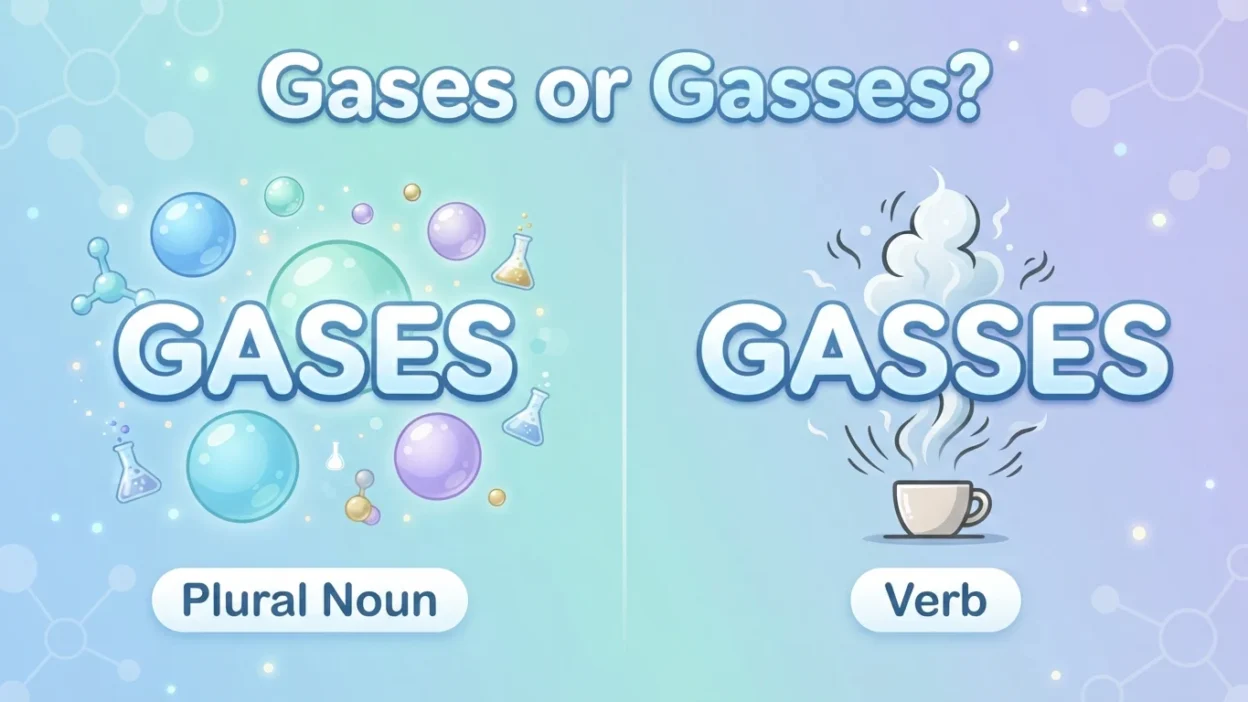
If you have ever stopped while writing and wondered whether the plural of “gas” is gases or gasses, you are not alone. Both spellings look reasonable, especially because English often changes the spelling of words when they become plural. However, when you mean more than one gas, the standard plural form is usually gases.
The confusion becomes even more understandable because gasses is a real English word. It is not simply a spelling mistake. The important difference is that gases is the plural noun of “gas,” while gasses is the third-person singular form of the verb “gas.” Once you understand this small grammatical difference, choosing the correct spelling becomes much easier.
Quick Answer: Gases or Gasses?
Gases is the correct plural form of the noun gas.
- Gas → gases = more than one gas
- Gas → gasses = a verb form meaning “treats with gas” or “fills with gas,” depending on context
For example:
- Scientists study different gases in the atmosphere.
- The machine gasses the vegetables to control their ripening.
So, if you are talking about multiple types or quantities of gas, use gases.
What Does “Gases” Mean?
Gases is the plural form of the noun gas. It refers to two or more gases or different types of gaseous substances.
A gas is a state of matter that does not have a fixed shape or fixed volume. Unlike solids and liquids, gases spread out and fill the available space.
Common examples of gases include:
- Oxygen
- Nitrogen
- Carbon dioxide
- Hydrogen
- Helium
- Water vapor
- Methane
For example, you might say:
The atmosphere contains several different gases.
Here, gases is plural because the sentence refers to more than one type of gas.
The word can also be used in everyday contexts. For instance, people may talk about fuel gases, greenhouse gases, toxic gases, or gases produced during a chemical reaction.
What Does “Gasses” Mean?
Gasses is also a legitimate English word, but it has a different grammatical function.
It is generally the third-person singular present-tense form of the verb “gas.” The meaning depends on the context.
For example:
- The device gasses the chamber.
- The company gasses the plants to prevent insects.
- The machine gasses the food during processing.
In these examples, gasses describes an action performed by someone or something.
You can think of it this way:
Gases = noun
Gasses = verb
This distinction is the key to understanding the gases vs gasses spelling difference.
Gases vs Gasses: The Main Difference
Although the two words look almost identical, they serve different purposes in a sentence.
| Word | Part of Speech | Meaning | Example |
| gases | Noun | Plural of gas | Different gases are present in the atmosphere. |
| gasses | Verb | He/she/it gases something | The machine gasses the chamber. |
The easiest way to decide which spelling you need is to ask yourself:
Am I talking about more than one gas, or am I describing an action?
If you mean multiple gases, choose gases.
If you mean that a person, machine, or process performs an action involving gas, gasses may be correct.
Examples of “Gases”
Here are several examples showing how gases is normally used:
- The atmosphere contains several important gases.
- Oxygen and nitrogen are common gases found in Earth’s atmosphere.
- Some gases are invisible to the human eye.
- Scientists can identify gases using specialized instruments.
- Greenhouse gases contribute to climate change.
- Certain industrial gases must be stored carefully.
- The chemical reaction produced several gases.
- Different gases have different physical and chemical properties.
- The laboratory analyzes unknown gases.
- Some natural gases are used as sources of energy.
In all of these examples, gases is a plural noun because the sentences refer to multiple gases or categories of gas.
Examples of “Gasses”
Now look at examples where gasses functions as a verb:
- The machine gasses the chamber.
- The factory gasses certain products during processing.
- The system gasses the container before sealing it.
- The equipment gasses the plants to control pests.
- The process gasses the material under controlled conditions.
A useful test is to replace gasses with “treats with gas” or another suitable verb phrase. If the sentence still makes sense, gasses may be the correct choice.
Why Do People Confuse Gases and Gasses?
The confusion comes largely from English spelling patterns.
When people see a noun ending in s and want to make it plural, they may naturally assume that adding another s is necessary. However, English plurals do not always work that way.
The plural of gas is gases, pronounced approximately like “GAS-iz.”
This is similar to other words where an ending changes pronunciation when a plural is formed.
The extra s in gasses does not simply make “gas” plural. Instead, it creates a different grammatical form of the verb gas.
Understanding the role of the word in the sentence is therefore more reliable than trying to memorize the spelling alone.
Common Mistakes With Gases and Gasses
Mistake 1: Using “gasses” as the plural of gas
Incorrect:
There are several dangerous gasses in the laboratory.
For standard English, write:
There are several dangerous gases in the laboratory.
Here, the writer is referring to multiple gases, so gases is the appropriate plural noun.
Mistake 2: Assuming “gasses” is always wrong
It is also incorrect to assume that gasses can never be used.
For example:
The machine gasses the chamber.
Here, gasses is a verb, so the spelling is correct.
Mistake 3: Choosing based only on pronunciation
The pronunciation can be confusing because gases and gasses can sound similar in some contexts. Instead of relying only on sound, look at the grammatical role.
Ask:
- Is it a plural noun? → gases
- Is it a verb meaning someone or something treats with gas? → gasses
A Simple Memory Trick
A quick way to remember the difference is:
Gases = more than one gas.
Think:
One gas → two gases.
For gasses, remember:
Gasses = an action.
If you can replace the word with a verb such as “treats with gas,” you may need gasses.
For example:
The machine gasses the product.
The machine is doing something, so gasses is functioning as a verb.
Gases or Gasses in Science
In scientific and academic writing, gases is the spelling you will encounter when referring to multiple gaseous substances.
For example:
- Noble gases
- Greenhouse gases
- Combustible gases
- Atmospheric gases
- Toxic gases
- Industrial gases
You may frequently see phrases such as gases in the atmosphere, greenhouse gases, and different gases in science textbooks and research-based writing.
When discussing chemistry, physics, environmental science, or atmospheric science, make sure gases is used when the word is functioning as the plural noun.
American vs British English: Gases or Gasses
There is no major American vs British English difference in the standard plural spelling of the noun.
Both American and British English use:
gas → gases
The word gasses can also occur in both varieties of English when it is used as a verb.
Therefore, this is not a case where one spelling is American and the other is British. The difference is primarily grammatical, not regional.
Whether you are writing for an American audience, a British audience, or an international audience, use gases when you mean the plural of “gas.”
Is “Gasses” a Correct Word?
Yes. Gasses is a correct English word, but it is not normally the plural noun of “gas.”
It is used as a verb form, particularly as the third-person singular present form of gas.
For example:
The equipment gasses the chamber.
However, if you want to say that several types of gas are present, use:
Several gases are present.
This distinction explains why dictionaries may list both words even though their meanings and grammatical roles are different.
How to Choose the Correct Spelling
When you are unsure whether to write gases or gasses, follow these three steps:
- Look at the meaning.
If you mean multiple types or quantities of gas, use gases. - Look at the grammar.
If the word describes an action performed by “he,” “she,” “it,” or a singular subject, gasses may be correct. - Check the sentence without the word.
Try replacing it with “more than one gas” or “treats with gas.” The version that fits the meaning will usually make the answer obvious.
FAQs
Is gases the plural of gas?
Yes. Gases is the standard plural form of the noun gas. For example, “Different gases are present in the atmosphere.”
Is gasses grammatically correct?
Yes, gasses is grammatically correct when used as a verb. It is generally the third-person singular present form of “gas.”
Which is correct: gases or gasses in chemistry?
Gases is correct when referring to multiple gaseous substances in chemistry. For example, “The reaction produces several gases.”
Is “gasses” a spelling mistake?
Not necessarily. Gasses is a valid word when used as a verb. It is a mistake only when someone uses it as the plural noun of “gas” in standard English.
What is the plural of gas?
The plural of gas is gases.
Are gases and gasses pronounced the same?
They can be pronounced similarly, depending on the word’s grammatical use and the speaker’s pronunciation. Because the sound can be confusing, spelling and sentence context are more useful guides.
Is “gases” American or British English?
Gases is standard in both American and British English. There is no significant regional difference for the plural noun.
How can I remember gases vs gasses?
Remember: gases = more than one gas, while gasses = an action performed with gas. This simple grammar distinction will help you choose correctly.
Summary
The correct plural form of gas is gases. Use it whenever you are talking about two or more gases, different types of gas, or multiple gaseous substances. This spelling is standard in both American and British English and is especially common in scientific, technical, environmental, and everyday writing.
Gasses is not simply an incorrect version of “gases.” It is a legitimate verb form used when a singular subject performs an action involving gas. The easiest way to remember the difference is to focus on grammar: gases is a plural noun, while gasses is a verb.
Actionable Takeaway
When writing gases or gasses, ask yourself one simple question:
“Am I talking about more than one gas?”
- Yes → gases
- No, I am describing an action → gasses may be correct
So, in most sentences where you mean multiple types or quantities of gas, choose gases.