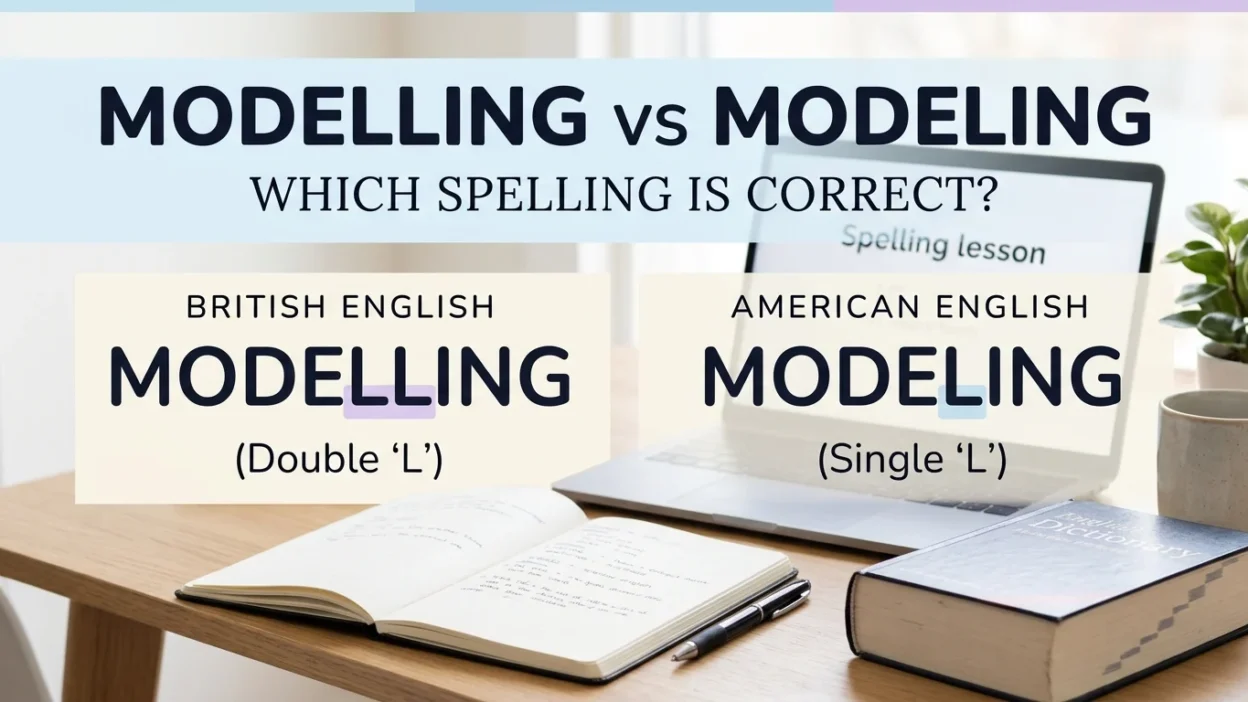
Have you ever wondered whether to write modelling or modeling? Both spellings are correct, but the right choice depends mainly on whether you are following British English or American English. Because the two words look almost identical, it is easy to second-guess yourself when writing an article, preparing an assignment, or editing professional content.
The good news is that you do not need to memorize two different meanings. Modelling and modeling generally mean the same thing: creating a representation, demonstrating something, or working as a model. The main difference is regional spelling. In this guide, you will learn when to use each form, explore practical examples, discover common spelling mistakes, and understand how to choose the correct version for your audience.
Quick Answer: Modelling vs Modeling
Modelling is the preferred spelling in British English, while modeling is the standard spelling in American English.
Both words are the present participle or gerund forms of the verb model. They can refer to creating a representation, demonstrating behavior, developing a mathematical simulation, or working in the fashion industry.
- British English: “The architect is modelling a new building.”
- American English: “The architect is modeling a new building.”
The meaning remains the same. The difference is simply the spelling convention used in each variety of English.
Easy memory trick: British English usually doubles the final l before adding -ing to model. American English generally uses a single l in modeling.
What Does Modelling or Modeling Mean?
The verb model has several meanings, so the words modelling and modeling can be used in different contexts. Understanding these meanings will help you choose the right expression for your sentence.
1. Creating a Representation of Something
Modelling or modeling can mean creating a physical, digital, mathematical, or conceptual representation of an object, system, or process.
Examples:
- “The engineering team is modelling the new bridge before construction begins.” (British English)
- “The engineering team is modeling the new bridge before construction begins.” (American English)
- “Computer modelling helps researchers test different possibilities.”
- “The company uses 3D modeling to design new products.”
In these examples, the word refers to representing something so people can study, visualize, or understand it more easily.
2. Demonstrating or Setting an Example
The verb can also mean showing others how to behave or perform an activity. This meaning is common in education, parenting, leadership, and psychology.
Examples:
- “Parents play an important role in modelling respectful behavior.”
- “Teachers are modelling effective problem-solving techniques.”
- “The coach is modeling the right way to perform the exercise.”
Both spellings communicate the same idea. The regional spelling depends on the English variety you are using.
3. Working as a Fashion or Commercial Model
In the fashion and advertising industries, modelling or modeling describes working as a model or displaying clothing, products, and designs.
Examples:
- “She is modelling the latest collection for a British fashion brand.”
- “He is modeling sportswear for an American clothing company.”
- “Fashion modelling requires confidence, preparation, and professionalism.”
Again, there is no difference in meaning between the two spellings.
4. Using Mathematics, Statistics, or Computer Simulations
In science and technology, modelling or modeling can describe building a mathematical model or computer simulation to understand a system or predict possible outcomes.
Examples:
- “Climate modelling helps scientists study long-term environmental changes.”
- “The researchers are modeling traffic patterns to improve road safety.”
- “Financial modeling can help businesses evaluate potential investments.”
The correct spelling follows the same British-versus-American rule, regardless of the subject.
Modelling vs Modeling: Key Differences
The following table summarizes the difference between the two spellings.
| Feature | Modelling | Modeling |
| Preferred English variety | British English | American English |
| Number of ls before -ing | Two | One |
| Base verb | Model | Model |
| Meaning | Creating, demonstrating, or representing something | Creating, demonstrating, or representing something |
| Common usage | UK, and often other British-English contexts | United States |
| Example | “She is modelling clothes.” | “She is modeling clothes.” |
The key point is that neither spelling is inherently more correct than the other. Each is appropriate within its respective spelling convention.
Why Does British English Use “Modelling” While American English Uses “Modeling”?
The difference comes from regional spelling conventions for words ending in a consonant followed by a suffix.
In British English, a final l is often doubled before adding -ing or -ed in words such as model, travel, and label.
Examples:
- model → modelling
- travel → travelling
- label → labelling
American English generally does not double the final l in these words when the final syllable is unstressed.
Examples:
- model → modeling
- travel → traveling
- label → labeling
This pattern is not universal across every English word. Stress, word structure, and established spelling conventions can affect whether a consonant is doubled. However, for modelling vs modeling, the British and American distinction is straightforward.
Modelling vs Modeling in Different Contexts
Both spellings appear across several professional and everyday settings. The spelling changes according to regional preference, not the subject being discussed.
Fashion and Commercial Work
British English: “The agency is recruiting new models for a modelling campaign.”
American English: “The agency is recruiting new models for a modeling campaign.”
Education and Parenting
British English: “The teacher is modelling positive communication skills.”
American English: “The teacher is modeling positive communication skills.”
Science and Research
British English: “The team is using mathematical modelling to study population growth.”
American English: “The team is using mathematical modeling to study population growth.”
Technology and Design
British English: “The designer is modelling a prototype in three dimensions.”
American English: “The designer is modeling a prototype in three dimensions.”
These examples show that the same rule applies whether you are writing about fashion, teaching, scientific research, or digital design.
Common Mistakes to Avoid
Even though the spelling difference is simple, writers sometimes make avoidable errors when choosing between modelling and modeling.
1. Assuming One Spelling Is Always Wrong
A common mistake is treating modelling as incorrect because a spell-checker prefers modeling, or vice versa.
- Correct in British English: “The artist is modelling a sculpture.”
- Correct in American English: “The artist is modeling a sculpture.”
Always consider your intended audience before deciding which spelling to use.
2. Mixing British and American Spellings
Using British and American spellings interchangeably within the same article can make your writing look inconsistent.
For example, a British-English article might use modelling, travelling, and colour. An American-English article would typically use modeling, traveling, and color.
Neither style is wrong, but consistency improves readability and professionalism.
3. Changing the Meaning Instead of the Spelling
Some learners assume that modelling refers to fashion, while modeling refers to computer simulations. This is incorrect.
Both spellings can describe fashion work, digital design, mathematical representation, and demonstrating behavior. The context determines the meaning, while the spelling convention determines which form you should write.
4. Forgetting Related Word Forms
The same regional spelling pattern appears in related forms.
| British English | American English |
| Modelling | Modeling |
| Modelled | Modeled |
| Modeller | Modeler |
| Modelling agency | Modeling agency |
Remember that the correct choice depends on your chosen English variety. Related forms should generally follow the same convention throughout your writing.
Which Spelling Should You Use?
Choose the spelling that matches your readers and publication requirements.
- For a British audience: Use modelling.
- For an American audience: Use modeling.
- For international content: Choose one variety and use it consistently.
- For academic or professional writing: Follow the required style guide or your organization’s editorial rules.
- For SEO articles: Consider the language variety used by your target audience and the keyword you intend to target.
If your website publishes English-learning content for readers around the world, it can be useful to explain both spellings while making one version the primary choice for each article. This helps readers understand the difference without confusing regional preference with correctness.
FAQs
1. Is modelling or modeling correct?
Both spellings are correct. Modelling is standard in British English, while modeling is standard in American English. The choice depends on the regional spelling convention you follow.
2. Is modelling British or American English?
Modelling is the preferred British English spelling. It is also commonly used in other varieties that follow British spelling conventions, including Australian English.
3. Is modeling American or British English?
Modeling is the standard American English spelling. It uses one l before the suffix -ing.
4. Why does modelling have two Ls?
British English commonly doubles the final l in model before adding -ing. This produces modelling. American English generally retains a single l, producing modeling.
5. Is it modelled or modeled?
Both forms are correct. Modelled is the usual British English spelling, while modeled is standard in American English.
For example:
- British: “The artist modelled the figure in clay.”
- American: “The artist modeled the figure in clay.”
6. Is it modelling agency or modeling agency?
Both expressions are correct. Use modelling agency when following British English conventions and modeling agency when following American English conventions.
7. Does modelling have a different meaning from modeling?
No. The two spellings have the same meaning. Both can refer to fashion work, creating representations, demonstrating behavior, or building mathematical and computer models.
8. Which spelling should I use for content?
Use the spelling that best matches your target audience and the language variety of your website. If you are targeting American readers, modeling is generally the better choice. For British readers, use modelling. Include the alternative naturally where it helps clarify the spelling difference, but avoid awkward keyword repetition.
Summary: Modelling vs Modeling
The difference between modelling and modeling is a matter of regional spelling, not meaning. British English generally uses modelling, with a double l, while American English uses modeling, with a single l. Both forms describe the same activities, including fashion work, demonstrating behavior, creating representations, and developing mathematical or computer simulations. The same distinction appears in related forms such as modelled/modeled and modeller/modeler.
The most important thing is to choose the spelling that suits your audience and maintain consistency throughout your writing. Whether you are preparing a school assignment, writing a professional report, publishing an article, or discussing computer design, either spelling works when used according to the appropriate regional convention.
Actionable takeaway: Remember this simple rule: British English = modelling; American English = modeling. When in doubt, check your publication’s style guide and apply the same spelling pattern to related words.