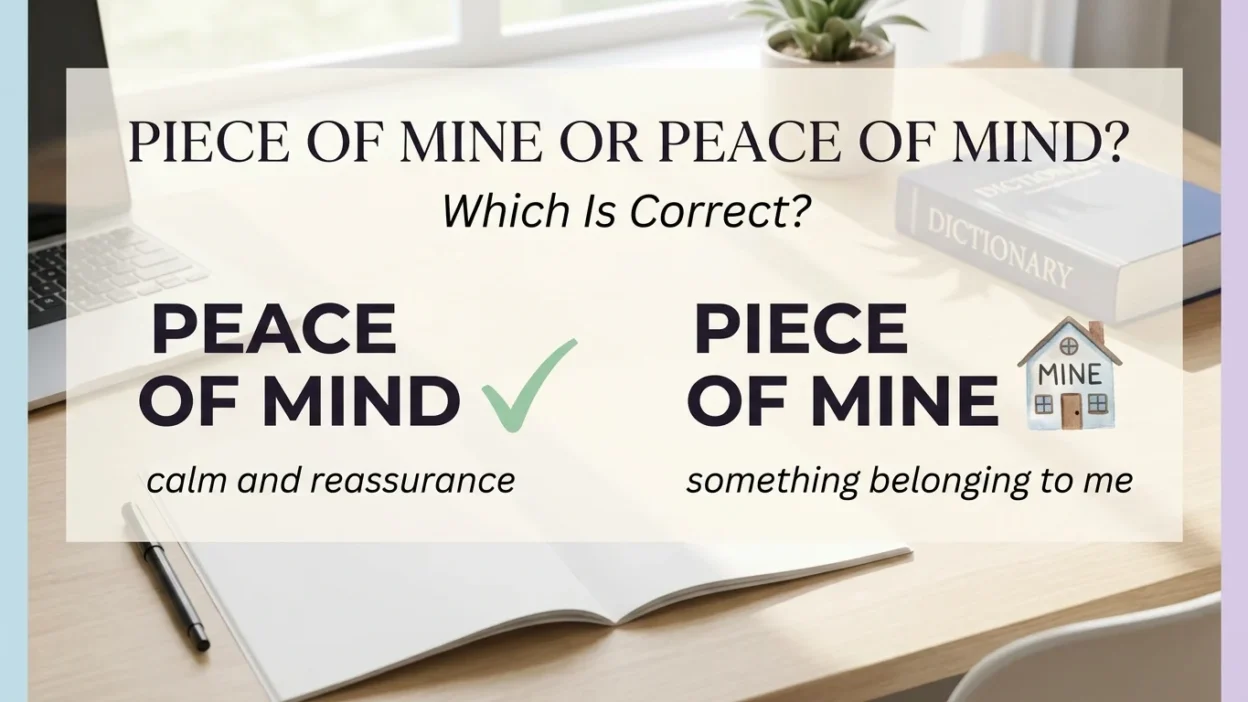
Have you ever wondered whether to write “piece of mine” or “peace of mind”? These expressions sound similar when spoken quickly, but they have completely different meanings. If you have seen them in a text message, an online post, or an English sentence, you may have wondered which phrase is correct and how to use it naturally.
The good news is that both expressions can be correct in the right context, but “peace of mind” is the established phrase when you mean feeling calm, safe, and free from worry. “Piece of mine” is not a standard substitute for that expression, although it can be grammatically possible when “piece” refers to a part of something belonging to you. In this guide, you’ll learn their meanings, explore practical examples, understand common mistakes, and discover how to choose the right phrase confidently.
Quick Answer: Piece of Mine or Peace of Mind?
The correct expression depends on what you want to say.
- Peace of mind: A feeling of calm, reassurance, or freedom from worry.
- Piece of mine: A grammatically possible phrase meaning a piece belonging to me, although it is less common without additional context.
- A piece of my mind: An idiom meaning to speak angrily or frankly to someone about something they have done.
- Give someone peace of mind: To reassure someone or help them feel less worried.
Examples:
- Correct: Installing a security system gives me peace of mind.
- Correct in the right context: This painting is a piece of mine.
- Different meaning: I gave him a piece of my mind after he broke his promise.
Easy tip: If you mean comfort, reassurance, or freedom from anxiety, use “peace of mind.” If you mean something that belongs to you, “piece of mine” may work in the appropriate sentence.
What Does “Peace of Mind” Mean?
Peace of mind is a feeling of mental calm, comfort, and reassurance. It describes a state in which you feel less worried about a situation because you trust that things are safe, manageable, or under control.
People commonly use this expression when discussing health, family, finances, safety, work, relationships, and everyday decisions.
For example, a person might purchase travel insurance for peace of mind. The insurance does not guarantee that nothing will go wrong, but knowing that certain unexpected expenses may be covered can reduce worry.
Similarly, receiving confirmation that a family member has arrived safely can give you peace of mind.
Examples of “Peace of Mind” in Sentences
- Having an emergency fund gives me peace of mind.
- I called my parents to make sure they arrived safely and to give myself peace of mind.
- A reliable home security system can provide peace of mind.
- She reviewed the contract carefully for her own peace of mind.
- Regular health checkups can offer peace of mind when you have concerns about your health.
- Knowing that the bills are paid gives him peace of mind.
- I prefer booking a reputable hotel because it gives me peace of mind when traveling.
- The teacher contacted the parents to give them peace of mind about their child’s progress.
In each example, the phrase refers to feeling reassured rather than possessing a physical object.
What Does “Piece of Mine” Mean?
The phrase “piece of mine” can be grammatically correct when “piece” refers to a part or item that belongs to the speaker. However, it is not a common fixed expression with one universal meaning.
The word “piece” is a noun that can refer to a portion of something, an item of artwork, a written work, or a separate part of a larger whole. The word “mine” is a possessive pronoun meaning “belonging to me.”
For example:
- This painting is a piece of mine.
- That article is a piece of mine that was published last year.
- The final song is a piece of mine that I wrote during college.
In these sentences, “a piece of mine” means one piece of work created or owned by the speaker.
However, in ordinary conversation, people are more likely to use a complete expression that explains what the piece is. Without context, “piece of mine” may sound incomplete or confusing.
Examples of “Piece of Mine” in Sentences
- This short story is a piece of mine that I wrote as a teenager.
- The sculpture is a piece of mine from my early art collection.
- That song is a piece of mine, although my friend helped arrange the music.
- I submitted a piece of mine to the literary magazine.
- The painting is a piece of mine that I have kept for years.
These examples show that “piece of mine” can work when discussing something you created, own, or contributed.
Important: If you want to describe mental calmness, reassurance, or freedom from worry, “piece of mine” is not the correct substitute for “peace of mind.”
Piece of Mine vs. Peace of Mind: Key Differences
Although the expressions sound alike, their meanings and grammatical functions are different.
| Feature | Piece of Mine | Peace of Mind |
| Main meaning | A piece belonging to me | Mental calmness or reassurance |
| Key word | Piece: a part or item | Peace: calm or freedom from disturbance |
| Typical context | Art, writing, music, or possessions | Safety, reassurance, confidence, or reduced worry |
| Common phrase? | Grammatically possible, but context-dependent | Established English expression |
| Example | This poem is a piece of mine. | This insurance gives me peace of mind. |
| Similar expression | A work of mine | A sense of calm |
The main distinction is between “piece,” which refers to an item or part, and “peace,” which refers to calmness or freedom from disturbance.
A simple spelling change completely changes the meaning.
Why Do People Confuse “Piece of Mine” and “Peace of Mind”?
Several features of English make these phrases easy to mix up.
1. They Sound Similar
“Piece” and “peace” are homophones in standard English. They have the same pronunciation but different spellings and meanings.
Because they sound alike, people sometimes choose the wrong word when writing from memory or typing quickly.
2. Both Words Are Common English Words
“Piece” appears in expressions such as “a piece of cake” and “a piece of advice.” “Peace” appears in phrases such as “world peace” and “peace of mind.”
Recognizing the individual words helps you identify the intended meaning.
3. Autocorrect May Not Catch the Error
A spelling checker may accept both “piece” and “peace” because each is a valid English word. It may not recognize that the word is wrong for the context.
For example, “I need a piece of mind” contains correctly spelled individual words, but it does not express the intended meaning of “I need peace of mind.”
Reading the entire sentence aloud and checking its meaning can help you catch this type of mistake.
Common Mistakes to Avoid
Understanding a few frequent errors will help you use these expressions more confidently.
Mistake 1: Writing “Piece of Mind” Instead of “Peace of Mind”
Incorrect: Having a savings account gives me a piece of mind.
Correct: Having a savings account gives me peace of mind.
Why? The sentence refers to reassurance and reduced worry, not a physical piece belonging to the speaker.
Mistake 2: Assuming “Piece of Mine” Is Always Incorrect
Incorrect assumption: The phrase “piece of mine” can never be used.
Correct understanding: It can be correct when referring to something belonging to or created by the speaker.
Example: This painting is a piece of mine.
Mistake 3: Confusing “Peace of Mind” With “A Piece of My Mind”
These expressions have different meanings.
- Peace of mind: A calm, reassured state.
- A piece of my mind: A frank or angry expression of criticism.
Example: “I told the manager exactly what went wrong and gave him a piece of my mind.”
This does not mean that the speaker helped the manager feel calm. It means the speaker expressed strong disapproval.
Mistake 4: Using “Piece of Mine” Without Enough Context
The sentence “That is a piece of mine” may be grammatically correct, but readers may wonder what the piece is.
Clearer: “That short story is a piece of mine.”
Providing context makes your writing easier to understand.
Mistake 5: Relying Only on Spell-Check
Because “piece” and “peace” are both correctly spelled words, automated spelling tools may not detect the error.
Always consider the meaning of the complete sentence, especially when using homophones.
American English vs. British English
There is no meaningful difference between American and British English in the spelling or meaning of “peace of mind.”
Both varieties use “peace of mind” to describe reassurance, mental calmness, and freedom from worry. Both also use “piece of mine” when referring to a piece of work or another item belonging to the speaker.
Examples in American English:
- A home security system gives me peace of mind.
- This short story is a piece of mine.
Examples in British English:
- Travel insurance gives me peace of mind.
- This painting is a piece of mine.
The spelling distinction is the same in both varieties. “Peace” means calmness, while “piece” means a part or item.
For formal writing, business communication, and academic work, choose the expression that accurately conveys your intended meaning rather than relying on pronunciation alone.
Related Expressions and Synonyms
If you want to expand your vocabulary, these related expressions can help you communicate more precisely.
Alternatives to “Peace of Mind”
- Reassurance: Something that reduces doubt or worry.
- Peacefulness: A calm and undisturbed state.
- A sense of security: Feeling protected or safe.
- Relief: The feeling that worry or discomfort has decreased.
- Tranquility: A state of calmness and quiet.
- Confidence: Trust in a person, situation, or outcome.
- Freedom from worry: A straightforward description of feeling unconcerned.
Examples:
- Knowing that my family is safe gives me reassurance.
- The backup plan provides a sense of security.
- Completing the project before the deadline brought me relief.
Alternatives to “Piece of Mine”
Depending on the context, you could use:
- A work of mine: Something you created.
- One of my creations: An item you made.
- One of my pieces: A specific item from your collection or body of work.
- An article I wrote: A written piece created by you.
- A song I composed: A musical work you created.
These alternatives are particularly useful when discussing creative work, writing, music, or art.
Frequently Asked Questions
1. Is it “piece of mine” or “peace of mind”?
Both can be correct in different contexts. “Peace of mind” means calmness or reassurance, while “piece of mine” can refer to an item or work belonging to you.
2. Is “piece of mind” ever correct?
It can be correct if you literally mean a piece or part of someone’s mind in a specific context, such as a fictional or scientific discussion. However, it is incorrect when you intend to express calmness or reassurance. In that case, use “peace of mind.”
3. What does “peace of mind” mean in simple English?
It means feeling calm, safe, and less worried about something. For example, knowing that your family is safe can give you peace of mind.
4. What does “a piece of mine” mean?
It means a piece belonging to you. It may refer to a painting, song, article, story, or another item you own or created.
5. Is “peace of mind” an idiom?
Yes. “Peace of mind” is an established expression meaning mental calmness, reassurance, or freedom from worry.
6. What is the difference between “peace of mind” and “a piece of my mind”?
“Peace of mind” means feeling calm and reassured. “A piece of my mind” is an idiom used when someone speaks frankly, often angrily, to express disapproval.
7. How can I remember the correct spelling?
Remember that “peace” is associated with calmness, harmony, and reassurance. “Piece” refers to a part or item, as in “a piece of cake.” Connecting each word to its meaning will help you remember the difference.
8. Is “peace of mind” the same in American and British English?
Yes. The phrase has the same spelling and essentially the same meaning in both varieties of English.
Summary: Piece of Mine or Peace of Mind?
The difference between “piece of mine” and “peace of mind” comes down to spelling, meaning, and context. “Peace of mind” is the established expression for mental calmness, reassurance, and freedom from worry. “Piece of mine” can be grammatically correct when you are referring to something that belongs to you, such as a painting, song, article, or story. The expressions are not interchangeable, even though they sound alike.
To avoid mistakes, think about what you want to communicate before choosing the spelling. If you are discussing comfort, safety, or reassurance, use “peace of mind.” If you are describing something you own or created, “piece of mine” may be appropriate. Actionable takeaway: Remember this simple distinction: peace means calm, while a piece is a part of something. Applying this rule will make your everyday writing clearer and help you avoid a common homophone mistake.