Have you ever wondered whether to write “on Friday or in Friday” in an email, text message, school assignment, or professional document? You are not alone. Many English learners confuse these prepositions because both on and in are used to talk about time. However, when referring to a specific day of the week, English follows a simple rule.
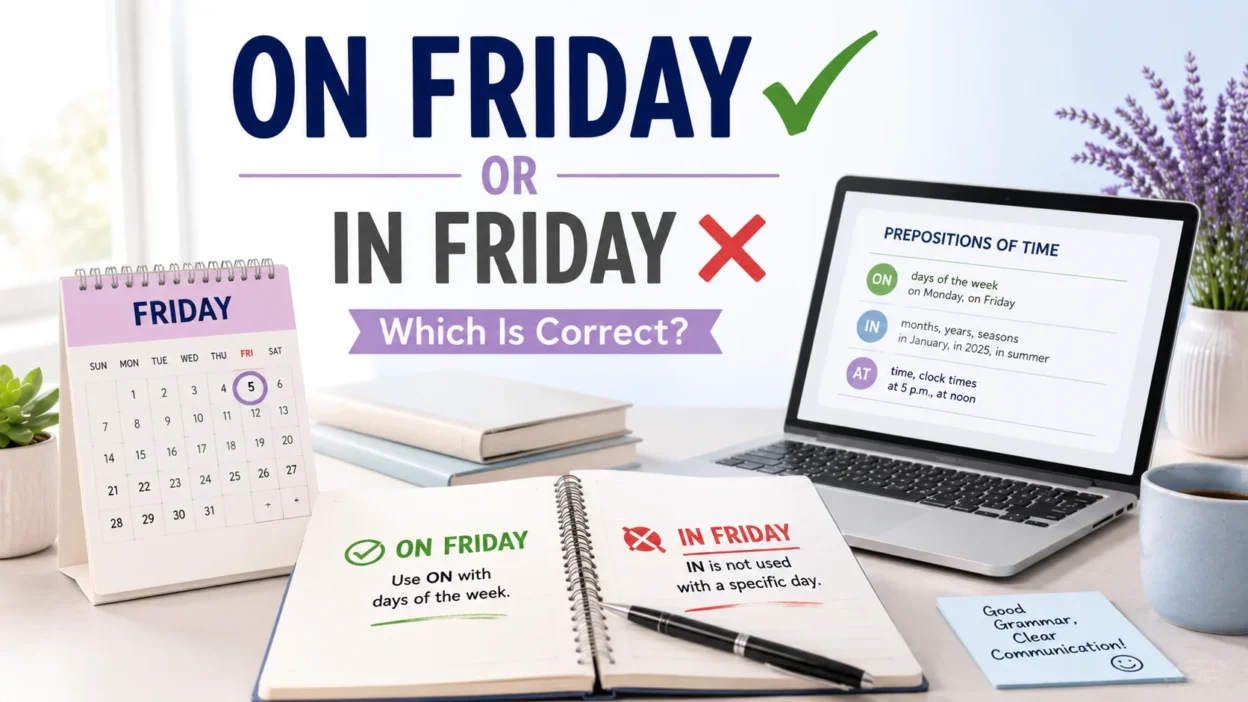
The correct phrase is “on Friday.” You should use on when talking about a particular day, such as Friday, Monday, or Sunday. The phrase in Friday is generally incorrect in standard English when you mean that something will happen on that day. Once you understand this rule, choosing the right preposition becomes much easier.
Quick Answer: On Friday or In Friday?
“On Friday” is correct, while “in Friday” is incorrect when referring to a specific day of the week.
Use on Friday to describe an event, meeting, appointment, or activity that happens on Friday.
Examples:
- I have an important meeting on Friday.
- We are going shopping on Friday.
- She will submit her assignment on Friday.
Do not write “I have a meeting in Friday.” Instead, write “I have a meeting on Friday.”
Easy rule to remember: Use on for specific days and dates, in for months, years, and longer periods, and at for specific clock times.
Why Is “On Friday” Correct?
In English grammar, prepositions help us explain when something happens. The preposition on is used with specific days of the week and calendar dates.
Friday is a particular day, so we say on Friday, just as we say on Monday, on Tuesday, or on Saturday.
Consider these examples:
- My exam is on Friday.
- The office will be closed on Friday.
- We usually visit our grandparents on Friday.
- The new course starts on Friday.
- I promised to call you on Friday.
In each sentence, on connects an activity or event to a particular day.
This rule applies whether you are speaking casually, writing an academic assignment, sending a business email, or making plans with friends.
What Does “On Friday” Mean?
The phrase “on Friday” means that something happens, will happen, or happened on the day called Friday.
Its exact meaning depends on the tense and context of the sentence.
1. Talking About Future Plans
Use on Friday when discussing something scheduled for an upcoming Friday.
Examples:
- I will meet my manager on Friday.
- We are planning a family dinner on Friday.
- The doctor has scheduled my appointment on Friday.
- Our team will present the project on Friday.
2. Talking About Past Events
You can also use on Friday to explain when something happened in the past.
Examples:
- I visited my cousin on Friday.
- She completed her assignment on Friday.
- We watched a movie on Friday.
- He called me on Friday evening.
3. Talking About Regular Activities
Use on Fridays, with the plural form, to describe something that happens regularly every Friday.
Examples:
- I work from home on Fridays.
- Our English class meets on Fridays.
- They play football on Fridays.
- We usually order takeout on Fridays.
Notice the difference between on Friday and on Fridays. The first commonly refers to one particular Friday, while the second often describes a repeated habit.
Why Is “In Friday” Incorrect?
The phrase “in Friday” is generally incorrect when you mean that an event happens on the day of the week.
English uses different prepositions for different types of time expressions. Although in is appropriate with many time periods, it does not normally precede the name of a specific weekday.
Incorrect: I will visit you in Friday.
Correct: I will visit you on Friday.
Incorrect: Our meeting is in Friday morning.
Correct: Our meeting is on Friday morning.
Incorrect: She submitted the report in Friday.
Correct: She submitted the report on Friday.
The confusion often happens because people learn expressions such as in the morning, in the afternoon, and in the evening. However, when a specific day is mentioned, the usual expression changes to on Friday morning, on Friday afternoon, or on Friday evening.
Remember that prepositions do not always translate word for word from one language to another. Learning common English time expressions as complete phrases can help you avoid these mistakes.
On Friday vs. In Friday: Comparison Table
| Expression | Correct or Incorrect? | Explanation | Example |
| On Friday | Correct | Used with a specific weekday | I have a test on Friday. |
| In Friday | Incorrect in this context | Not the standard preposition for a weekday | Write “on Friday.” |
| On Fridays | Correct | Used for recurring Friday activities | I exercise on Fridays. |
| In the morning | Correct | Used for a general part of the day | I study in the morning. |
| On Friday morning | Correct | Used for a part of a specific day | We will leave on Friday morning. |
| In March | Correct | Used with a month | My course begins in March. |
| In 2027 | Correct | Used with a year | She will graduate in 2027. |
| At 9 a.m. | Correct | Used with a specific time | The meeting starts at 9 a.m. |
This comparison shows why on Friday is the appropriate expression. The correct preposition depends on the type of time expression that follows it.
How to Use “On Friday” in Different Sentences
Understanding the rule is helpful, but seeing it in everyday situations makes it easier to remember.
In Everyday Conversations
- Are you free on Friday?
- Let’s go out for dinner on Friday.
- I will see you on Friday.
- What are you doing on Friday?
In Professional Emails
- I will send you the updated document on Friday.
- Could we schedule the interview on Friday?
- The final report is due on Friday.
- Our next team meeting will take place on Friday.
In School and Academic Writing
- The students will take their examination on Friday.
- The assignment must be submitted on Friday.
- The teacher announced the results on Friday.
- The workshop will begin on Friday morning.
With Specific Dates
When you mention a weekday and a calendar date together, use on.
Examples:
- The conference is on Friday, October 23.
- Her birthday falls on Friday, May 14.
- We booked our tickets for Friday, November 6.
The weekday and date should match the actual calendar if you are referring to a real event. The grammatical pattern remains the same.
Common Mistakes to Avoid
Even learners who understand the basic rule sometimes make mistakes when combining Friday with other time expressions.
Mistake 1: Using “In” Before a Weekday
Incorrect: I will call you in Friday.
Correct: I will call you on Friday.
Why? Specific days of the week normally take on.
Mistake 2: Forgetting “On” Before a Specific Day
Incorrect: We have an exam Friday morning.
Correct: We have an exam on Friday morning.
The version without on is also common and acceptable in informal English, particularly in American English. However, including on is a clear, standard choice for learners and formal writing.
Mistake 3: Saying “In Friday Night”
Incorrect: We are going to a party in Friday night.
Correct: We are going to a party on Friday night.
Use on when a time expression includes a specific day, even when that expression refers to nighttime.
Mistake 4: Confusing “On Friday” With “By Friday”
These expressions have different meanings.
- On Friday: Something happens on Friday.
- By Friday: Something must happen no later than Friday.
Examples:
- I will finish the report on Friday. (I plan to finish it that day.)
- I will finish the report by Friday. (I will finish it before or on Friday.)
Choosing the right expression makes your intended deadline or schedule clearer.
Mistake 5: Using “At Friday”
Incorrect: The event begins at Friday.
Correct: The event begins on Friday.
Use at for clock times, such as at 7 p.m., at noon, or at midnight, rather than for weekdays.
On Friday or In Friday in American and British English
There is no meaningful difference between American and British English regarding the standard use of on Friday. Both varieties use on with specific weekdays.
Examples accepted in both varieties:
- I will see you on Friday.
- The meeting is on Friday morning.
- We usually go shopping on Fridays.
There can be small differences in informal usage. American English speakers often omit on in expressions such as “I’ll see you Friday,” while British English speakers may also use that construction. Both varieties commonly use the preposition when clarity or a more formal tone is desired.
For example:
- American English: I’ll call you Friday.
- British English: I’ll call you on Friday.
These are not strict national rules. Both forms may be heard in either country, and “on Friday” is correct in both American and British English.
Simple Tricks to Remember the Correct Preposition
If you often mix up on, in, and at, use these practical memory tips.
Trick 1: Remember “On” for Days
Think of the phrase on Monday, on Tuesday, on Wednesday, on Thursday, on Friday, on Saturday, and on Sunday.
If you can replace Friday with another weekday, the preposition usually stays the same.
Trick 2: Use “In” for Longer Periods
Remember these examples:
- In January
- In summer
- In 2028
- In the morning
These expressions refer to months, seasons, years, or general parts of the day rather than a specific weekday.
Trick 3: Use “At” for Clock Times
Examples include:
- At 8 a.m.
- At 2:30 p.m.
- At noon
- At midnight
A useful general pattern is at a time, on a day, in a month or year. It will help you make the right choice in many everyday situations.
FAQs
1. Is it “on Friday” or “in Friday”?
“On Friday” is correct when referring to a specific day of the week. “In Friday” is not standard English for this meaning.
2. Can I say “in Friday morning”?
No. The standard expression is “on Friday morning.” Use in the morning when you are not specifying a particular day.
3. Is “on Fridays” grammatically correct?
Yes. Use on Fridays when describing a regular activity or habit that occurs every Friday or on Fridays generally. For example, “I attend English classes on Fridays.”
4. Is “I will see you Friday” correct?
Yes. “I will see you Friday” is common in informal English, especially in American English. “I will see you on Friday” is also correct and works well in both American and British English.
5. Should I use “on” before every day of the week?
Generally, yes, when using a weekday as a time expression: on Monday, on Tuesday, and on Friday. However, casual English sometimes omits the preposition, as in “See you Friday.”
6. What is the difference between “on Friday” and “by Friday”?
On Friday identifies the day something happens. By Friday gives a deadline, meaning something should be completed no later than Friday.
For example, “The package arrives on Friday” identifies the arrival day, while “Send the package by Friday” gives a deadline.
7. Is “on Friday night” correct?
Yes. On Friday night is the standard expression when referring to a particular Friday evening or night. For example, “We watched a film on Friday night.”
8. Is “on Friday” correct in formal writing?
Yes. It is grammatically correct and suitable for professional emails, academic assignments, reports, business documents, and everyday communication.
Summary: On Friday or In Friday?
When choosing between “on Friday” and “in Friday,” remember that on Friday is the standard and grammatically correct expression for referring to a specific weekday. Use it for meetings, appointments, deadlines, school activities, social plans, and past events. The same rule applies to other weekdays, including Monday, Tuesday, Wednesday, Thursday, Saturday, and Sunday. American and British English follow the same basic rule, although speakers sometimes omit on in casual conversation.
The easiest way to remember this grammar rule is to associate on with specific days, in with longer periods such as months and years, and at with clock times. Instead of saying “I have a meeting in Friday,” say “I have a meeting on Friday.” Practise using these expressions in messages, emails, and everyday conversations, and the correct preposition will soon feel natural.
Actionable takeaway: Whenever you write the name of a specific weekday, start with “on” unless you are using an informal construction that naturally omits the preposition.