Have you ever wondered whether to write spoilt vs spoiled? Both spellings are correct, but choosing the right one can feel confusing, especially when you encounter different forms in books, websites, and everyday conversations. The good news is that you do not need to memorize two different meanings because these words are alternative forms of the same verb, spoil.
The words can describe a child who receives too much attention, food that has gone bad, or an experience that has been ruined. However, American English generally prefers spoiled, while British English commonly uses spoilt. In this guide, you will learn the meanings, grammatical rules, practical examples, common mistakes, and regional differences so you can choose the right spelling confidently.
Quick Answer: Spoilt vs Spoiled
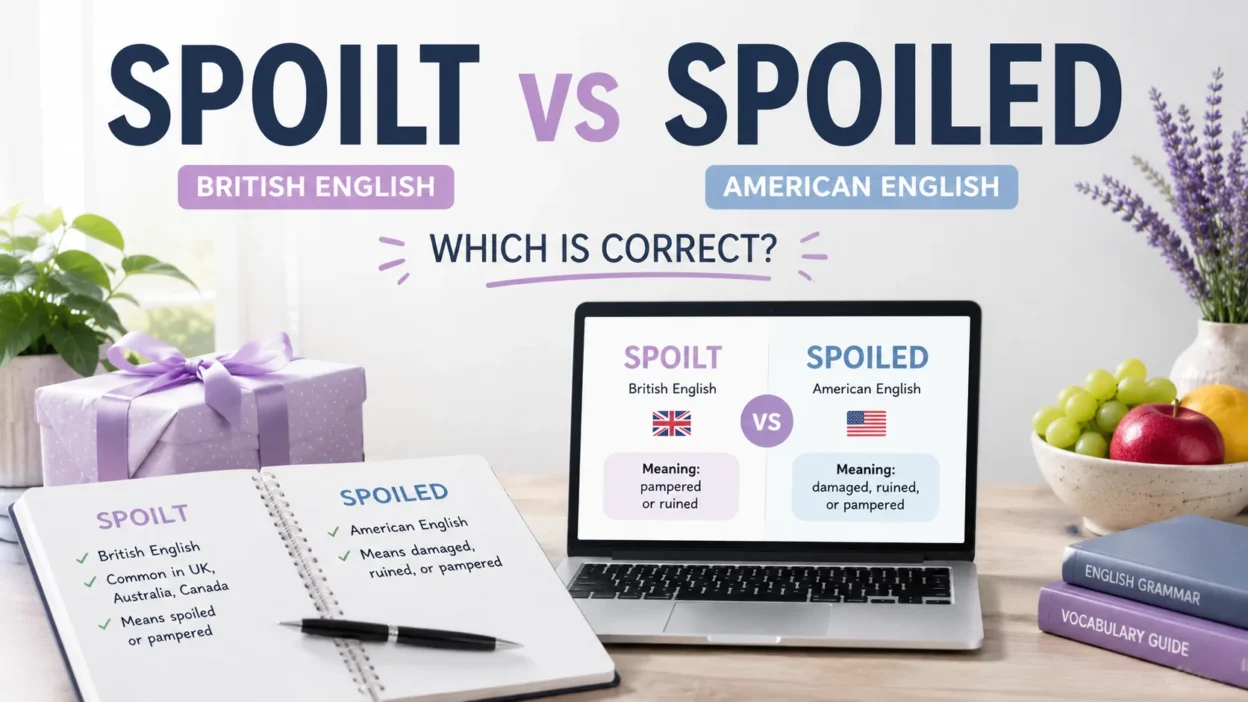
Both “spoilt” and “spoiled” are correct English words. They are alternative past-tense and past-participle forms of the verb spoil. The main difference is regional preference: spoiled is more common in American English, while spoilt is particularly common in British English.
Here is the simple rule:
- Spoiled: The usual choice in American English; also correct in British English.
- Spoilt: Common in British English; less common in American English.
Examples:
- American English: The child was spoiled by his grandparents.
- British English: The child was spoilt by his grandparents.
- Both varieties: The milk had spoiled before we used it.
- Both varieties: Someone spoiled the surprise.
Neither spelling is universally wrong. Choose the form that suits your audience and keep it consistent throughout your writing.
What Does Spoiled Mean?
Spoiled is the past tense and past participle of the verb spoil. Depending on the context, it can mean that someone has been overindulged, food has become unfit to eat, or an event or experience has been ruined.
1. Spoiled Means Overindulged
When describing a person, spoiled often refers to someone who is accustomed to receiving whatever they want. They may have difficulty accepting limits, sharing with others, or handling disappointment.
Examples:
- The child was spoiled by receiving a new toy every week.
- His parents worried that he had become too spoiled.
- She is a spoiled child who expects everyone to agree with her.
- The grandparents spoiled their grandchildren with gifts and treats.
This meaning often appears in discussions about parenting, behavior, and personal responsibility. However, calling someone spoiled can sound critical, so consider the tone before using it.
2. Spoiled Means No Longer Fresh
The word can also describe food that has deteriorated and may no longer be safe or pleasant to eat.
Examples:
- The spoiled milk smelled unpleasant.
- We threw away the spoiled fruit.
- The meat had spoiled because it was not refrigerated properly.
- Warm weather caused the food to spoil quickly.
In these examples, spoiled describes the condition of food rather than a person’s behavior.
3. Spoiled Means Ruined
Something can also be spoiled when its quality, enjoyment, or intended effect has been damaged.
Examples:
- Someone spoiled the ending of the movie.
- The heavy rain spoiled our picnic.
- His careless comment spoiled the surprise.
- The argument spoiled an otherwise enjoyable evening.
This meaning is common when discussing plans, celebrations, entertainment, and unexpected disappointments.
What Does Spoilt Mean?
Spoilt has essentially the same meanings as spoiled. It is an alternative past-tense and past-participle form of spoil, particularly common in British English.
You can use spoilt to describe an overindulged person, food that has gone bad, or an experience that has been ruined.
Examples of Spoilt in a Sentence
- The child was spoilt by relatives who rarely said no.
- The milk had spoilt in the warm weather.
- The unexpected announcement spoilt the surprise.
- Our holiday was nearly spoilt by bad weather.
- She did not want her children to grow up spoilt.
- The fruit was spoilt before we had a chance to eat it.
These sentences are grammatically correct, particularly in British English.
Is Spoilt More Informal Than Spoiled?
Not necessarily. Neither spelling is inherently more formal or informal than the other.
For example:
- The event was spoiled by poor planning.
- The event was spoilt by poor planning.
Both sentences are correct. The difference is primarily regional preference and writing style, not formality.
Spoilt vs Spoiled: Comparison Table
| Feature | Spoilt | Spoiled |
| Meaning | Overindulged, ruined, or no longer fresh | Overindulged, ruined, or no longer fresh |
| Grammar | Past tense and past participle | Past tense and past participle |
| British English | Common | Also correct and widely used |
| American English | Less common | Preferred |
| Example about behavior | The child was spoilt. | The child was spoiled. |
| Example about food | The milk had spoilt. | The milk had spoiled. |
| Example about an event | The rain spoilt the picnic. | The rain spoiled the picnic. |
The key takeaway is that spoilt and spoiled generally mean the same thing. Choose the form that matches your intended audience and maintain that choice throughout your article.
Spoilt vs Spoiled in American and British English
The difference between these forms is mainly a matter of regional preference. Both are accepted English forms, but one is more common in certain varieties.
American English: Spoiled
In American English, spoiled is the usual choice in everyday speech, education, journalism, and professional writing.
Examples:
- The spoiled child refused to share his toys.
- The food spoiled after being left outside.
- The ending of the show was spoiled by a social media post.
- The weather spoiled our weekend plans.
If you are writing for an American audience, using spoiled throughout your article is generally the safest option.
British English: Spoilt or Spoiled
British English commonly uses spoilt, particularly when describing someone’s behavior or an experience that has been ruined. However, spoiled is also standard and widely used.
Examples:
- The children were spoilt by their generous grandparents.
- The rain spoilt our afternoon walk.
- The food had spoiled before dinner.
- The surprise was spoiled by a careless message.
British writers can use either form. The distinction is a preference rather than a strict grammatical rule.
Which Form Should You Use in International Writing?
If your audience includes readers from different countries, either form can work. Consider these guidelines:
- Use spoiled when following American English conventions.
- Use spoilt when following a British English style that favors this form.
- Follow your publisher’s, school’s, or employer’s style guide.
- Avoid switching between forms without a clear reason.
For SEO content, use the spelling that matches your target keyword and audience’s search habits. Make the article useful and natural rather than repeating both versions unnecessarily.
Grammar Rules: How to Use Spoilt and Spoiled Correctly
Understanding the grammar behind these words makes it easier to use them in different sentence structures.
1. Use Spoiled or Spoilt as the Past Tense
When an action happened in the past, either form can be used.
Examples:
- She spoiled the surprise.
- She spoilt the surprise.
- The heat spoiled the food.
- The heat spoilt the food.
The choice depends on regional preference.
2. Use Spoiled or Spoilt With Have, Has, or Had
Both words can function as past participles.
Examples:
- The milk has spoiled.
- The milk has spoilt.
- The children have spoiled the game.
- The children have spoilt the game.
- The food had spoiled before we arrived.
These constructions describe completed actions or states.
3. Use Spoiled or Spoilt as an Adjective
Both forms can describe a person, object, or experience.
Examples:
- He is a spoiled child.
- He is a spoilt child.
- The spoiled food was discarded.
- They were disappointed by the spoiled surprise.
The form spoiled is especially common in American English, while spoilt is often favored in British English.
4. Understand the Difference Between Spoil and Spoiled
Spoil is the base form, while spoiled and spoilt are past forms.
- Present: I do not want to spoil the surprise.
- Past: I spoiled the surprise yesterday.
- Past participle: I have spoiled the surprise.
The same pattern applies when using spoilt instead.
Common Mistakes When Using Spoilt and Spoiled
Even when you know both spellings are correct, a few common errors are worth avoiding.
Mistake 1: Assuming Spoilt Is Incorrect
Incorrect assumption: Only spoiled is grammatically correct.
Correct understanding: Both forms are accepted. Spoiled is preferred in American English, while spoilt is common in British English.
Mistake 2: Assuming Spoiled Is Incorrect in British English
Incorrect assumption: British writers must always use spoilt.
Correct understanding: British English accepts both forms. Spoilt is common, but spoiled is also widely used.
Mistake 3: Mixing Spellings Without a Reason
Example:
- The child was spoiled by his parents.
- The rain spoilt the party.
Neither sentence is wrong, but using both forms in the same article may create an inconsistent style.
Better approach: Choose one form as your default and use it consistently unless you have a specific reason to change it.
Mistake 4: Confusing Spoilt and Spoiled in Meaning
Some learners assume spoiled describes bad food while spoilt describes a person’s behavior. This is incorrect.
Both words can describe:
- A child who has been overindulged.
- Food that is no longer fresh.
- A ruined surprise or experience.
The meaning depends on the context, not the spelling.
Mistake 5: Using the Wrong Verb Form
Incorrect: The food has spoil yesterday.
Correct: The food spoiled yesterday.
Correct: The food has spoiled.
Use the past tense spoiled or spoilt for a completed past action. With has or have, use the past participle.
More Examples of Spoilt vs Spoiled
These examples show how the two forms work in everyday communication.
| Context | Example with spoiled | Example with spoilt |
| Parenting | The child was spoiled by constant gifts. | The child was spoilt by constant gifts. |
| Food | The cheese had spoiled. | The cheese had spoilt. |
| Weather | The storm spoiled our plans. | The storm spoilt our plans. |
| Entertainment | Someone spoiled the ending. | Someone spoilt the ending. |
| Celebration | The argument spoiled the party. | The argument spoilt the party. |
Each pair communicates essentially the same meaning. Choose the form that best matches your preferred English variety.
FAQs
1. Is spoilt or spoiled correct?
Both are correct. Spoiled is the preferred form in American English, while spoilt is common in British English. Both can describe a person, food, or an experience that has been ruined.
2. Is spoilt British or American English?
Spoilt is particularly common in British English. American English generally prefers spoiled, although spoilt may occasionally appear in American writing.
3. Is spoiled British English?
Yes. Although spoiled is especially common in American English, it is also accepted and widely used in British English.
4. Should I write “spoilt child” or “spoiled child”?
Both expressions are correct. Spoilt child is common in British English, while spoiled child is preferred in American English. Both describe a child who has been overindulged.
5. Is food spoilt or spoiled?
Both forms are correct. You can write “The food has spoiled” or “The food has spoilt.” The first is more typical of American usage, while the second is common in British English.
6. Is spoilt a past tense or an adjective?
It can be both. Spoilt is a past-tense and past-participle form of spoil, and it can also function as an adjective, as in “a spoilt child.”
7. Can I use spoilt and spoiled in the same article?
You can, but it is usually better to remain consistent. Choose the form that matches your intended audience or publication style unless the context specifically calls for a different spelling.
8. What is the difference between spoil, spoiled, and spoilt?
Spoil is the base verb. Spoiled and spoilt are alternative past-tense and past-participle forms. For example: “Do not spoil the surprise,” “You spoiled the surprise,” and “You have spoilt the surprise.”
Summary: Spoilt vs Spoiled
The difference between spoilt vs spoiled is mainly regional, not grammatical. Both words are accepted forms of the verb spoil and can describe overindulged people, food that has gone bad, or experiences that have been ruined. American English generally favors spoiled, while British English commonly uses spoilt, although both spellings are acceptable in British writing.
To use these words confidently, consider your audience and the context of your sentence. If you are writing for an American publication, spoiled is usually the best choice. If you are following a British English style, spoilt may sound more natural. Above all, keep your spelling consistent and remember that neither form has a completely different meaning from the other.
Actionable takeaway: Remember this simple rule: American English usually prefers “spoiled,” while British English often prefers “spoilt.” When editing your writing, check your audience, choose your spelling, and use it consistently throughout the article.