Have you ever wondered whether to write “awoke” or “woke” when talking about waking up? Both words are correct forms of the verb wake, and they are often used interchangeably in everyday English. However, understanding their grammatical roles and common usage patterns can help you choose the right word and make your writing sound more natural.
The confusion usually arises because English has several irregular verb forms, and wake is one of them. Whether you are describing waking up early, talking about something that happened yesterday, or improving your English grammar, this guide will explain the difference between “awoke” and “woke,” provide clear examples, and show you how to avoid common mistakes.
Quick Answer: Awoke vs Woke
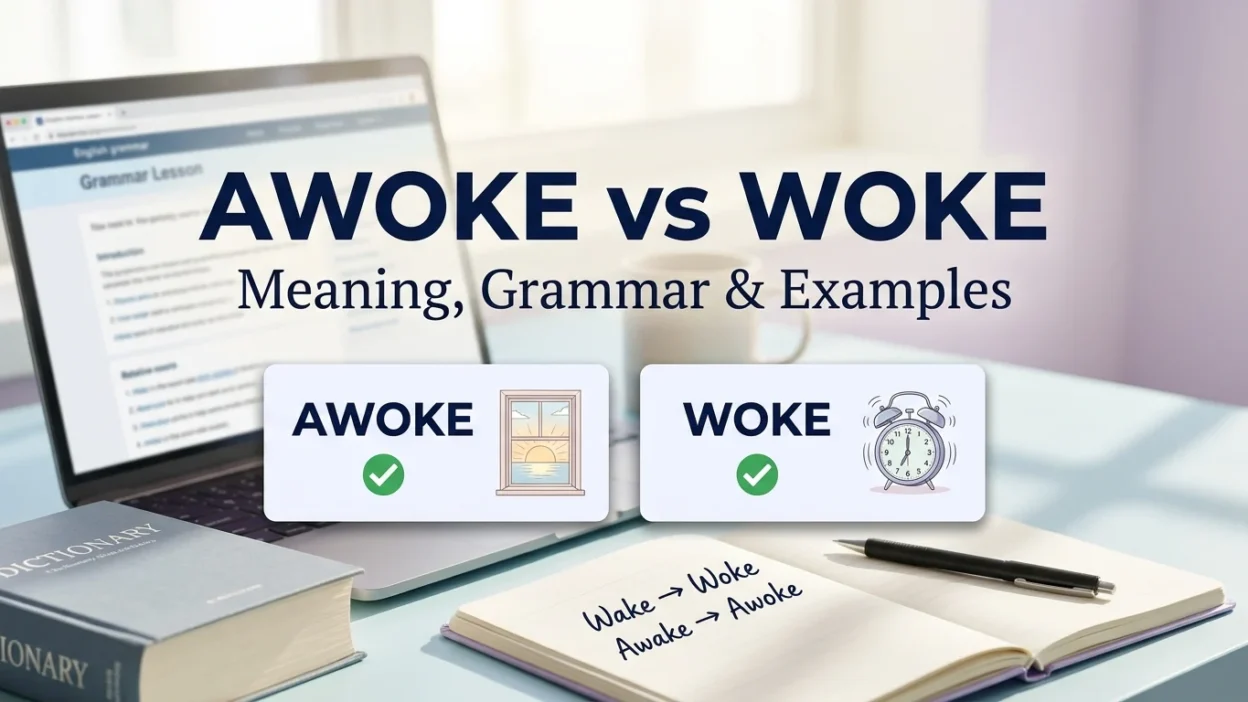
Both “awoke” and “woke” are correct simple past tense forms of the verb “wake.” They can both mean that someone stopped sleeping or became aware of something.
- Awoke: A correct past tense form that often sounds more literary, formal, or descriptive.
- Woke: A common past tense form widely used in everyday conversation and modern writing.
Examples:
- I woke up early this morning.
- I awoke to the sound of birds singing.
Both sentences are grammatically correct. The main difference is style and usage, not basic meaning.
Remember that the past participle is usually woken, as in “I have woken up early,” although waked also exists in some uses. In standard everyday English, avoid confusing the simple past tense with the past participle.
What Does Awoke Mean?
Awoke is the simple past tense of awake or, in common usage, a past tense form of wake. It describes the moment someone stopped sleeping or became conscious of something.
The word is often associated with descriptive, literary, or slightly formal writing. Writers may choose awoke to make a sentence feel more expressive or narrative.
Examples of Awoke in Sentences
- She awoke early and watched the sunrise.
- He awoke to the sound of rain against the window.
- I awoke suddenly in the middle of the night.
- The child awoke from a peaceful nap.
- They awoke to find snow covering the garden.
- She awoke with a feeling of excitement about the day.
- He awoke when someone knocked loudly on the door.
- The traveler awoke in an unfamiliar room.
In these examples, awoke describes the act of waking up or becoming conscious.
It can also be used figuratively to describe becoming aware of an issue, feeling, or situation.
For example:
- The experience awoke a sense of responsibility in him.
- The documentary awoke public interest in environmental protection.
In these sentences, awoke does not refer to sleep. Instead, it means that a feeling, awareness, or interest began to develop.
Synonyms of Awoke
Depending on the context, related words include:
- Woke: The more common alternative simple past form.
- Awakened: A past tense and past participle form that can sound more formal.
- Roused: Awakened someone or caused them to become active.
- Stirred: Began to move or become active, sometimes figuratively.
- Became aware: Recognized or understood something.
These words are not always interchangeable. For example, roused often suggests that something or someone caused the waking, while became aware focuses on understanding or recognition.
What Does Woke Mean?
Woke is the simple past tense of wake. It is commonly used to describe someone who stopped sleeping or became conscious.
In everyday English, woke is often the first choice when describing ordinary daily activities. It is natural in casual conversation, personal stories, messages, and most general writing.
Examples of Woke in Sentences
- I woke up at seven o’clock this morning.
- She woke when the alarm started ringing.
- He woke his brother before leaving the house.
- We woke early to catch the first train.
- The baby woke several times during the night.
- They woke to the smell of freshly baked bread.
- I woke suddenly after hearing a loud noise.
- She woke up feeling refreshed and ready for work.
These examples show how woke works in everyday situations.
The word can also be used figuratively:
- The news woke people to the seriousness of the problem.
- His experience woke him to the importance of saving money.
Here, woke means that someone became aware of something.
An Important Note About the Word “Woke”
In contemporary English, woke can also function as an adjective or slang term referring to awareness of social and political issues, particularly discrimination and injustice. Depending on the speaker and context, it may be used positively, neutrally, or critically.
For example:
- The original phrase “stay woke” encouraged people to remain alert to injustice.
- In political commentary, woke may be used to criticize certain progressive ideas or attitudes.
This modern usage is different from the ordinary verb form in “I woke up early.” Context determines the intended meaning.
Awoke vs Woke: Key Differences
The two words have essentially the same core meaning when used as the past tense of wake. Their differences mainly involve style, frequency, and context.
| Feature | Awoke | Woke |
| Part of speech | Simple past tense verb | Simple past tense verb |
| Base verb | Wake | Wake |
| Main meaning | Stopped sleeping or became aware | Stopped sleeping or became aware |
| Tone | Often literary or descriptive | Usually conversational and neutral |
| Common usage | Narrative and expressive writing | Everyday speech and general writing |
| Example | She awoke at dawn. | She woke at dawn. |
| Figurative use | The event awoke his curiosity. | The event woke his curiosity. |
Both forms are correct, and neither is universally better. The best choice depends on the sentence, the tone you want, and your personal writing style.
When Should You Use Awoke?
Use awoke when you want a slightly more literary, descriptive, or expressive tone. It is particularly useful in storytelling and narrative writing.
1. Describing a Peaceful Morning
“She awoke to the gentle sound of birds outside her window.”
The wording creates a descriptive atmosphere and fits naturally into a story.
2. Writing a Personal Narrative
“I awoke in the middle of the night and realized I had forgotten to set my alarm.”
Here, awoke gives the sentence a narrative feel.
3. Describing a Sudden Experience
“He awoke suddenly when the door slammed.”
The word works well in a descriptive passage.
4. Expressing a New Awareness
“The incident awoke a strong sense of responsibility in the community.”
This figurative usage describes a feeling or awareness becoming active.
You do not need to use awoke in every formal sentence. It is a stylistic choice, not a requirement of formal grammar.
When Should You Use Woke?
Use woke when you want a direct, natural, and familiar way to describe waking up or becoming aware of something.
1. Everyday Conversations
“I woke up late and missed the bus.”
This is a natural way to describe a daily event.
2. Text Messages and Informal Writing
“I woke up early today, so I finished my work before lunch.”
The wording is simple and conversational.
3. Reporting Past Events
“She woke when the phone rang.”
The sentence is concise and grammatically correct.
4. Describing a Realization
“The experience woke him to the dangers of careless spending.”
This figurative use is also possible, although “made him aware of” may sound clearer in some contexts.
For most everyday situations, woke is a reliable choice. It is widely understood and fits naturally into ordinary English.
Grammar Rules: Wake, Woke, Awoke, and Woken
To understand awoke vs woke fully, it helps to learn the main forms of the verb.
| Verb form | Word | Example |
| Base form | Wake | I wake up early every day. |
| Simple past | Woke | I woke up early yesterday. |
| Simple past alternative | Awoke | I awoke before sunrise. |
| Past participle | Woken | I have woken up early all week. |
| Past participle alternative | Awakened | I was awakened by a loud noise. |
The most important distinction is between the simple past and the past participle.
Use woke or awoke for a completed event in the past:
- I woke up late yesterday.
- I awoke before dawn.
Use woken with auxiliary verbs such as have, has, or had:
- I have woken up early all week.
- She had woken before the alarm rang.
You can also use awakened:
- She has awakened to the reality of the situation.
In everyday English, “I have woken up” is generally more natural than “I have awoke,” which is not the standard form for the present perfect tense.
Common Mistakes to Avoid
Even though woke and awoke are both correct, certain sentence structures can cause confusion.
Mistake 1: Using Awoke After “Have”
Incorrect: “I have awoke at six every morning this week.”
Correct: “I have woken up at six every morning this week.”
After have in the present perfect, use the past participle woken.
Mistake 2: Assuming Awoke Is More Grammatically Correct
Incorrect assumption: “Woke is informal and should never be used in formal writing.”
Correction: Both woke and awoke are standard English forms. Choose according to context and style.
Mistake 3: Confusing Woke With Waked
Waked exists as a verb form in some contexts, but woke is the usual simple past form of wake in standard contemporary English.
For example:
Natural: “I woke up early yesterday.”
Mistake 4: Using Woke When You Need the Present Tense
Incorrect: “I woke up at six every day.”
This sentence is not necessarily wrong, but it describes a past routine. If you mean that this is your current daily habit, write:
Correct: “I wake up at six every day.”
Mistake 5: Forgetting the Difference Between Woke and Woken
Incorrect: “She has woke up already.”
Correct: “She has woken up already.”
Remember the pattern: wake, woke, woken.
American English vs British English
There is no significant difference between American and British English in the standard use of woke and awoke. Both varieties recognize the words as correct past tense forms of wake.
Examples in American English:
- I woke up early this morning.
- She awoke to the sound of thunder.
Examples in British English:
- I woke up early this morning.
- She awoke to the sound of thunder.
Both varieties also commonly use woken as the past participle.
You may notice differences in pronunciation, preferred expressions, or writing style among individual speakers, but neither woke nor awoke belongs exclusively to American or British English.
The modern adjective woke, particularly in social and political discussions, is also used in both varieties, although its connotations may vary depending on the context.
FAQs
1. Is awoke or woke correct?
Both are correct. They are simple past tense forms of wake. “I woke up early” and “I awoke early” are both grammatically acceptable.
2. What is the difference between awoke and woke?
The main difference is style. Woke is more common in everyday conversation, while awoke often sounds more literary or descriptive. Their basic meaning is the same.
3. Is awoke the past tense of wake?
Yes. Awoke is an accepted simple past form of wake. The form woke is also correct and more common in everyday usage.
4. Is woke the past tense or past participle of wake?
Woke is the simple past tense. The standard past participle is woken, as in “I have woken up early.”
5. Can I say “I have awoke”?
In standard contemporary English, use “I have woken” or “I have awakened.” Awoke is normally used as a simple past form, not as the past participle in this construction.
6. Is “I awoke early” more formal than “I woke early”?
It can sound more literary or descriptive, but it is not automatically more formal or more correct. Both sentences are grammatically correct.
7. Is woke an adjective as well as a verb?
Yes. Woke is the past tense of wake, but it can also be an adjective or slang term describing awareness of social and political issues. The intended meaning depends on context.
8. What are the three forms of wake?
The three commonly taught forms are wake, woke, and woken. Awoke is an additional accepted simple past form, and awakened is another related verb form.
Summary: Awoke vs Woke
The difference between awoke and woke is simpler than it first appears. Both words are correct simple past tense forms of wake, and both can describe someone stopping sleep or becoming aware of something. Woke is generally more common in everyday conversation, while awoke can give a sentence a more descriptive or literary tone. Neither form is restricted to American or British English.
The most important grammar rule is to distinguish the simple past from the past participle. Use woke or awoke for a completed past event, but use woken after have, has, or had in standard perfect-tense constructions. Once you understand these forms, choosing the right word becomes much easier, whether you are writing a personal story, an email, or an English assignment.
Actionable takeaway: Remember the pattern wake → woke/awoke → woken. For everyday writing, choose woke; for a more descriptive style, consider awoke.