Have you ever come across the words “innate” and “enate” and wondered whether they mean the same thing? Although these words look and sound similar, they have very different meanings and are used in different contexts. Understanding the difference can help you avoid spelling mistakes and choose the right word when writing or speaking English.
The confusion is understandable because both words begin with similar sounds, and “enate” is unfamiliar to many English learners. However, innate is a common English adjective meaning natural or inborn, while enate is a rare word associated mainly with the maternal side of a family or ancestry. In this guide, you will learn their definitions, grammatical uses, examples, and practical tips for remembering the difference.
Quick Answer: Innate vs Enate
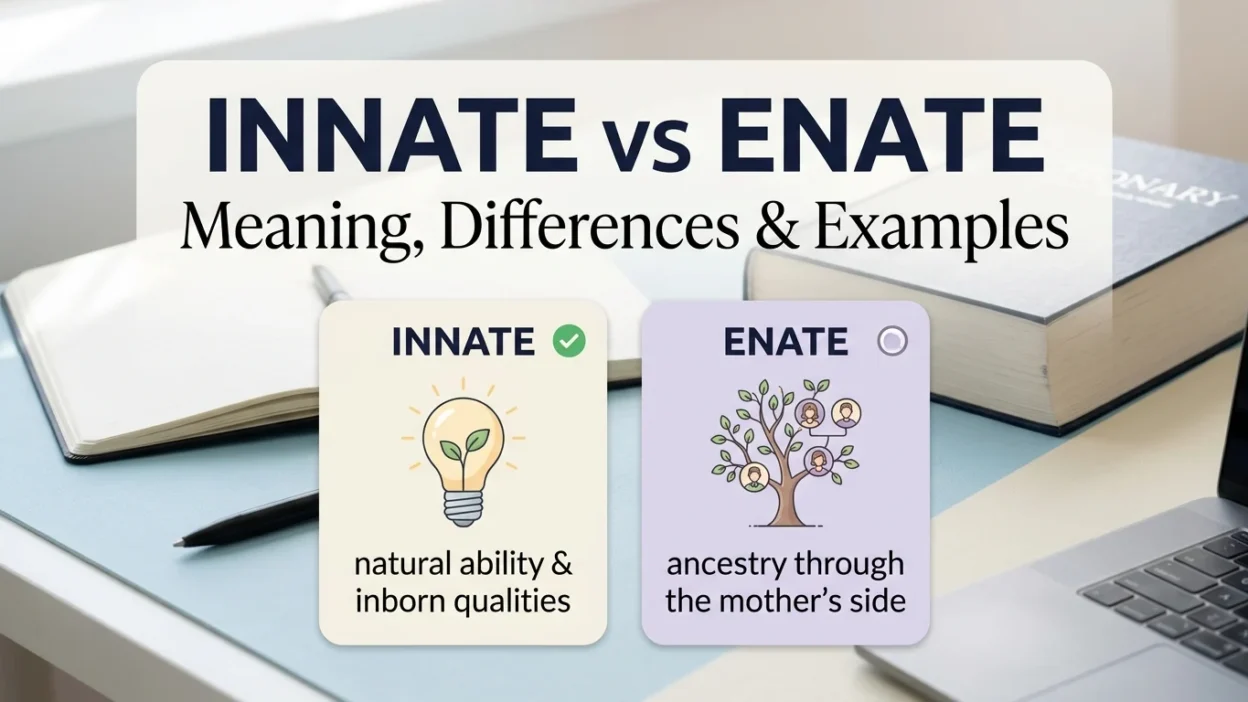
Innate is the correct word when you mean something that is inborn, natural, or present from birth. Enate is a rare term used primarily in genealogy and anthropology to refer to a person’s maternal relatives or descent through the mother’s side.
Examples:
- Innate: She has an innate ability to understand music.
- Enate: The historian examined the family’s enate line of descent.
If you are describing a natural talent, instinct, quality, or characteristic, use innate. If you are discussing maternal ancestry in a specialized context, enate may be appropriate.
For most everyday writing, conversations, school assignments, and professional communication, innate is the word you are most likely to need.
What Does Innate Mean?
The word innate is an adjective that describes a quality, ability, tendency, or characteristic that is natural or inborn rather than acquired through learning or experience.
Something innate may be present from birth or arise from a person’s natural constitution. The word is frequently used in discussions about personality, intelligence, human behavior, instincts, and natural abilities.
Examples of Innate in Sentences
- She has an innate talent for playing the piano.
- Humans have an innate capacity to learn language.
- His innate curiosity encourages him to ask thoughtful questions.
- The child displayed an innate sense of rhythm.
- Some animals possess innate behaviors that help them survive.
- Her innate kindness makes people feel welcome.
- The researcher studied the role of innate immunity in protecting the body.
- He seems to have an innate understanding of complex mathematical ideas.
In each example, innate describes something natural or inborn rather than something developed entirely through deliberate instruction.
However, innate does not always mean that a skill is fully developed at birth. A person may have a natural aptitude that becomes stronger through practice and experience.
For instance, someone with an innate talent for music may still need years of lessons to become an accomplished musician.
Synonyms of Innate
Depending on the context, useful synonyms include:
- Inborn: Existing from birth.
- Natural: Arising from nature or a person’s inherent qualities.
- Inherent: Existing as an essential or permanent characteristic of something.
- Instinctive: Done or felt naturally, without conscious reasoning.
- Ingrained: Deeply established, although often developed through experience.
- Inbred: Inherited or deeply established by nature; this word can carry additional biological or negative connotations, so it is not always interchangeable with innate.
These words have overlapping meanings, but they are not identical. For example, an instinctive reaction happens without deliberate thought, whereas an innate ability may be a natural capacity that someone develops over time.
What Does Enate Mean?
Enate is a rare adjective that refers to the maternal side of a family or to descent through the mother’s side. It is most likely to appear in specialized genealogical, anthropological, or historical writing.
For example, a family historian might use enate relatives to refer to relatives connected through the maternal line.
Examples of Enate in Sentences
- The genealogist traced the family’s enate ancestry.
- The historical document recorded several members of the ruler’s enate line.
- Researchers examined the relationship between enate kinship and inheritance practices.
- The family tree included relatives from both the paternal and enate sides.
- The scholar compared enate and agnate lines in an ancient society.
These examples illustrate specialized usage rather than everyday conversation. Because enate is uncommon, readers may need a dictionary or additional context to understand it.
Enate and Maternal Ancestry
The word is associated with the Latin word enatus, connected with being born or arising from a family line. In genealogical usage, its particular significance is maternal descent.
Related terms include:
- Maternal: Relating to the mother.
- Matrilineal: Tracing descent through the mother’s line.
- Agnate: Relating to kinship through the male line, especially the father’s side.
- Paternal: Relating to the father.
Although these words may appear in similar discussions, their meanings are not completely interchangeable. Maternal is much more common in ordinary English than enate.
Innate vs Enate: Key Differences
The main difference between innate and enate is their meaning and context. They are not alternative spellings of the same word.
| Feature | Innate | Enate |
| Part of speech | Adjective | Adjective |
| Main meaning | Inborn or natural | Related to the maternal side of a family |
| Common usage | Everyday, academic, scientific, and professional English | Specialized genealogy, anthropology, and historical writing |
| Frequency | Common | Rare |
| Related terms | Inborn, natural, inherent | Maternal, matrilineal |
| Example | She has an innate ability to lead. | The researcher studied the enate line. |
| Best use | Natural qualities, tendencies, and abilities | Maternal ancestry or kinship |
Remember that innate describes a quality or characteristic, whereas enate identifies a relationship with the maternal side of a family.
When Should You Use Innate?
Use innate when describing something natural, inherent, or inborn. It is useful in many contexts, including education, psychology, science, business, and everyday conversation.
1. Describing Natural Talents
“Her innate artistic ability was evident from an early age.”
This sentence suggests that she had a natural aptitude for art, even before extensive training.
2. Describing Personality Traits
“He has an innate sense of fairness.”
Here, innate describes a characteristic that seems natural to the person.
3. Discussing Human Behavior
“Scientists continue to investigate which aspects of human behavior are innate and which are learned.”
This usage is common in psychology and behavioral research.
4. Discussing Biology
“The immune system includes innate defenses that help protect the body against pathogens.”
In biology, innate immunity refers to the body’s built-in defense mechanisms. This is a well-established scientific expression.
5. Describing Natural Abilities at Work
“Her innate problem-solving skills make her an effective team leader.”
This sentence emphasizes a natural aptitude rather than a skill acquired exclusively through training.
When Should You Use Enate?
Use enate when the subject specifically concerns the maternal line of descent or relatives connected through the mother’s side.
1. Family History
“The historian documented the ruler’s enate relatives.”
The sentence refers to relatives on the maternal side.
2. Genealogical Research
“The genealogist investigated the enate line to establish the family’s connections.”
The word appears in a specialized family-history context.
3. Historical Kinship Systems
“The researcher compared enate and agnate relationships in the historical records.”
This example contrasts maternal and paternal lines of kinship.
In ordinary writing, you will often communicate the same idea more clearly by using maternal relatives, mother’s side of the family, or maternal ancestry.
For example:
Less familiar: “She researched her enate ancestry.”
More familiar: “She researched her maternal ancestry.”
Both may communicate the intended idea, but the second is more accessible to a general audience.
Common Mistakes to Avoid
Understanding a word’s meaning is important, but knowing when not to use it is equally helpful.
Mistake 1: Using Enate to Mean Inborn
Incorrect: “He has an enate ability to solve problems.”
Correct: “He has an innate ability to solve problems.”
Use innate to describe a natural ability or quality.
Mistake 2: Treating Enate as a Common Alternative Spelling
Incorrect assumption: “Enate is simply another spelling of innate.”
Correction: The two words have different meanings. Enate is a legitimate but rare word, not a standard alternative spelling of innate.
Mistake 3: Using Innate When Discussing Maternal Ancestry
Unclear: “The historian examined the innate line of descent.”
Clearer: “The historian examined the maternal line of descent.”
The first sentence incorrectly uses innate to refer to family relationships.
Mistake 4: Assuming Every Natural Skill Is Entirely Inborn
The word innate suggests a natural or inborn quality, but it does not mean that practice and learning are irrelevant.
For example, a person may have an innate aptitude for mathematics while still needing education and practice to develop advanced mathematical skills.
Mistake 5: Choosing an Unfamiliar Word When a Simple One Works
Although enate is appropriate in specialized contexts, readers may not recognize it. In general writing, maternal or related to the mother’s side of the family will often be clearer.
American English vs British English
There is no significant difference between American and British English in the meanings or standard spellings of innate and enate.
Both varieties use innate to describe natural or inborn characteristics. The term also appears in scientific expressions such as innate immunity in both varieties of English.
Enate is rare in both American and British English and is largely confined to specialized discussions of genealogy, kinship, and ancestry.
Examples:
- American English: “She has an innate ability to recognize patterns.”
- British English: “She has an innate ability to recognise patterns.”
The spelling difference in these examples is recognize versus recognise, not innate. Both versions use innate correctly.
For everyday American or British English, choose innate when you mean natural or inborn. Use enate only when you specifically mean maternal ancestry or kinship.
FAQs
1. Is innate or enate the correct word?
Both are legitimate English words, but they have different meanings. Innate means natural or inborn, while enate refers to the maternal side of a family or ancestry.
2. What does innate mean in simple English?
Innate means something you naturally have rather than something you acquire entirely through learning or experience. For example, an innate talent is a natural ability.
3. What does enate mean in genealogy?
In genealogical or kinship contexts, enate refers to relatives or descent connected through the mother’s side of a family. It is a rare, specialized term.
4. Is enate a real English word?
Yes. Enate is a real English word, although it is uncommon. It is used mainly in specialized discussions of maternal ancestry and kinship.
5. Can innate and enate be used interchangeably?
No. Innate describes natural or inborn characteristics, whereas enate concerns maternal family relationships. Substituting one for the other changes the meaning of the sentence.
6. What are common synonyms for innate?
Common synonyms include inborn, natural, and inherent. Depending on the sentence, instinctive may also work, although its meaning is slightly different.
7. What is the difference between innate and inborn?
The two words are very similar. Inborn directly emphasizes something present from birth, while innate can also describe a natural capacity or tendency that is not necessarily fully developed at birth.
8. Is innate spelled the same in American and British English?
Yes. Innate has the same spelling and meaning in both American and British English. Enate is also spelled the same in both varieties.
Summary: Innate vs Enate
The difference between innate and enate becomes simple once you understand what each word describes. Innate is the common adjective used for natural, inborn, or inherent qualities, such as an innate talent, innate curiosity, or innate immunity. Enate, by contrast, is a rare term associated with relatives or descent through the maternal side of a family. The words may look similar, but they are not interchangeable.
For most readers, writers, and English learners, innate will be the appropriate choice in everyday communication. Use enate when you are discussing maternal ancestry in a specialized context and the term fits your audience. If clarity is your priority, alternatives such as maternal and inborn can help communicate your meaning without confusing readers.
Actionable takeaway: Remember this simple distinction: innate = inborn or natural; enate = related to the mother’s side of a family. Before using either word, check whether you are describing a natural quality or a family relationship.