Have you ever wondered whether the correct expression is “bad rap” or “bad rep”? You may have heard both phrases in conversations, social media posts, or workplace discussions. Since they sound similar and both relate to how people view someone or something, choosing the right expression can be confusing.
The good news is that both phrases are used in English, but they have slightly different meanings. “Bad rap” is an established idiom that often suggests unfair criticism or undeserved blame, while “bad rep” is an informal shortening of “bad reputation.” In this guide, you’ll discover what each expression means, how to use it in a sentence, which phrase works best in formal writing, and how to avoid common English usage mistakes.
Quick Answer: Bad Rap or Bad Rep?
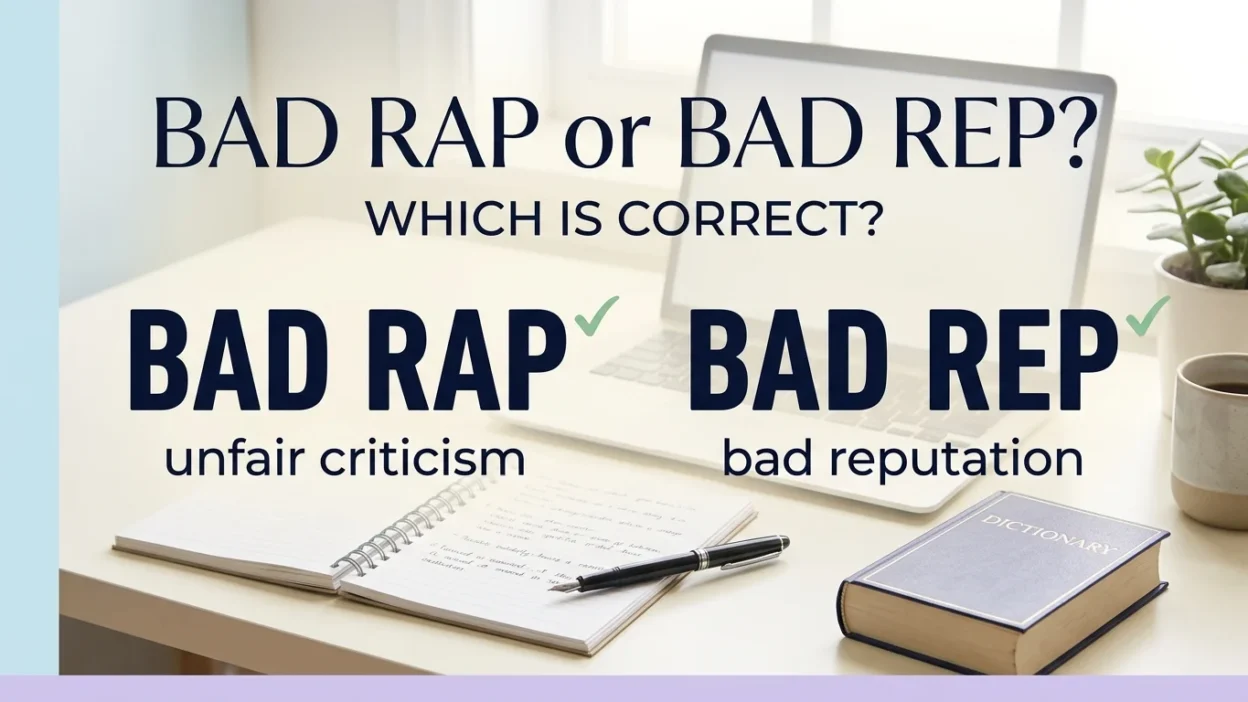
Both “bad rap” and “bad rep” can be correct, depending on the context and the meaning you want to convey.
- Bad rap: Unfair criticism, blame, or a negative judgment that someone or something may not deserve.
- Bad rep: An informal abbreviation of “bad reputation,” describing an unfavorable public image.
- Bad reputation: The clearest and most professional alternative for formal writing.
- Bad wrap: Generally incorrect when you mean an unfavorable reputation.
Example: “The restaurant gets a bad rap for being expensive, but its lunch menu is affordable.”
Here, “bad rap” suggests that people may judge the restaurant too harshly. On the other hand, “The restaurant has a bad rep in town” simply describes its negative reputation without necessarily suggesting that the criticism is unfair.
What Does “Bad Rap” Mean?
The phrase “bad rap” means receiving unfair criticism, blame, or an unfavorable judgment. It is an established English idiom often used when someone or something develops a negative image that may be exaggerated or undeserved.
For example, a student might get a bad rap for being lazy when they are actually struggling with a difficult subject. Similarly, a neighborhood may receive a bad rap because of a few negative news stories, even though most residents have positive experiences living there.
In this expression, “rap” does not refer to the musical genre. Instead, it is part of an established idiom associated with blame and negative judgment.
Examples of “Bad Rap” in Sentences
- Pineapple on pizza gets a bad rap, even though many people enjoy it.
- My colleague gets a bad rap for being quiet, but she is one of the most helpful people on our team.
- The new software received a bad rap before users had a chance to explore its features.
- Cats sometimes get a bad rap for being unfriendly, although many are affectionate pets.
- The school has a bad rap for strict rules, but its students appreciate the organized learning environment.
- He got a bad rap after one mistake overshadowed years of excellent work.
- Public transportation gets a bad rap in some cities, despite being reliable and affordable.
- The product received a bad rap because of a few misleading online reviews.
In these examples, the phrase often suggests that the negative judgment does not tell the whole story.
What Does “Bad Rep” Mean?
“Bad rep” is an informal shortening of “bad reputation.” It describes the negative opinion that people have about a person, business, organization, product, or place.
Unlike “bad rap,” “bad rep” does not necessarily suggest that the criticism is unfair. A business might have a bad rep because of repeated customer complaints, while a person might develop a bad rep because they consistently fail to keep their promises.
For example, a company that regularly delivers orders late may develop a bad rep among its customers. In this situation, the negative reputation may be based on actual experiences rather than misunderstandings.
Examples of “Bad Rep” in Sentences
- That mechanic has a bad rep because several customers complained about the service.
- The brand has a bad rep for producing unreliable appliances.
- He is trying to improve his bad rep at work by becoming more dependable.
- The online store developed a bad rep after failing to deliver several orders.
- This neighborhood has a bad rep, although many residents feel safe there.
- The restaurant has a bad rep for slow service, so management hired additional staff.
- The company is working hard to overcome its bad rep and rebuild customer trust.
- The product has a bad rep among buyers who experienced technical problems.
“Bad rep” is common in informal conversations and casual writing. In professional reports, academic work, and formal business communication, “bad reputation” is usually a more polished alternative.
Bad Rap vs. Bad Rep: Key Differences
Although these expressions overlap, they emphasize slightly different ideas. Understanding the distinction will help you choose the most suitable phrase.
| Feature | Bad Rap | Bad Rep |
| Main meaning | Negative judgment, blame, or criticism | Negative reputation |
| Expression type | Established English idiom | Informal shortening of “bad reputation” |
| Suggests unfairness? | Often, but not always | Not necessarily |
| Tone | Conversational and widely established | Casual and informal |
| Formal alternative | Unfair criticism or undeserved blame | Bad reputation or poor reputation |
| Example | “The product gets a bad rap.” | “The product has a bad rep.” |
The easiest way to remember the difference: “Bad rap” often emphasizes how something is judged, while “bad rep” emphasizes the reputation it has acquired. However, their meanings overlap, so context matters.
Why Do People Confuse “Bad Rap” and “Bad Rep”?
Several features of English make these phrases easy to mix up.
1. They Sound Similar
In many English accents, “rap” and “rep” differ by only one vowel sound. When people hear the phrase in conversation, it may not be immediately clear which spelling the speaker intends.
2. Both Expressions Relate to Reputation
Someone who receives unfair criticism may develop a negative reputation. Because the meanings overlap, both expressions can seem appropriate in similar situations.
3. “Rep” Is a Natural Abbreviation
English speakers frequently shorten longer words in casual speech. Since “rep” is a familiar abbreviation of “reputation,” the phrase “bad rep” feels natural to many speakers.
4. “Rap” Has Other Meanings
Many readers associate “rap” with music or rhythmic speech. This association can make the expression “bad rap” seem unusual, even though it is a well-established idiom.
Recognizing the difference between an unfair judgment and a general negative reputation makes the choice easier.
Common Mistakes to Avoid
Even fluent English speakers sometimes confuse these expressions. Here are five mistakes worth avoiding.
Mistake 1: Assuming “Bad Rap” Is Incorrect
Incorrect assumption: “Bad rap” must be a spelling mistake because the intended meaning is reputation.
Correct understanding: “Bad rap” is an established idiom, especially when the idea involves unfair blame or criticism.
Example: The movie gets a bad rap because people judge it by its trailer.
Mistake 2: Treating “Bad Rep” as the Best Choice Everywhere
“Bad rep” is understandable and common in informal English, but it may sound too casual in a professional report.
- Informal: The company has a bad rep for poor customer service.
- Formal: The company has a poor reputation for customer service.
Both sentences communicate a similar idea, but the second is more suitable for professional writing.
Mistake 3: Assuming Every Bad Reputation Is Unfair
A person or business can have a negative reputation because of genuine problems. “Bad rap” often suggests unfairness, whereas “bad rep” can describe a reputation whether or not it is deserved.
Example: The contractor has a bad rep because several clients reported unfinished projects.
Mistake 4: Confusing “Bad Rap” With “Bad Wrap”
When discussing criticism or reputation, the established expression is “bad rap,” not “bad wrap.”
- Correct: She gets a bad rap for being overly strict.
- Incorrect in this context: She gets a bad wrap for being overly strict.
“Wrap” generally refers to covering or enclosing something, so it does not convey the intended idiomatic meaning.
Mistake 5: Using Informal Language in Formal Writing
Although “bad rep” is widely understood, formal writing often benefits from more precise language.
Instead of writing “The organization has a bad rep,” consider “The organization has a poor reputation” or “The organization has faced criticism.”
Bad Rap or Bad Rep in American and British English
Both expressions are understood in American and British English, although preferences may vary by region, age, and context.
In American English, “bad rap” is a familiar idiom, particularly when someone or something is considered unfairly criticized. “Bad rep” is also used in informal conversation.
In British English, “bad rap” is understood, and “bad rep” can also appear in casual speech. Speakers may prefer “bad reputation” when they want a more neutral or formal expression.
There is no strict American-versus-British spelling rule that makes one phrase universally correct and the other incorrect.
For international audiences, business communication, and academic writing, “bad reputation” is usually the clearest choice because it avoids ambiguity and sounds appropriate in formal contexts.
Better Alternatives to “Bad Rap” and “Bad Rep”
If you want to communicate the same idea more precisely, consider these alternatives:
- Bad reputation: A generally negative public image.
- Poor reputation: A neutral, professional way to describe an unfavorable public image.
- Unfair criticism: Negative comments or judgments that are not justified.
- Undeserved blame: Responsibility unfairly placed on someone.
- Negative perception: An unfavorable way people view someone or something.
- Bad name: An informal expression for a damaged reputation.
- Negative publicity: Unfavorable attention in public discussion or the media.
- Unfavorable image: A negative impression held by an audience or community.
Choose the alternative that matches your intended meaning. For example, “unfair criticism” is more precise when the problem is unjust judgment, while “poor reputation” works well when discussing a business’s public image.
Frequently Asked Questions
1. Is “bad rap” or “bad rep” correct?
Both expressions are used in English. “Bad rap” is an established idiom often associated with unfair criticism, while “bad rep” is an informal shortening of “bad reputation.”
2. Does “bad rap” mean a bad reputation?
Yes. “Bad rap” can refer to a negative reputation, especially one that may be undeserved. It often emphasizes unfair judgment rather than simply describing public opinion.
3. Is “bad rep” short for “bad reputation”?
Yes. “Rep” is a shortened form of “reputation.” Therefore, “bad rep” means a negative reputation and is commonly used in informal conversation.
4. Is “bad rap” more correct than “bad rep”?
Neither expression is universally more correct. “Bad rap” is the established idiom, while “bad rep” is a recognizable informal alternative. Choose according to the meaning and tone you want.
5. Can I use “bad rep” in professional writing?
You can, but it may sound informal. In business reports, academic writing, and formal articles, “bad reputation,” “poor reputation,” or “negative public image” is often more suitable.
6. What is the opposite of “bad rap”?
Depending on the context, alternatives include “a fair assessment,” “well-deserved praise,” or “a good reputation.” When someone is criticized unfairly, you could say they deserve a fairer judgment.
7. Is “bad wrap” the correct spelling?
Not when discussing someone’s reputation or unfair criticism. The established expression is “bad rap.” The word “wrap” refers to covering or enclosing something.
8. Which phrase should English learners remember?
Remember “bad rap” as an established idiom that often suggests unfair criticism. Remember “bad rep” as an informal way of saying “bad reputation.” When in doubt, use “bad reputation” for clarity.
Summary: Bad Rap or Bad Rep?
The difference between “bad rap” and “bad rep” is small but useful to understand. “Bad rap” is a well-established English idiom that often suggests unfair criticism, blame, or an undeserved negative image. “Bad rep” is an informal abbreviation of “bad reputation” and describes the negative opinion people have about a person, place, or organization. Because their meanings overlap, both expressions can work in everyday conversation.
For clear and professional communication, choose “bad reputation” or “poor reputation.” In casual conversation, use “bad rap” when you want to emphasize unfair judgment and “bad rep” when you simply mean a negative reputation. Actionable takeaway: Before choosing between the two, ask yourself whether you are describing unfair criticism or a generally negative public image. This small distinction will help you write more naturally and avoid a common English usage mistake.