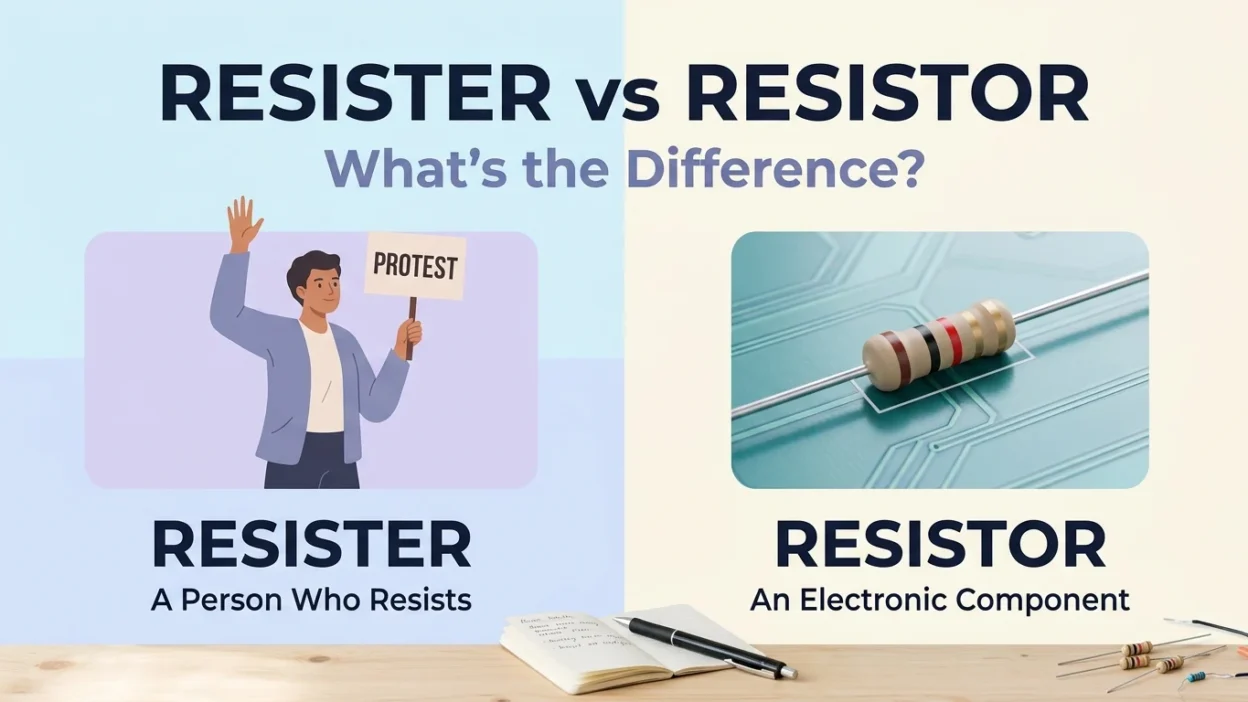
Have you ever searched for resister vs resistor and wondered which spelling is correct? These words look almost identical, and both are connected to the verb resist. However, they have different uses. One is a valid word for a person or thing that resists something, while the other is a common technical term used in electronics.
The key is understanding the context. If you are writing about someone who opposes authority, refuses to comply, or fights against something, resister may be the word you need. If you are discussing electrical circuits, electronic components, or resistance in a device, the correct word is resistor. This guide explains their meanings, differences, examples, and common spelling mistakes so you can choose confidently.
Quick Answer: Resister vs Resistor
Resister refers to a person or thing that resists, opposes, or refuses to accept something. Resistor usually refers to an electronic component designed to oppose or limit the flow of electric current.
- Resister: Someone or something that resists or opposes.
- Resistor: An electrical component that provides resistance in a circuit.
Examples:
- The resister refused to follow the unfair rule.
- The technician replaced the damaged resistor on the circuit board.
Easy memory trick: A resister resists an action or authority; a resistor is a component used in an electrical circuit.
What Does Resister Mean?
Resister is a noun formed from the verb resist. It describes a person or, less commonly, a thing that resists, opposes, or refuses to comply with something.
To resist means to stand against an action, pressure, influence, demand, or force. Therefore, a resister is someone who engages in that resistance.
Although resister is a valid English word, it is less common than resistance and may be less familiar to readers. Depending on the sentence, words such as opponent, protester, or resistant person may sound more natural.
Examples of Resister in Sentences
- The resister refused to accept the unfair decision.
- As a resister of political oppression, she continued to speak out.
- The group honored every resister who stood against injustice.
- He became known as a resister of unnecessary workplace changes.
- The story follows a young resister who challenges an authoritarian system.
In these examples, resister refers to a person who opposes something.
When Should You Use Resister?
Use resister when the emphasis is on a person or entity actively resisting something.
Common contexts include:
1. Social or political resistance
Example: The resister continued to challenge the unjust policy.
2. Personal opposition
Example: She was a resister of pressure to change her beliefs.
3. Historical or literary writing
Example: The novel describes a resister who fought against an oppressive regime.
In some contexts, resister may sound unusual compared with more familiar alternatives. For example, protester is often more natural when someone publicly demonstrates against a policy, while opponent may be more suitable when describing someone who disagrees with an idea.
What Does Resistor Mean?
Resistor is a noun most commonly used in electronics and electrical engineering. It refers to a component designed to provide electrical resistance, helping control current and voltage within a circuit.
A resistor is one of the fundamental components found in many electronic devices, including computers, televisions, radios, chargers, and circuit boards.
Unlike resister, which generally describes someone or something that opposes an action, resistor has a specific technical meaning in electronics.
Examples of Resistor in Sentences
- The engineer installed a resistor to limit the current.
- A damaged resistor caused the circuit to malfunction.
- The student learned how to identify a resistor on a circuit board.
- This resistor has a resistance of 220 ohms.
- The technician replaced the burnt resistor in the power supply.
In these examples, resistor refers to an electronic component rather than a person who opposes something.
What Does a Resistor Do?
A resistor provides resistance to electric current. Depending on the circuit design, it can help limit current, divide voltage, set operating conditions, or protect other components.
For example, a resistor is often connected in series with an LED to limit the current flowing through it.
The relationship between voltage, current, and resistance is described by Ohm’s law:
I=fracVRI=\\frac{V}{R}
Here:
- (I) represents current, measured in amperes.
- (V) represents voltage, measured in volts.
- (R) represents resistance, measured in ohms.
For a fixed voltage, increasing the resistance reduces the current in a simple resistive circuit.
Common Types of Resistors
- Fixed resistor: Has a specified resistance value under its rated operating conditions.
- Variable resistor: Allows its resistance to be adjusted.
- Thermistor: A resistor whose resistance changes significantly with temperature.
- Photoresistor: A light-sensitive resistor whose resistance changes with light intensity.
These examples show why resistor is an important term in electronics, electrical engineering, and science education.
Resister vs Resistor: Key Differences
| Feature | Resister | Resistor |
| Part of speech | Noun | Noun |
| Main meaning | A person or thing that resists | An electronic component |
| Common context | Opposition, social issues, personal resistance | Electronics and electrical circuits |
| Related word | Resist | Resistance |
| Example | The resister opposed the decision. | The resistor limited the current. |
| Frequency of use | Relatively uncommon | Common in technical writing |
The two words are related to the idea of resistance, but they are not interchangeable. Choosing the wrong one can change the meaning of your sentence.
Resister vs Resistor: Examples in Everyday and Technical Writing
Looking at both words in context can help you remember which one to use.
Examples of Resister
- The resister spoke against the proposed changes.
- The historical account described a resister who refused to cooperate.
- She became a resister of social pressure.
- The resister stood firm despite criticism.
Examples of Resistor
- The circuit requires a 1-kilohm resistor.
- The technician measured the resistor with a multimeter.
- A resistor helps control the current flowing through the LED.
- The electronics student identified the resistor by its color bands.
Using Both Words in One Sentence
You can use both words in the same sentence when discussing different kinds of resistance.
- The resister opposed the new technology, while the engineer added a resistor to the circuit.
- The student wrote about a historical resister before learning how an electrical resistor works.
- A political resister challenges authority, whereas an electronic resistor limits current.
These examples make the difference clear: one term concerns resistance as an action, while the other names a physical electronic component.
Common Mistakes When Using Resister and Resistor
Although the difference is straightforward, these words can be confused because they share the same root.
1. Using Resister When Talking About Electronics
Incorrect: The electrician replaced the damaged resister.
Correct: The electrician replaced the damaged resistor.
Why? The standard term for an electronic component that provides resistance is resistor.
2. Using Resistor to Describe a Person
Incorrect: She was a resistor against unfair treatment.
Better: She was a resister against unfair treatment.
More natural in many contexts: She resisted unfair treatment.
Why? Resistor usually refers to an electronic component. When describing a person, resister may be appropriate, although rewriting the sentence with resisted or opponent can sound more natural.
3. Assuming Resister Is Always a Misspelling
Incorrect assumption: Resister is not a real English word.
Correct understanding: Resister is a valid noun derived from resist. It is simply much less common than resistor in everyday technical writing.
4. Confusing Resistor With Resistance
These words are related but have different meanings.
- Resistor: A component that provides electrical resistance.
- Resistance: The property that opposes the flow of electric current.
Example: “The resistor has a resistance of 100 ohms.”
Here, resistor names the component, while resistance describes its electrical property.
5. Ignoring the Context
The most reliable way to choose between the two words is to examine the sentence.
Ask yourself:
- Am I describing someone who opposes something? Consider resister.
- Am I referring to an electronic component? Use resistor.
- Am I describing the property of opposing electric current? Use resistance.
Checking the meaning before choosing the spelling can prevent most errors.
American English vs British English: Resister or Resistor?
There is no significant American-versus-British spelling difference between resister and resistor. Both varieties of English use resister for a person or thing that resists and resistor for the electronic component.
Examples in American English:
- The resister challenged the decision.
- The technician replaced the resistor.
Examples in British English:
- The resister challenged the decision.
- The technician replaced the resistor.
The technical term resistor is standard in electronics internationally. The spelling does not normally change according to the country in which you are writing.
FAQs
1. Is resister or resistor the correct spelling?
Both are correct words, but they have different meanings. Resister refers to a person or thing that resists, while resistor usually means an electrical component.
2. What is a resister in simple English?
A resister is someone who opposes, refuses, or stands against something. For example, a person who resists an unfair rule may be described as a resister.
3. What is a resistor used for?
A resistor provides electrical resistance in a circuit. It can limit current, divide voltage, and help electronic components operate within their intended conditions.
4. Why is it called a resistor?
The word resistor is derived from resist and refers to a component that provides resistance to electric current.
5. Is resister a real word?
Yes. Resister is a valid English noun, although it is relatively uncommon. It refers to a person or thing that resists something.
6. Are resister and resistor pronounced the same?
No. They are similar in spelling, but their endings are pronounced differently in standard English. Resister ends with the sound “ter,” while resistor ends with the sound “tor.” Exact vowel sounds can vary by accent.
7. Is there a difference between resister and resistor in British English?
No special regional distinction exists. British and American English use resistor for the electronic component and resister for someone or something that resists.
8. What is the difference between a resistor and resistance?
A resistor is an electronic component, whereas resistance is the electrical property that opposes current. Resistance is measured in ohms, represented by the symbol Ω.
Summary: Resister vs Resistor
The difference between resister vs resistor comes down to meaning and context. A resister is a person or thing that resists, opposes, or refuses to accept something. A resistor, on the other hand, is an electronic component used to provide resistance in an electrical circuit. Although the words share the same root, they serve different purposes and should not be used interchangeably.
To choose the correct word, think about what you are describing. If you are writing about a person who challenges a rule or opposes an action, resister may fit your sentence. If you are discussing circuit boards, electronic components, current, voltage, or ohms, resistor is the correct term. These spelling rules apply in both American and British English.
Actionable takeaway: Remember this simple rule: a resister resists; a resistor is an electronic component.