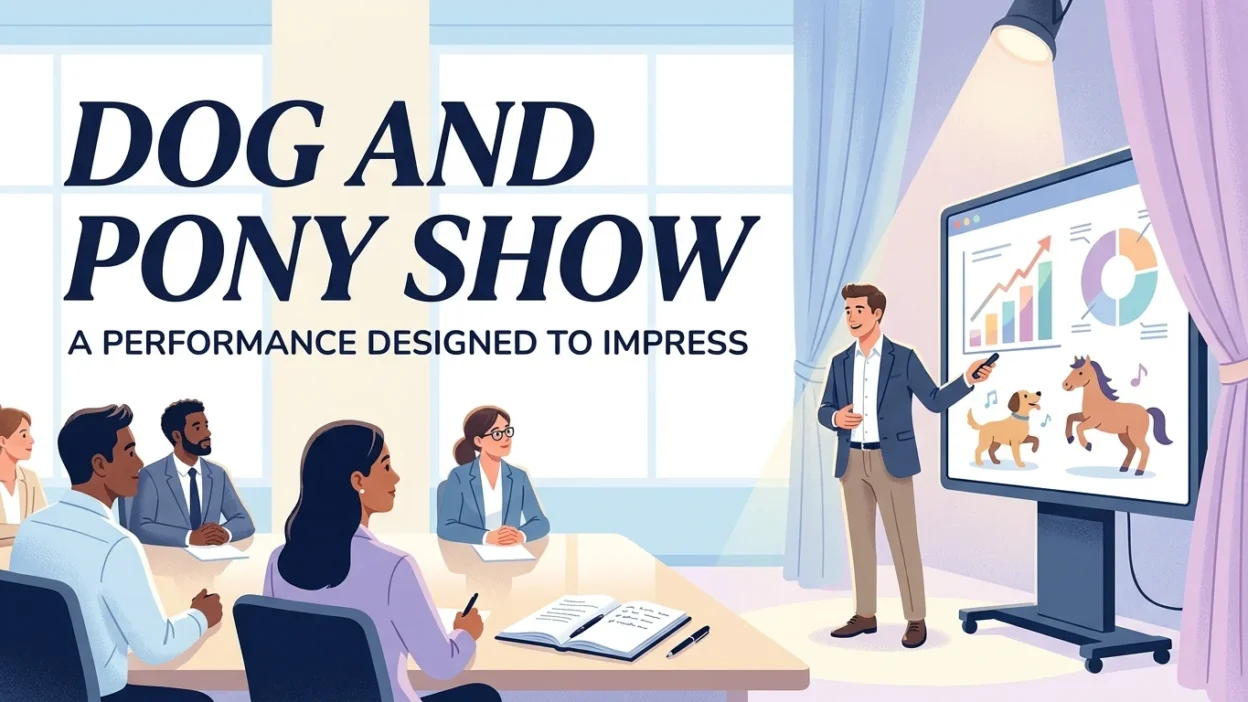
Have you ever attended a business presentation that looked impressive but offered very little real value? Or watched someone make a big display to attract attention instead of focusing on what truly matters? In English, the phrase dog and pony show describes exactly this kind of situation. It is a colorful idiom that often appears in business meetings, politics, marketing, and everyday conversations.
Understanding the meaning of dog and pony show can help you recognize when someone is putting on a performance to impress an audience. Although the expression can describe an entertaining or elaborate presentation, it often carries a negative tone, suggesting that the display is more about appearances than substance. In this guide, you will learn its meaning, origin, practical examples, synonyms, and common usage mistakes.
Quick Answer: What Does Dog and Pony Show Mean?
A dog and pony show is an elaborate presentation, performance, or display designed to attract attention, impress an audience, or persuade people. The expression often implies that the event is flashy, overly theatrical, or intended to distract people from a lack of meaningful substance.
For example:
- The company organized a dog and pony show to impress potential investors.
- The politician’s speech felt like a dog and pony show rather than a serious discussion.
- We do not need another dog and pony show; we need practical solutions.
Simple meaning: A dog and pony show is a performance designed to impress people, sometimes without offering much real value.
What Is the Meaning of Dog and Pony Show?
The idiom dog and pony show is an informal expression used when a presentation or event seems designed primarily to create an impression. It can refer to a business demonstration, a political event, a sales pitch, or any elaborate display meant to win approval.
The phrase is often critical, but its exact meaning depends on context. Sometimes it simply describes an elaborate promotional presentation. In other situations, it suggests that the presentation is superficial, exaggerated, or misleading.
Dog and Pony Show in Simple English
In simple terms, a dog and pony show means making a big performance to impress people.
Imagine that a company invites potential clients to a meeting. Instead of discussing the product’s actual performance, the company uses flashy slides, dramatic videos, and rehearsed speeches. If the presentation focuses more on appearance than useful information, someone might call it a dog and pony show.
Examples:
- The meeting was just a dog and pony show.
- They put on a dog and pony show to win the client’s approval.
- The team wanted honest answers, not another dog and pony show.
Is Dog and Pony Show a Positive or Negative Phrase?
The phrase is usually negative or skeptical, particularly in business and political contexts.
It can suggest that someone is trying too hard to impress an audience or hide weaknesses behind an attractive presentation. However, it does not automatically mean that an event is dishonest. The speaker may simply believe that the event emphasizes showmanship more than substance.
For example:
- Positive or neutral context: The organizers prepared an elaborate dog and pony show for the product launch.
- Negative context: The product launch was a dog and pony show that concealed the product’s limitations.
The second sentence clearly criticizes the presentation.
Origin of the Phrase Dog and Pony Show
The expression is associated with traveling entertainment shows in which trained dogs, ponies, and other performers entertained audiences. Such shows were designed to attract spectators with lively demonstrations and engaging performances.
Over time, dog and pony show developed a figurative meaning. Instead of referring to an actual entertainment performance, it came to describe an elaborate display intended to attract attention or impress people.
The expression became especially familiar in American business and political language, where it is often used to criticize presentations that appear more concerned with appearances than substance.
Today, the phrase is commonly used in workplaces, boardrooms, sales presentations, political discussions, and other situations where people feel that a performance is being staged to win approval.
Examples of Dog and Pony Show in Sentences
The best way to understand this idiom is to see how people use it in different situations.
1. Business and Corporate Meetings
In business, a dog and pony show often describes a highly polished presentation designed to impress executives, investors, or clients.
Examples:
- The executives organized a dog and pony show to convince investors that the company was growing.
- The presentation included impressive graphics, but the financial results were disappointing.
- We spent three hours preparing for the client’s visit, and the whole meeting felt like a dog and pony show.
- The management team wanted evidence of progress, not another dog and pony show.
2. Politics and Public Relations
In politics, the expression can criticize an event that appears designed to improve someone’s public image rather than address an important issue.
Examples:
- Critics called the press conference a dog and pony show.
- The candidate’s televised event looked more like a dog and pony show than a serious policy discussion.
- Voters wanted concrete answers instead of another political dog and pony show.
3. Sales and Marketing
Sales teams sometimes organize elaborate product demonstrations to persuade potential customers to buy something.
Examples:
- The sales team put on a dog and pony show for the prospective client.
- The product demonstration was a dog and pony show, with plenty of excitement but few useful details.
- Instead of another dog and pony show, the customer wanted a straightforward explanation of the product’s benefits.
4. Everyday Life
The phrase is not limited to professional environments. It can also describe social events, school presentations, or personal situations.
Examples:
- The family reunion became a dog and pony show for relatives who wanted to impress one another.
- His apology felt like a dog and pony show because he never accepted responsibility.
- The school ceremony was a dog and pony show designed to impress visiting officials.
In each example, the expression suggests that the event involves a performance intended to influence how others see someone or something.
Dog and Pony Show: Synonyms and Similar Expressions
Several English expressions convey a similar idea, but their meanings and tones are not always identical.
| Expression | Meaning | Example |
| Showmanship | Skill at attracting or entertaining an audience | His presentation relied on showmanship. |
| Publicity stunt | An action designed to attract media attention | The announcement looked like a publicity stunt. |
| Smoke and mirrors | Tricks or misleading appearances that conceal the truth | The proposal was full of smoke and mirrors. |
| Grandstanding | Acting dramatically to attract attention or approval | The speech was little more than grandstanding. |
| Window dressing | Superficial changes intended to make something look better | The new policy seemed like window dressing. |
| Promotional spectacle | An elaborate event intended to generate interest | The launch became a promotional spectacle. |
| Empty show | A display without meaningful substance | The meeting was an empty show. |
Which synonym should you choose?
- Use publicity stunt when media attention is the main objective.
- Use smoke and mirrors when something appears deceptive or misleading.
- Use grandstanding when someone is acting to attract attention or approval.
- Use window dressing when superficial improvements hide deeper problems.
- Use dog and pony show when an elaborate presentation seems designed mainly to impress an audience.
Dog and Pony Show vs. Similar Phrases
Although these expressions overlap, they are not interchangeable in every situation.
| Phrase | Main emphasis | Typical tone |
| Dog and pony show | An elaborate presentation designed to impress | Often skeptical |
| Publicity stunt | Attracting media or public attention | Usually critical |
| Smoke and mirrors | Concealing the truth through misleading appearances | Strongly critical |
| Grandstanding | Seeking attention or approval through dramatic behavior | Critical |
| Sales pitch | Persuading someone to buy a product or service | Neutral |
| Presentation | Explaining or demonstrating information | Neutral |
A sales pitch is not necessarily a dog and pony show. A clear, informative sales presentation can offer real value. The idiom becomes appropriate when the speaker believes that the display is overly theatrical or more concerned with appearances than useful information.
Common Mistakes When Using Dog and Pony Show
Even native English speakers can misunderstand idioms or use them in situations where their meaning does not quite fit.
1. Taking the Phrase Literally
A dog and pony show does not usually involve actual dogs or ponies.
Incorrect interpretation: The manager mentioned a dog and pony show, so animals must be part of the event.
Correct interpretation: The manager was referring to an elaborate presentation intended to impress an audience.
The expression is figurative in most modern contexts.
2. Assuming Every Presentation Is a Dog and Pony Show
A presentation is not automatically a dog and pony show just because it includes attractive slides, demonstrations, or entertainment.
The phrase is most appropriate when you want to suggest that the performance emphasizes appearances over substance.
For example:
- Neutral: The team presented its quarterly results.
- Critical: The team put on a dog and pony show without explaining the disappointing results.
3. Using the Phrase in Highly Formal Writing Without Context
The expression is informal and often carries a critical tone. In a formal report, it may sound judgmental unless the surrounding discussion supports that assessment.
Instead of writing, “The review was a dog and pony show,” you could write, “The review emphasized presentation over substantive evaluation.”
Choose the wording that fits your audience and purpose.
4. Confusing It With a Publicity Stunt
A publicity stunt is primarily intended to attract attention or generate publicity. A dog and pony show more specifically suggests an elaborate presentation or display designed to impress an audience.
A single event can be both, but the expressions emphasize different aspects.
5. Writing the Phrase Incorrectly
The standard expression is dog and pony show, with and between the two animal names.
In ordinary writing, do not hyphenate the entire phrase unnecessarily. For example:
- Correct: The presentation was a dog and pony show.
- Correct: They organized a dog-and-pony-show-style event.
The second example uses hyphens to connect the phrase as a compound modifier before event. In most everyday sentences, however, the standard unhyphenated expression is sufficient.
American English vs British English
Dog and pony show is particularly associated with American English. It is also understood in British English, especially in business, political, and media contexts, but it may sound more distinctly American to some British speakers.
Examples:
- American English: The executives put on a dog and pony show for investors.
- British English: The executives put on a dog and pony show for investors.
There is no standard spelling difference between American and British English for this idiom. The main difference is familiarity and frequency of use.
If you are writing for a British audience, alternatives such as publicity stunt, showy presentation, or elaborate display may sometimes sound more natural, depending on the intended meaning.
FAQs
1. What does dog and pony show mean in simple terms?
It means an elaborate performance or presentation designed to impress people. The phrase often suggests that the display is more about appearances than meaningful results.
2. Is dog and pony show an idiom?
Yes. It is an idiomatic expression because its figurative meaning differs from the literal meaning of the individual words.
3. Is dog and pony show negative?
Usually, yes. It often expresses skepticism or criticism about a presentation that seems superficial. However, the phrase can sometimes describe an elaborate promotional event without implying outright dishonesty.
4. How do you use dog and pony show in a sentence?
You can use it as a noun phrase. For example: “The company organized a dog and pony show to impress potential investors.”
5. Where did the phrase dog and pony show originate?
The expression is associated with traveling entertainment shows featuring trained dogs and ponies. Its figurative meaning later developed to describe elaborate displays intended to impress an audience.
6. Is dog and pony show used in British English?
Yes. British English speakers understand the phrase, although it is particularly associated with American English. Other expressions may be preferred depending on the context.
7. What is another word for dog and pony show?
Possible alternatives include publicity stunt, grandstanding, promotional spectacle, showmanship, and window dressing. The best choice depends on whether you mean an elaborate presentation, attention-seeking behavior, or misleading appearances.
8. Can a business presentation be called a dog and pony show?
Yes. The expression is common in business contexts, particularly when a presentation seems designed to impress executives, clients, or investors without providing enough meaningful information.
Summary: Dog and Pony Show
The idiom dog and pony show describes an elaborate presentation, performance, or display designed to attract attention or impress an audience. It frequently appears in business, politics, marketing, and everyday conversations. Although it can refer to a promotional event, it often carries a critical tone, suggesting that the presentation focuses on appearances rather than substance. Understanding this nuance will help you recognize the expression and use it naturally.
When using the phrase, consider your audience and the message you want to communicate. It works well in informal discussions and commentary, especially when criticizing a presentation that seems overly theatrical. In formal writing, a more precise expression such as superficial presentation or publicity stunt may communicate your point more clearly.
Actionable takeaway: Remember that a dog and pony show is not simply an impressive presentation. It is a display that seems designed mainly to impress people, often at the expense of substance.