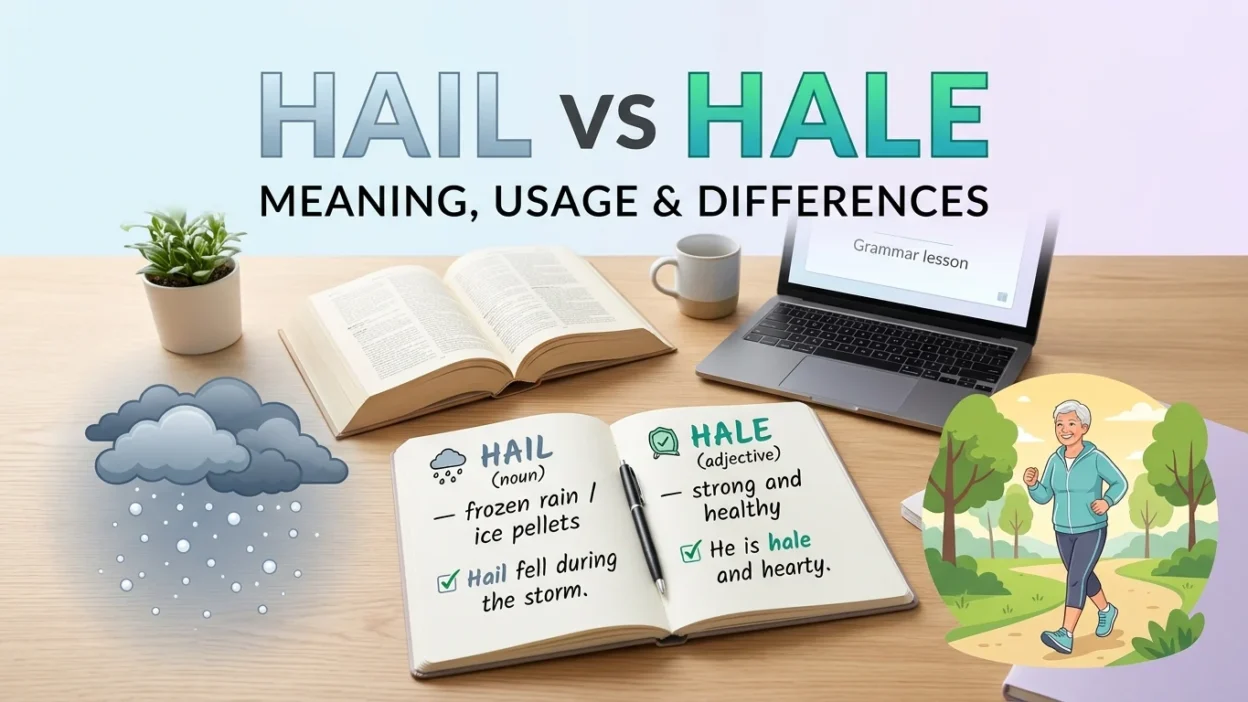
Have you ever wondered whether to write hail or hale? These two English words sound exactly alike, but their meanings, spellings, and uses are quite different. Choosing the correct word can make your writing clearer and help you avoid common spelling mistakes.
The difference between hail vs hale is easier to understand than you might think. Hail commonly refers to frozen balls of ice that fall from the sky, a greeting or public recognition, or the act of coming from a particular place. Hale, on the other hand, is an adjective meaning healthy and strong, especially when describing an older person. Learning a few simple examples will help you remember which word belongs in each sentence.
Quick Answer: Hail vs Hale
Hail and hale are homophones, meaning they have the same pronunciation but different meanings and spellings.
- Hail: Frozen precipitation, a greeting, enthusiastic praise, or a verb meaning to call out to someone or describe someone’s origin.
- Hale: An adjective meaning healthy, vigorous, and physically strong, often despite advanced age.
Examples:
- The storm brought heavy hail that damaged several cars.
- At 85, my grandfather is still hale and active.
- The crowd began to hail the athlete as a hero.
Easy memory trick: Think of hail as the word for weather or calling out, and hale as a word for health.
What Does Hail Mean?
The word hail has several meanings in English. It can function as a noun or a verb, depending on the context. Understanding these different uses is essential for choosing the right spelling.
1. Hail as a Type of Weather
As a noun, hail refers to small balls or irregular lumps of ice that form in thunderstorms and fall from clouds. Hailstones can range from tiny pellets to large pieces capable of damaging vehicles, crops, roofs, and windows.
Examples:
- The sudden hail damaged the flowers in our garden.
- Heavy hail fell during the afternoon thunderstorm.
- Farmers worried that the hail would destroy their crops.
- We moved the car into the garage to protect it from hail.
In weather reports, hailstorm, hailstones, and hail damage are related terms you may encounter.
2. Hail as a Greeting or Call
As a verb, hail can mean to greet someone, call out to them, or attract their attention. It is sometimes used in formal, literary, or dramatic language.
Examples:
- The travelers hailed the villagers from across the road.
- She hailed her friend as they passed each other.
- The captain hailed the approaching ship.
The expression hail a taxi is another familiar example. It means to signal a taxi to stop so you can get in.
3. Hail as Praise or Recognition
The verb hail can also mean to praise or recognize someone or something enthusiastically. It frequently appears in news reports, reviews, and formal writing.
Examples:
- Critics hailed the film as a masterpiece.
- The community hailed the volunteers as heroes.
- Experts hailed the discovery as a major scientific breakthrough.
In these sentences, hail expresses admiration, approval, or public recognition.
4. Hail as an Expression of Origin
The phrase hail from means to come from a particular place, background, or origin. It is common in biographies, introductions, journalism, and everyday conversation.
Examples:
- She hails from a small town in Scotland.
- The talented musician hails from Pakistan.
- Many of the players hail from different countries.
Remember that hail from is an established expression. You should not replace hail with hale in this phrase.
What Does Hale Mean?
Hale is an adjective that means healthy, strong, and physically vigorous. It is particularly associated with older people who remain active and enjoy good health despite their age.
Although hale is a correct English word, it is less common in everyday conversation than words such as healthy, fit, and robust. You are more likely to encounter it in descriptive writing, biographies, literature, or expressions such as hale and hearty.
1. Hale as a Description of Good Health
When someone is described as hale, it suggests that the person is in good physical condition and has plenty of strength or vitality.
Examples:
- My grandfather is still hale and enjoys walking every morning.
- The people older than farmer remained hale despite his demanding lifestyle.
- She was surprised to find her former teacher hale and energetic.
- At ninety, he appeared hale, cheerful, and independent.
Notice that hale describes a person’s condition. It does not refer to weather, frozen precipitation, or the act of calling someone.
2. The Expression “Hale and Hearty”
One of the most familiar uses of hale is in the expression hale and hearty, which means healthy, strong, and full of energy.
Examples:
- Our grandmother is hale and hearty at the age of eighty.
- He retired from teaching while still hale and hearty.
- The old sailor remained hale and hearty throughout his retirement.
This phrase is especially useful when describing someone who has maintained good health into old age.
3. Hale in Formal and Descriptive Writing
Because hale sounds somewhat traditional, it can give a sentence a literary or descriptive quality. In casual conversation, people often choose healthy or strong instead.
Compare these examples:
- Traditional: The hale old gentleman walked through the village.
- Everyday: The healthy older man walked through the village.
Both sentences communicate good physical health, but the first has a more traditional tone.
Hail vs Hale: Key Differences
The main difference between hail and hale is their meaning. Their pronunciation is identical in standard English, but their grammatical roles and contexts can differ.
| Feature | Hail | Hale |
| Part of speech | Noun or verb | Adjective |
| Main meaning | Ice precipitation, greeting, praise, or origin | Healthy and strong |
| Pronunciation | /heɪl/ | /heɪl/ |
| Common expression | Hail a taxi; hail from | Hale and hearty |
| Example | Hail fell during the storm. | He is hale at 85. |
| Memory clue | Weather, calling, or recognition | Health and strength |
The easiest way to distinguish them is to look at the meaning of the entire sentence. If you are discussing a storm, greeting someone, praising a person, or describing someone’s origin, hail is generally the correct choice. If you are describing someone’s good health and physical strength, use hale.
Hail vs Hale: Example Sentences
Seeing the two words in context makes their differences easier to remember. Here are additional examples for everyday writing, schoolwork, and professional communication.
Examples Using Hail
- The hail covered the garden in a thin layer of ice.
- We heard hail striking the roof during the night.
- She tried to hail a passing taxi.
- Newspapers hailed the young scientist as a genius.
- The celebrated chef hails from a coastal town.
- The sailors hailed the ship approaching the harbor.
- The storm produced hailstones large enough to damage the windows.
- The new policy was hailed as a positive change.
Examples Using Hale
- My great-grandfather remains hale and active at 92.
- The doctor described the elderly man as surprisingly hale.
- She looked hale and hearty after her long holiday.
- The hale farmer continued working in his fields.
- Despite his age, he appeared hale and full of energy.
- Everyone admired the hale gentleman who walked several miles daily.
- The writer portrayed the village elder as a hale, cheerful man.
- Her grandfather was hale enough to enjoy his daily gardening routine.
Hail vs Hale in Short Conversations
Conversation 1: Weather
- A: What happened to the garden?
- B: A hailstorm damaged several plants.
Conversation 2: Health
- A: How is your grandfather doing?
- B: He is still hale and hearty.
Conversation 3: Recognition
- A: What did people think of the new invention?
- B: They hailed it as a remarkable achievement.
These examples show that context—not pronunciation—is the key to selecting the correct word.
Common Mistakes When Using Hail and Hale
Even confident English speakers sometimes confuse homophones. Because hail and hale sound identical, it is easy to select the wrong spelling when writing quickly. The following mistakes are worth avoiding.
Mistake 1: Using Hale for Ice From a Storm
Incorrect: Heavy hale damaged the roof.
Correct: Heavy hail damaged the roof.
Why? Hail is the noun for frozen precipitation. Hale describes someone who is healthy and strong.
Mistake 2: Using Hail to Describe an Older Person’s Health
Incorrect: My grandfather is still hail and hearty.
Correct: My grandfather is still hale and hearty.
Why? Hale and hearty is the established expression for someone who remains healthy and vigorous.
Mistake 3: Confusing Hail From With Hale From
Incorrect: She hales from a small village.
Correct: She hails from a small village.
Why? Hail from means to originate from a particular place. The adjective hale cannot replace the verb in this expression.
Mistake 4: Assuming Both Words Are Interchangeable
Incorrect: The crowd haled the winner as a hero.
Correct: The crowd hailed the winner as a hero.
Why? Hailed is the past tense of hail, meaning praised or recognized. Hale does not have that meaning.
Mistake 5: Choosing a Spelling Based Only on Sound
Since both words are pronounced /heɪl/, listening to a sentence will not tell you which spelling is correct. You must understand the intended meaning.
Helpful proofreading tip: When you encounter hail or hale, ask yourself whether the sentence concerns weather, calling, praise, or origin—or whether it describes physical health. This simple check will resolve most spelling doubts.
American vs British English: Is There a Difference?
There is no significant difference in the meanings or standard spellings of hail and hale between American and British English. Both varieties use the words in the same general ways.
| Usage | American English | British English |
| Frozen precipitation | Hail | Hail |
| To praise someone | Hail | Hail |
| To originate from somewhere | Hail from | Hail from |
| Healthy and strong | Hale | Hale |
| Traditional expression | Hale and hearty | Hale and hearty |
For example, an American writer might say, “The crowd hailed the singer as a legend,” while a British writer could use precisely the same sentence.
Similarly, both varieties accept “My grandfather is hale and hearty.” Although hale is relatively uncommon in casual speech on both sides of the Atlantic, it remains a valid English adjective.
The key point is that this is not an American-versus-British spelling issue. The correct choice depends on the meaning you want to communicate.
Synonyms and Related Words
Understanding synonyms can help you expand your vocabulary and choose more natural wording.
Synonyms for Hail
The appropriate synonym depends on which meaning of hail you intend.
| Meaning of hail | Synonyms or related expressions |
| Frozen precipitation | Hailstones, ice pellets |
| To greet | Welcome, salute, greet |
| To praise | Applaud, acclaim, celebrate |
| To call someone | Summon, signal, call out |
| To originate from | Come from, originate in, be from |
These alternatives are not interchangeable in every sentence. For example, applaud can replace hail when expressing approval, but it cannot replace hail when describing ice falling from a cloud.
Synonyms for Hale
Because hale describes physical health and strength, its closest alternatives include:
- Healthy: In good physical condition.
- Robust: Strong and vigorous.
- Fit: Physically healthy and capable.
- Vigorous: Full of energy and strength.
- Hearty: Healthy and energetic, depending on context.
- Sturdy: Strongly built or physically solid.
For example, “The hale gentleman enjoyed a morning walk” could become “The healthy gentleman enjoyed a morning walk.”
However, hale and hearty is a familiar expression, so replacing either word may change the traditional tone of the phrase.
FAQs
1. Is it hail or hale?
Both are correct English words, but they have different meanings. Hail refers to frozen precipitation and can also mean to greet, praise, call out to someone, or describe someone’s origin. Hale means healthy and strong, particularly when describing an older person.
2. What is the difference between hail and hale?
The primary difference is their meaning and grammatical function. Hail can be a noun or a verb, while hale is an adjective. Both are pronounced /heɪl/, so context determines which spelling you should use.
3. Is “hale and hearty” or “hail and hearty” correct?
“Hale and hearty” is correct. It describes someone who is healthy, strong, and energetic. For example, “Despite turning 90, she remains hale and hearty.” The spelling hail and hearty is incorrect in this expression.
4. What does “hail from” mean?
The expression hail from means to come from or originate in a particular place. For example, “The author hails from London.” In this context, hail is a verb, and hale from is incorrect.
5. Is hail a noun or a verb?
Hail can be both a noun and a verb. As a noun, it refers to balls of ice that fall during certain storms. As a verb, it can mean to greet someone, signal for attention, praise someone, or originate from a place.
6. Can hale be used to describe young peopleYes. Hale can describe a healthy, strong person of any age, although it is particularly associated with older adults. For younger people, words such as healthy, fit, and energetic are often more natural in everyday conversation.
7. Are hail and hale homophones?
Yes. Hail and hale are homophones because they have the same pronunciation but different spellings and meanings. Other familiar homophones include sale and sail, as well as brake and break.
8. Does hail vs hale have different spellings in American and British English?
No. Both American and British English use hail for frozen precipitation and the verb meanings, while hale describes good health and physical strength. There is no standard regional spelling difference between these words.
Summary: Hail vs Hale
The difference between hail vs hale becomes simple once you understand their meanings. Hail refers to frozen precipitation and can also mean to greet, call out to someone, praise someone, or indicate where someone comes from. Hale is an adjective meaning healthy, strong, and vigorous. Both words sound alike, but they are not interchangeable. Whether you are writing a school assignment, a blog post, a professional email, or a casual message, choosing the correct spelling helps you communicate clearly.
The best way to remember these words is to associate hail with a hailstorm or the expression hail a hero, and hale with the phrase hale and hearty. When you are unsure, examine the sentence’s meaning instead of relying on pronunciation alone. With a little practice, you can confidently distinguish these homophones and avoid common spelling errors.
Actionable takeaway: Remember this simple rule: Hail for weather, greetings, praise, and origin; hale for health and strength.