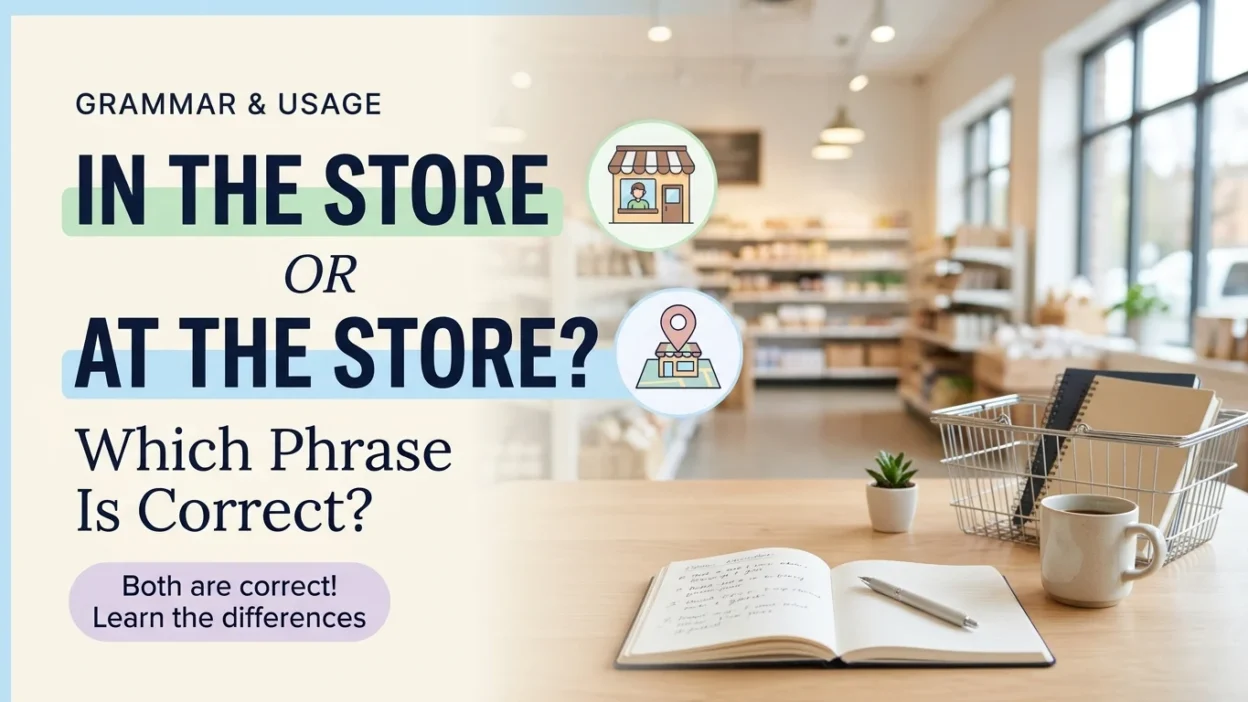
Have you ever wondered whether to say “in the store” or “at the store”? Both phrases are grammatically correct, but they can express slightly different ideas depending on the situation. If you are talking about shopping, describing someone’s location, or writing a sentence in English, choosing the right preposition can make your meaning clearer and more natural.
The good news is that you do not need to memorize complicated grammar rules to understand the difference. Once you know how English speakers use in and at when referring to a store, you can choose the right expression with confidence. Let’s explore their meanings, practical examples, common mistakes, and differences between American and British English.
Quick Answer: In the Store or at the Store?
Both “in the store” and “at the store” are correct English expressions. The best choice depends on what you want to emphasize.
- In the store: Emphasizes being inside the store’s physical space.
- At the store: Emphasizes being at the store as a location, whether or not the person’s exact position inside it matters.
For example:
- “She is in the store looking for a new jacket.” This emphasizes that she is inside the building.
- “She is at the store right now.” This simply tells you where she is.
In everyday conversation, these phrases sometimes overlap. If someone says, “I’m at the store,” you can reasonably understand that they are probably shopping or inside the building. The difference is one of emphasis, not a strict rule that makes one phrase correct and the other incorrect.
What Does “In the Store” Mean?
The phrase “in the store” uses the preposition “in” to describe a person or object within a physical space. It often highlights the interior of a shop, supermarket, department store, or other retail building.
Use “in the store” when you want to explain that someone is inside, something is available within the shop, or an activity is happening inside the premises.
Examples of “In the Store”
1. “I left my umbrella in the store.” The umbrella was left inside the shop.
2. “There are several customers in the store.” The sentence describes people inside the building.
3. “You can find fresh vegetables in the store.” The products are available inside the shop.
4. “He is in the store trying on a pair of shoes.” The sentence emphasizes his physical location indoors.
5. “It was very crowded in the store this morning.” The focus is on the conditions inside the shop.
When Should You Use “In the Store”?
Choose this phrase when the physical interior is important to your message.
For instance, if you are explaining where you found your missing wallet, you might say, “I found it in the store near the checkout counter.” The word “in” makes it clear that the wallet was inside the premises.
Similarly, a store employee might say, “We have more products in the store room,” although “stockroom” is often the more natural term for an area where merchandise is stored.
Remember that “in the store” is not limited to shopping activities. It can describe people, products, objects, events, and conditions inside a retail space.
What Does “At the Store” Mean?
The phrase “at the store” uses “at” to identify a location or destination. It tells the listener where someone is or where an activity is taking place without necessarily emphasizing whether the person is physically inside the building.
This expression is especially common in everyday American English. People use it when talking about errands, shopping plans, meeting someone, or explaining why they are unavailable.
Examples of “At the Store”
1. “My father is at the store buying groceries.” The sentence identifies his current location and activity.
2. “I’ll meet you at the store at five.” The store is the meeting location.
3. “She is at the store right now, so she cannot answer the phone.” The phrase explains where she is.
4. “We stopped at the store on our way home.” The store was one of the places visited during the journey.
5. “Are you still at the store, or have you left?” The speaker asks whether the person remains at that location.
When Should You Use “At the Store”?
Use “at the store” when the important information is someone’s location, a destination, or an errand rather than their exact position inside the building.
For example, if your friend asks where you are, you can simply reply, “I’m at the store.” You do not need to explain whether you are in an aisle, near the entrance, or standing at the checkout.
This phrase is also useful when making plans. “Let’s meet at the store” identifies the meeting place without specifying precisely where inside it you will meet.
In the Store vs. At the Store: Key Differences
Although both phrases can describe the same situation, they place emphasis on different aspects of location.
| Feature | In the store | At the store |
| Main emphasis | Inside the physical space | General location or destination |
| Common purpose | Describing what is happening indoors | Explaining where someone is |
| Example | The children are in the store. | The children are at the store. |
| Shopping context | Focuses on being inside | Focuses on the shopping stop or location |
| Meeting someone | Can mean meeting inside | Commonly identifies the meeting place |
| Grammatical correctness | Correct | Correct |
Consider these two sentences:
- “I am in the store looking for milk.”
- “I am at the store buying milk.”
Both sentences sound natural. The first emphasizes your presence inside the building, while the second emphasizes your location and shopping errand.
However, these distinctions are not absolute. A person can use “at the store” while clearly being inside, and “in the store” can describe a broader shopping situation. Context determines which expression sounds most appropriate.
Can You Use “In the Store” and “At the Store” Interchangeably?
Yes, in many everyday situations, you can use these expressions interchangeably without causing confusion. However, they are not identical in every context.
Imagine that your friend asks, “Where is Sarah?”
You could answer:
- “She is at the store.”
- “She is in the store.”
Both answers are understandable. The first gives her general location, while the second more directly suggests that she is inside the building.
Now consider a different situation. You are describing a security camera that records activity inside a shop. You might say, “The camera captured everything that happened in the store.” Here, “in the store” is more suitable because the focus is on activity within the building.
On the other hand, if you are arranging a meeting, “I’ll see you at the store” is a natural choice because you are identifying the meeting location.
The practical rule: Use “in” to emphasize the interior and “at” to emphasize the location. If both descriptions fit your situation, either may work.
Common Mistakes When Using “In the Store” or “At the Store”
English learners sometimes struggle with prepositions because the same place can be described in different ways. Understanding a few common errors can help you avoid awkward sentences.
1. Thinking Only One Phrase Is Correct
Incorrect assumption: “I am at the store” is correct, but “I am in the store” is wrong.
Correction: Both expressions are grammatically correct. Choose the one that best matches your intended meaning.
- Correct: “I am in the store looking for a gift.”
- Correct: “I am at the store picking up a few things.”
2. Using “In” When the Location Is Outside
Suppose you are waiting outside a shop for your friend. Saying “I’m in the store” may mislead the listener because it suggests that you are inside.
A clearer sentence would be:
- “I’m outside the store waiting for you.”
- “I’m at the store entrance.”
The right preposition depends on your actual position and the information you want to communicate.
3. Confusing “At the Store” With “To the Store”
These phrases serve different grammatical purposes.
- “I am at the store.” — You are at that location.
- “I am going to the store.” — You are traveling toward that destination.
A common mistake is saying, “I am going at the store.” In standard English, say, “I am going to the store.”
4. Forgetting the Article “The”
When referring to a particular store that the speaker and listener can identify, use the appropriate article.
- Correct: “She is at the store.”
- Correct: “He is in the store.”
- Usually incorrect for a specific, identified store: “She is at store.”
However, English sometimes omits articles in particular expressions, such as “at school” or “at work.” These established patterns do not mean that “at store” is normally appropriate in standard English.
5. Assuming “At” Always Means Outside
Another misconception is that “at the store” describes someone standing outside the building.
That is not true. A person can be inside, near the entrance, or elsewhere on the premises and still naturally say, “I’m at the store.” The phrase identifies the general location rather than specifying an exact physical position.
American English vs. British English: Is There a Difference?
Both “in the store” and “at the store” are used in American and British English. The underlying grammatical distinction between the prepositions remains broadly the same.
The main difference is often vocabulary rather than preposition choice.
| American English | British English | Example |
| Store | Shop | I’m at the store/shop. |
| Grocery store | Supermarket or grocery shop | I’m at the supermarket. |
| Shopping cart | Shopping trolley | The trolley is in the shop. |
| Parking lot | Car park | The car park is outside the store. |
In the United States, “I’m at the store” is a very common way to explain that someone is running errands or shopping. In the United Kingdom, speakers also use “I’m at the shop,” “I’m in the shop,” and “I’m at the supermarket,” depending on context and personal preference.
British English speakers do use the word “store,” particularly in contexts such as department stores, large retail establishments, and storage facilities. Likewise, American speakers use “shop” in expressions such as “coffee shop” and “workshop.”
There is no rule that assigns “in the store” exclusively to American English or “at the store” exclusively to British English. Both are standard in both varieties.
More Examples of “In the Store” and “At the Store”
The best way to master English prepositions is to see how they work in real conversations. Here are additional examples from everyday life.
Everyday Shopping Situations
- “I saw my neighbor in the store yesterday.” — Emphasizes encountering the neighbor inside.
- “My sister is at the store getting some snacks.” — Emphasizes her location and errand.
- “The manager is in the store talking to a customer.” — Highlights an activity inside.
- “We need to stop at the store before going home.” — Identifies a planned destination.
- “There are too many people in the store today.” — Describes the conditions inside.
- “I’ll wait for you at the store.” — Identifies the meeting location.
Examples in Questions and Negative Sentences
These phrases also work naturally in questions and negative statements.
- “Are you in the store or outside?”
- “Is your brother at the store right now?”
- “I am not at the store; I’m still at home.”
- “She isn’t in the store anymore.”
- “Why are there so many people in the store?”
- “Will you be at the store this afternoon?”
Notice that the prepositions do not change when you form a question or negative sentence. You simply adjust the sentence structure to express your meaning.
A Simple Trick to Remember the Difference
If you often confuse “in the store” and “at the store,” try this simple memory trick:
- IN = Inside: Think about the interior of the building.
- AT = Address or area: Think about the store as a location or destination.
For example, if you want to describe where you found a product, say, “I found it in the store.” If you want to tell a friend where you are, say, “I’m at the store.”
This is a useful guideline, not an inflexible grammar rule. Both expressions can describe the same person at the same time, and the surrounding sentence helps determine which sounds most natural.
FAQs
1. Is it “in the store” or “at the store”?
Both are correct. “In the store” emphasizes being inside the building, while “at the store” emphasizes the general location or destination. Choose the expression that best fits your context.
2. Is “I’m at the store” grammatically correct?
Yes. “I’m at the store” is a natural and grammatically correct sentence. It tells someone where you are without specifying your exact position inside or around the building.
3. Does “in the store” mean you are shopping?
Not necessarily. It means you are inside the store. You might be shopping, working, meeting someone, or simply waiting. The sentence’s context explains what you are doing.
4. Can I say “I am in the store right now”?
Yes. This is completely correct. It emphasizes that you are physically inside the store at the present moment.
5. Is “at the store” more common in American English?
“At the store” is very common in American English, especially when discussing errands or shopping. However, “in the store” is also widely used, and both expressions are standard in British English.
6. Should I say “going to the store” or “going at the store”?
Say “going to the store.” The preposition “to” indicates movement toward a destination. “Going at the store” is not the standard expression for traveling there.
7. Can “at the store” mean someone is outside?
Yes, depending on the context. It can refer to someone outside the entrance, inside the building, or elsewhere at the location. If the person’s exact position matters, use a more specific phrase, such as “outside the store” or “inside the store.”
8. Is “in-store” the same as “in the store”?
Not exactly. “In the store” is a regular prepositional phrase, as in “I am in the store.” “In-store” is often used as an adjective or adverb, particularly in retail contexts, such as “in-store pickup” or “in-store promotions.”
Summary: In the Store or at the Store?
The difference between “in the store” and “at the store” is mainly about emphasis. “In the store” highlights the interior of a shop or building, while “at the store” identifies a general location or destination. Both expressions are grammatically correct, widely used, and appropriate in American and British English. In everyday conversation, their meanings often overlap, so you should consider the context instead of trying to memorize an absolute rule.
As an actionable takeaway, remember “in = inside” and “at = location.” Say “I left my bag in the store” when you want to emphasize where the bag was left, and “I’m at the store” when you simply want to tell someone where you are. Practise using both expressions in your own sentences, and you will become more confident with English prepositions and everyday communication.