Have you ever wondered whether to write trawling or trolling? These two words look and sound similar, so it is easy to confuse them when writing an article, sending a message, or discussing fishing and online behavior. However, despite their similar spelling, they have different meanings and are used in very different situations.
The main difference is that trawling usually refers to fishing with a large net or searching through information systematically, while trolling often means deliberately provoking people online or fishing with a baited line. Understanding the context helps you choose the right word. Whether you are writing about commercial fishing, internet culture, research, or everyday communication, this guide will help you use trawling and trolling correctly.
Quick Answer: Trawling vs Trolling
Trawling and trolling are both correct words, but they have different meanings.
- Trawling: Fishing by dragging a net through water; it can also mean searching through a large amount of information.
- Trolling: Deliberately provoking or annoying people, especially online; it can also describe a fishing method that uses a moving baited line.
Examples:
- The fishing boat was trawling for shrimp.
- I spent an hour trawling through old records.
- Someone was trolling people in the comment section.
- They went trolling for salmon in the lake.
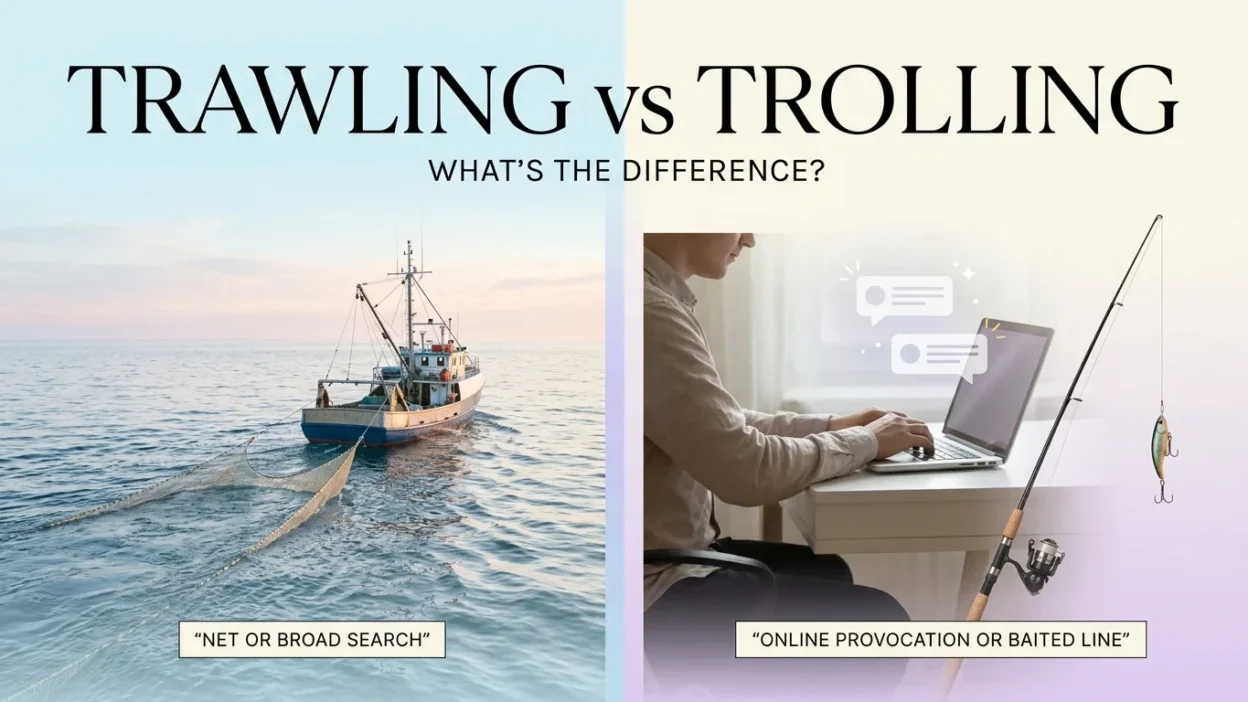
Easy way to remember: Trawling often involves a net or a broad search. Trolling often involves provoking people or pulling bait through the water.
What Does Trawling Mean?
Trawling is the present participle or gerund form of the verb trawl. Its most common meaning is a fishing method in which a net, called a trawl, is pulled through the water to catch fish or other marine animals.
Trawling is widely associated with commercial fishing, where boats use nets to collect large quantities of seafood. Depending on the equipment and method, trawling may take place near the seabed or in open water.
The word also has a figurative meaning. When someone is trawling through information, documents, websites, or records, they are searching through a large amount of material to find something useful.
Examples of Trawling in Sentences
- The fishermen spent the morning trawling for cod.
- The vessel was trawling along the coast.
- Researchers were trawling through historical documents for evidence.
- I spent hours trawling the internet for reliable sources.
- The journalist was trawling through public records.
- The company is trawling through applications to find suitable candidates.
In the last four examples, trawling does not describe fishing. It describes a thorough search through a large collection of information.
Common Uses of Trawling
1. Commercial fishing
Trawling is a method of catching fish with a net pulled through the water by a moving boat.
Example: The fishing company uses trawling to catch haddock.
2. Online research
The word can describe searching many websites, forums, or databases for specific information.
Example: She was trawling online forums for customer feedback.
3. Reviewing records
It can also refer to looking through a large number of files or documents.
Example: The investigator spent days trawling through financial records.
What Does Trolling Mean?
Trolling has two main meanings. In internet culture, it describes deliberately posting comments or messages intended to provoke, upset, mislead, or anger other people. An individual who does this is called a troll.
Online trolling can take place on social media, discussion forums, gaming platforms, video channels, and other digital spaces. The behavior may involve insulting comments, inflammatory statements, or deliberately disruptive contributions designed to get a reaction.
In fishing, trolling is a separate technique in which a baited line or fishing lure is drawn through the water, usually behind a moving boat.
Examples of Trolling in Sentences
- Someone was trolling the discussion group with insulting comments.
- The account kept trolling other users on social media.
- Please ignore the person who is trolling the conversation.
- We went trolling for trout early in the morning.
- The anglers were trolling lures behind their boat.
- He accused the commenter of trolling just to start an argument.
The context makes the meaning clear. In a discussion about social media, trolling usually refers to provoking others. In a conversation about fishing, it can describe moving bait or a lure through the water.
Common Uses of Trolling
1. Online provocation
Example: The user was trolling people by posting deliberately offensive comments.
2. Fishing with a moving line
Example: They spent the afternoon trolling for lake trout.
3. Deliberately disrupting a discussion
Example: The moderator removed several comments from a person who was trolling the forum.
Not every disagreement or critical comment is trolling. The term usually suggests deliberate provocation or disruptive intent, rather than simply expressing a different opinion.
Trawling vs Trolling: Comparison Table
| Feature | Trawling | Trolling |
| Main meaning | Fishing with a dragged net | Deliberately provoking people online; also a fishing technique |
| Fishing equipment | Usually a trawl net | Usually a baited line or lure |
| Online meaning | Searching widely through information | Provoking or upsetting people online |
| Common context | Commercial fishing, research, records | Social media, internet forums, recreational fishing |
| Example | The crew was trawling for prawns. | The account was trolling other users. |
| Related verb | Trawl | Troll |
| Present participle | Trawling | Trolling |
The key distinction is the activity being described. Trawling is commonly associated with nets and systematic searching, whereas trolling often refers to provoking others or fishing with a moving line.
Trawling vs Trolling in Online Communication
These words are especially easy to confuse when discussing internet activity because both can describe something people do online.
Trawling the Internet
When you are trawling the internet, you are searching through a large amount of online content to find information.
Examples:
- I was trawling the internet for affordable laptops.
- The researcher spent the afternoon trawling online archives.
- She was trawling social media for customer opinions.
The word does not automatically imply anything negative. It simply suggests a broad or thorough search.
Trolling on Social Media
When someone is trolling on social media, they are usually trying to provoke an emotional response or disrupt a discussion.
Examples:
- The commenter was trolling other users for attention.
- He posted an inflammatory message and continued trolling the group.
- The moderators removed the account for repeated trolling.
The important distinction is searching versus provoking. Trawling through a website means looking for information; trolling people on a website means trying to get a reaction from them.
Trawling vs Trolling in Fishing
Both words have legitimate fishing-related meanings, but they describe different methods.
How Trawling Works
In trawling, a fishing vessel pulls a large net through the water. Depending on the method, the net may be dragged along or near the seabed, or towed through the water column.
Trawling is often used in commercial fisheries because it can catch large quantities of fish. However, some forms of trawling can affect marine habitats or result in bycatch, which is the unintended capture of other species.
Example: The vessel was trawling for prawns offshore.
How Trolling Works
In fishing, trolling involves moving a baited line or artificial lure through the water, often behind a boat. The movement helps attract fish that may strike the lure.
Example: The anglers were trolling for salmon near the shoreline.
Unlike trawling, trolling in this sense does not involve dragging a large fishing net. The two techniques use different equipment and operate differently.
Common Mistakes to Avoid
1. Using “Trolling” When You Mean Searching
Incorrect: I was trolling the internet for historical documents.
Better: I was trawling the internet for historical documents.
Trolling may be understood as deliberately provoking people, so trawling is clearer when you mean searching through information.
2. Using “Trawling” for Online Provocation
Incorrect: He was trawling people in the comments to make them angry.
Better: He was trolling people in the comments to make them angry.
Use trolling when describing deliberate online provocation.
3. Assuming Both Fishing Methods Are the Same
Trawling involves pulling a net through the water. Fishing-related trolling involves drawing a baited line or lure through the water.
Although both techniques may involve a moving boat, their equipment and methods are different.
4. Calling Every Disagreement Trolling
Someone who disagrees with you is not necessarily trolling. A person may offer a genuine criticism, ask a difficult question, or express an unpopular opinion without intending to provoke others.
Use trolling when the behavior appears deliberately disruptive or intended to trigger a reaction.
5. Confusing the Words Because They Look Similar
Remember that the extra “a” in trawling can help you associate it with a wide search or a trawl net. Trolling is the word commonly associated with online provocation and baited-line fishing.
American vs British English: Is There a Difference?
There is no major American-versus-British spelling difference between trawling and trolling. Both spellings are standard in American and British English, and their core meanings remain the same.
Examples used in both varieties include:
- The vessel was trawling for fish.
- The journalist was trawling through public records.
- Someone was trolling the online community.
- They spent the morning trolling for salmon.
Some fishing terminology may vary regionally, and the exact meaning of a word can depend on the surrounding discussion. However, you do not need to choose a different spelling based on whether your audience is American or British.
For formal writing, focus on selecting the word that accurately describes the activity rather than changing the spelling.
FAQs
1. What is the main difference between trawling and trolling?
Trawling usually means fishing with a net or searching extensively through information. Trolling commonly means provoking people online or fishing with a moving baited line.
2. Is trawling the internet correct?
Yes. Trawling the internet is a figurative expression meaning to search through a large amount of online information to find something useful.
3. Does trolling always mean online bullying?
No. Online trolling generally involves deliberate provocation or disruption, but it is not always the same as sustained bullying. Trolling also has a legitimate meaning in fishing.
4. What is the difference between trawling and trolling in fishing?
Trawling uses a net pulled through the water, while fishing-related trolling uses a baited line or lure moved through the water, often behind a boat.
5. Is “trolling through documents” correct?
It is not the usual choice if you mean searching through documents. “Trawling through documents” is clearer because it describes a broad or systematic search.
6. Is trawling a negative word?
Not necessarily. It can describe ordinary commercial fishing or searching through information. Some fishing practices raise environmental concerns, but the word itself is not inherently negative.
7. Can trolling be used as a noun?
Yes. Trolling can describe the behavior itself. For example, “The moderator took action against trolling in the discussion group.”
8. Are trawling and trolling spelled differently in American and British English?
No. Both words are spelled the same way in standard American and British English. Their meanings depend on context, not regional spelling differences.
Summary: Trawling vs Trolling
The difference between trawling vs trolling comes down to meaning and context. Trawling usually refers to catching fish with a net dragged through the water, but it can also mean searching extensively through websites, documents, or other information. Trolling commonly describes deliberately provoking people online, although it also refers to a fishing method that uses a moving baited line or lure. Both words are correct in American and British English, and neither is simply an alternative spelling of the other.
To choose the right word, ask yourself what the person is doing. If someone is searching through information or using a fishing net, trawling is usually appropriate. If someone is provoking people online or fishing with a moving lure, trolling is the better choice. Understanding this distinction will make your writing more precise and help you avoid common vocabulary mistakes.
Actionable takeaway: Remember “trawling = net or broad search” and “trolling = online provocation or baited-line fishing.” Check the context before choosing your word.