Have you ever confused dual vs duel while writing an email, completing an assignment, or checking your spelling? These two words look almost identical, and they sound the same in most varieties of English. However, their meanings are completely different. Choosing the wrong word can change the meaning of your sentence and leave your reader confused.
The good news is that learning the difference between dual and duel is simple once you understand how each word works. Whether you want to describe a dual-purpose device, a dual citizenship arrangement, or a duel between two opponents, this guide will help you use both words correctly. You will learn their definitions, examples, common mistakes, and practical tips for remembering the difference.
Quick Answer: Dual vs Duel
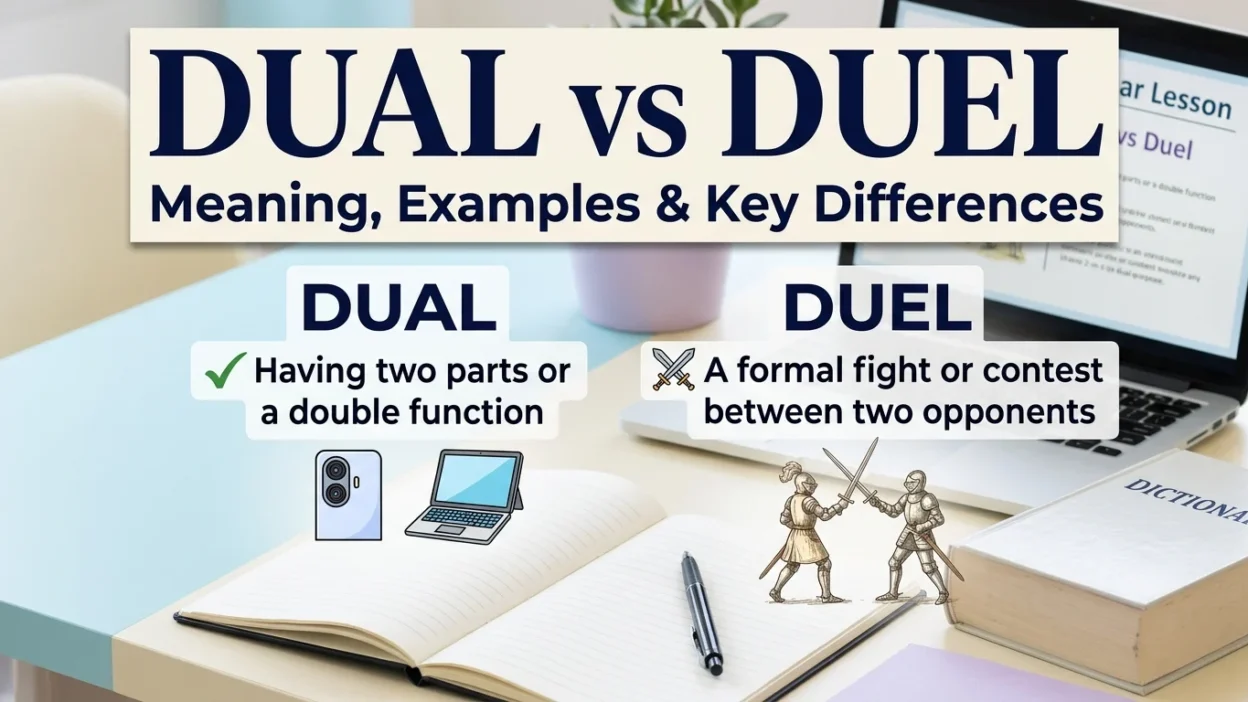
Dual means having two parts, functions, roles, or aspects. Duel means a fight or contest between two people, traditionally involving weapons, or a direct competition between opponents.
- Dual: The smartphone has a dual-camera system.
- Duel: The two knights fought a duel.
Easy trick to remember: Dual relates to two parts or functions, while duel relates to a fight or contest. Both words are pronounced alike, so context is the best way to distinguish them.
What Does Dual Mean?
Dual is an adjective that describes something involving two parts, two purposes, two roles, or two related aspects. It is often used in technology, business, education, law, and everyday conversation.
When something is dual, it has two distinct elements or serves two functions. These elements may work together or represent different sides of the same situation.
For example, a dual-purpose tool can perform two tasks, while a person with dual citizenship holds citizenship in two countries, subject to the relevant laws.
Examples of Dual in Sentences
Here are several examples showing how to use dual correctly:
- My new laptop has a dual-screen feature that improves productivity.
- She has dual citizenship in Canada and the United Kingdom.
- The manager plays a dual role as a team leader and project coordinator.
- This room serves a dual purpose as an office and a guest bedroom.
- The company introduced a dual pricing strategy for its products.
- He enrolled in a dual-degree program at the university.
- The vehicle comes with dual airbags for additional protection.
- The project has a dual objective: reducing costs and improving quality.
In each sentence, dual describes two functions, roles, components, or objectives rather than a fight.
Common Phrases With Dual
You will often encounter dual in the following expressions:
- Dual purpose: Something designed for two uses.
- Dual role: A person or thing performing two roles.
- Dual citizenship: Citizenship in two countries.
- Dual function: Something that performs two functions.
- Dual identity: Having two identities or distinct aspects of identity.
- Dual responsibility: Having two areas of responsibility.
- Dual system: A system involving two components or approaches.
These expressions are common in formal writing, professional communication, technology, and everyday English.
What Does Duel Mean?
Duel is a noun or verb associated with a fight, contest, or direct confrontation between two opponents.
Traditionally, a duel was a formal fight between two people, often using swords or pistols, to settle a dispute or defend one’s honor. In modern English, the word can also describe a sporting contest, a close competition, or a direct battle between rivals.
As a noun, duel refers to the contest itself. As a verb, to duel means to fight or compete directly against someone.
Examples of Duel in Sentences
Consider these examples to understand the word’s meaning:
- The two knights prepared for a duel at sunrise.
- The rivals agreed to a duel to settle their disagreement.
- The champion won the duel against his strongest opponent.
- The movie features an exciting duel between two skilled swordsmen.
- The two tennis players engaged in a thrilling duel on the court.
- The political candidates dueled over economic policy during the debate.
- The chess match became a strategic duel between two grandmasters.
- The detectives faced a verbal duel as each challenged the other’s arguments.
Notice that duel often suggests a direct confrontation between two sides. It does not always involve physical violence; the word can be used figuratively to describe a fierce intellectual, political, or sporting contest.
Common Phrases With Duel
Here are some familiar expressions using duel:
- Sword duel: A fight involving swords.
- Pistol duel: A traditional confrontation involving pistols.
- Duel of words: A heated verbal exchange.
- Political duel: A fierce contest between political rivals.
- Duel of wits: A competition requiring intelligence and cleverness.
- To duel with someone: To fight or compete directly against another person.
These expressions appear in fiction, news reporting, sports commentary, historical writing, and everyday conversation.
Dual vs Duel: Key Differences
Although dual and duel sound alike, they have different grammatical functions and meanings. Understanding these differences will help you choose the correct word when writing.
| Feature | Dual | Duel |
| Part of speech | Adjective | Noun and verb |
| Main meaning | Having two parts or functions | A fight or contest between opponents |
| Common context | Technology, roles, citizenship, and purposes | Fighting, rivalry, sports, and competition |
| Example | The car has dual controls. | The rivals fought a duel. |
| Related word | Double | Combat or confrontation |
| Memory tip | Think of two parts | Think of two opponents |
The main distinction is that dual describes something with two aspects, whereas duel describes a confrontation or competition. A dual-purpose product has two uses, but a duel involves opponents facing each other.
Dual vs Duel: Common Mistakes to Avoid
Because these words are homophones in most English accents, even confident writers sometimes mix them up. Here are common mistakes and their corrections.
1. Using Duel When You Mean Dual
Incorrect: The phone comes with a duel-camera system.
Correct: The phone comes with a dual-camera system.
Why? The sentence describes a camera system with two cameras. It does not describe a fight or contest, so dual is the correct choice.
2. Using Dual When You Mean Duel
Incorrect: The two warriors prepared for a dual.
Correct: The two warriors prepared for a duel.
Why? The warriors are preparing to fight each other. The correct noun is duel.
3. Confusing Dual Purpose With Duel Purpose
Incorrect: This bag has a duel purpose.
Correct: This bag has a dual purpose.
Why? The bag is designed for two uses. Remember that dual describes the number of functions, not a confrontation.
4. Using Duel as an Adjective for Two Features
Incorrect: The device offers duel functionality.
Correct: The device offers dual functionality.
Why? The device has two functions, so dual is needed. Although duel can function as a verb, it does not mean “having two features.”
5. Assuming Both Words Are Interchangeable
Incorrect: The company introduced a duel strategy to reduce expenses.
Correct: The company introduced a dual strategy to reduce expenses.
Why? If the strategy has two components, dual is appropriate. Duel would suggest a fight or competition, which is not the intended meaning.
Writing tip: When you are unsure, ask yourself whether the sentence describes two features or a confrontation. Two features usually call for dual; a fight or contest calls for duel.
Are Dual and Duel Pronounced the Same?
Yes. In most varieties of English, dual and duel are homophones, meaning they have the same pronunciation but different meanings and spellings.
Both are commonly pronounced /ˈduː.əl/, with slight variations depending on accent. The words may sound like “DOO-uhl” when spoken aloud.
Because pronunciation usually cannot distinguish them, readers and listeners rely on context to understand which word is intended.
For example:
- “The system has dual controls” refers to two sets of controls.
- “The competitors entered a duel” refers to a contest between opponents.
This is why correct spelling matters, especially in professional writing, school assignments, articles, and online content.
Dual vs Duel in American and British English
There is no significant difference in the meanings or standard spellings of dual and duel between American and British English. Both varieties use the same spelling and basic definitions.
| Usage | American English | British English |
| Having two functions | Dual-purpose device | Dual-purpose device |
| Citizenship in two countries | Dual citizenship | Dual citizenship |
| A traditional fight | A duel | A duel |
| Direct competition | A duel between rivals | A duel between rivals |
Some related vocabulary may differ between American and British English, but the distinction between dual and duel remains the same.
Whether you are writing for a US audience, a UK audience, or an international readership, use dual for two parts or functions and duel for a fight or contest.
How to Remember the Difference Between Dual and Duel
If you regularly confuse these spellings, a simple memory trick can make them easier to remember.
- Dual = two: Think of dual-purpose products, dual roles, or dual citizenship.
- Duel = opponents: Imagine two knights facing each other in a historical duel.
You can also connect dual with double, since both relate to the idea of two. For duel, picture a direct contest between two rivals.
Try this quick practice exercise:
- The new phone features a _____ camera. (dual)
- The two rivals challenged each other to a _____. (duel)
- She has a _____ role in the organization. (dual)
- The movie ends with a dramatic sword _____. (duel)
- The car offers _____ climate controls. (dual)
Answers: 1. dual; 2. duel; 3. dual; 4. duel; 5. dual.
Practicing with short sentences helps you recognize the context instead of relying on sound alone.
FAQs
1. What is the main difference between dual and duel?
Dual means having two parts, roles, or functions. Duel means a fight or contest between two opponents. For example, a dual-purpose device serves two uses, while a duel involves a confrontation.
2. Are dual and duel homophones?
Yes. In most English accents, dual and duel are pronounced the same way but have different spellings and meanings. Their context helps readers understand which word is correct.
3. Is it dual citizenship or duel citizenship?
The correct expression is dual citizenship. It refers to a person holding citizenship in two countries, subject to applicable laws. Duel citizenship is a spelling mistake in this context.
4. Is it dual purpose or duel purpose?
The correct expression is dual purpose. It describes something designed to serve two purposes. For example, a sofa bed has a dual purpose because it can be used for sitting and sleeping.
5. Can duel be used as a verb?
Yes. Duel can be a verb meaning to fight or compete directly against someone. For example, “The two chess champions dueled for the title.” The word can describe a literal fight or a figurative competition.
6. Is dual the same as double?
Not always. Both words can relate to two, but their usage differs. Dual often emphasizes two functions, roles, or components, while double can mean twice as much or two times a quantity. For example, a dual-purpose tool has two uses, whereas a double portion contains twice the usual amount.
7. Do American and British English spell dual and duel differently?
No. Both American and British English use the standard spellings dual and duel with the same basic meanings. The distinction does not change between these varieties of English.
8. How can I quickly remember when to use dual or duel?
Remember dual = two parts and duel = two opponents. Use dual for two features, functions, or roles. Use duel when describing a fight, confrontation, or direct contest.
Summary: Dual vs Duel
The difference between dual and duel becomes easy to understand when you focus on their meanings rather than their pronunciation. Dual is an adjective describing something with two parts, functions, or roles, as in dual citizenship, dual controls, and dual-purpose equipment. Duel, on the other hand, is a noun or verb referring to a fight or direct contest between opponents, as in a sword duel or the rivals dueled for the championship.
Both words are pronounced similarly in most English accents, and their spelling and meanings remain consistent in American and British English. To avoid mistakes, check what your sentence describes: if it involves two features or purposes, choose dual; if it involves a confrontation or competition, choose duel.
Actionable takeaway: Before publishing or submitting your writing, search for dual and duel and check each sentence against its intended meaning. This quick proofreading habit can help you avoid confusing homophones and make your English clearer and more professional.