Have you ever wondered whether to write Santa Clause or Santa Claus when talking about the jolly Christmas character who delivers presents? You are not alone. These two expressions look almost identical and sound nearly the same, but they have different meanings. Choosing the wrong spelling can create confusion, especially in Christmas cards, holiday messages, school assignments, and festive social media posts.
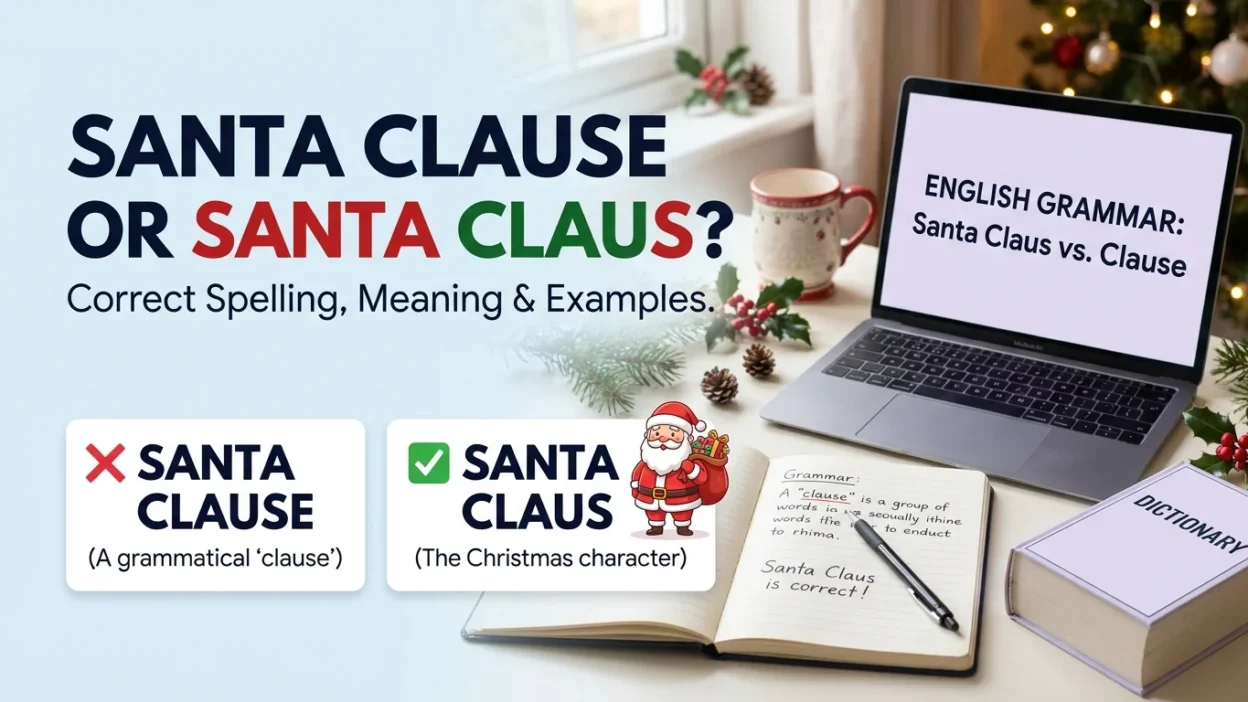
The correct spelling for the famous Christmas gift-giver is Santa Claus. The word clause is a grammatical term or a section of a legal document, while Claus is the traditional name associated with Santa Claus. Understanding this simple difference will help you avoid common spelling mistakes and use both expressions correctly. Let’s explore their meanings, examples, pronunciation, and the easiest ways to remember which one to use.
Quick Answer: Santa Clause vs Santa Claus
Santa Claus is the correct spelling when referring to the legendary Christmas character who brings presents to children. Santa clause is generally incorrect when used as the character’s name, although the phrase can be correct in a different context, such as a playful reference to a contractual provision involving Santa.
- Correct: Santa Claus leaves presents under the Christmas tree.
- Incorrect: Santa Clause leaves presents under the Christmas tree.
- Correct: The contract contains a special clause about holiday deliveries.
Easy trick to remember: Santa Claus has a name ending in Claus, while a clause is a part of a sentence or document.
What Does Santa Claus Mean?
Santa Claus is a popular Christmas figure known for bringing gifts to children, traditionally on Christmas Eve. He is commonly portrayed as a cheerful, bearded man wearing a red suit with white trim.
Santa Claus is also known by other names, including Santa, Saint Nicholas, Father Christmas, and Kris Kringle, although these names have different cultural and historical backgrounds.
The modern Santa Claus tradition draws on stories about Saint Nicholas, a historical Christian bishop associated with generosity, as well as European Christmas traditions. Over time, these influences helped shape the familiar character celebrated in many countries today.
Examples of Santa Claus in Sentences
Here are some natural examples showing how to use Santa Claus correctly:
- The children were excited to see Santa Claus at the Christmas market.
- My little brother believes that Santa Claus visits our house every Christmas Eve.
- We hung our stockings by the fireplace for Santa Claus.
- The shopping mall invited Santa Claus to meet families and take holiday photos.
- The children wrote letters to Santa Claus asking for their favorite gifts.
- Santa Claus is a familiar symbol of Christmas generosity.
- The movie tells a heartwarming story about Santa Claus and his helpers.
- Everyone dressed as Santa Claus for the school’s Christmas celebration.
In all these sentences, Claus is part of the character’s name. It should not be replaced with clause.
What Does Clause Mean?
A clause is a grammatical unit that contains a subject and a verb. A clause may express a complete thought on its own or form part of a larger sentence.
The word clause is also commonly used in legal, business, and formal writing to describe a particular provision or section of a document, contract, or agreement.
Unlike Claus, which is a proper name in Santa Claus, clause is an ordinary English word with its own meanings.
1. Clause in Grammar
In English grammar, a clause contains a subject and a verb. There are two main types: independent clauses and dependent clauses.
Examples:
- Independent clause: The children opened their presents.
- Dependent clause: Because Santa Claus arrived late.
- Complete sentence with both: The children opened their presents because Santa Claus arrived late.
The first clause expresses a complete thought, while the second depends on another clause to complete its meaning.
2. Clause in Legal and Formal Writing
In legal documents, a clause is a specific provision that explains a condition, obligation, right, or rule.
Examples:
- The contract includes a clause about holiday working hours.
- Please read the cancellation clause before signing the agreement.
- The rental agreement contains a clause about property maintenance.
- The company added a confidentiality clause to the contract.
In these examples, clause refers to a provision in a document, not to the Christmas character.
3. Santa Clause as a Wordplay Expression
Although Santa Clause is not the standard spelling of Santa Claus’s name, it can appear intentionally as a pun.
For example, a writer might use “Santa Clause” as a humorous title for a fictional legal provision that explains Santa’s rights or responsibilities. This plays on the similar sounds of the two words.
The expression is also recognizable from the Christmas comedy film The Santa Clause. In that title, Clause is an intentional pun connected to a legal provision in the film’s story.
Therefore, context matters: use Santa Claus for the character, but recognize that Santa Clause may be intentional wordplay or part of a specific title.
Santa Clause vs Santa Claus: Key Differences
The simplest way to understand these expressions is to compare their spelling, meaning, and usage.
| Feature | Santa Clause | Santa Claus |
| Standard meaning | A possible pun or special phrase involving a clause | The Christmas gift-giving character |
| Correct for Santa’s name? | No | Yes |
| Word type | Santa + the noun clause | Proper name |
| Common context | Wordplay, legal jokes, and the film title | Christmas stories, cards, and holiday traditions |
| Example | The movie is called The Santa Clause. | Santa Claus visits children at Christmas. |
Remember: The final word makes all the difference. Claus is the name; clause is the grammatical or legal term.
Common Mistakes When Using Santa Clause or Santa Claus
These mistakes are easy to make because the two words sound alike. Here are some common examples and their corrections.
1. Spelling Santa Claus as Santa Clause
Incorrect: We are waiting for Santa Clause to bring our gifts.
Correct: We are waiting for Santa Claus to bring our gifts.
Why? The sentence refers to the Christmas character, so the correct spelling is Claus.
2. Using Claus When You Mean a Grammatical Clause
Incorrect: This sentence contains an independent claus.
Correct: This sentence contains an independent clause.
Why? In grammar, the correct term is clause. Claus is a name, not the grammatical term.
3. Confusing Santa Claus With Father Christmas
Santa Claus and Father Christmas are closely related Christmas figures, and their names are often used for the familiar gift-giving character. However, they have distinct historical backgrounds and cultural associations.
Example: “Father Christmas appears in many British Christmas traditions.”
The spelling of the character’s name depends on the name you intend to use. Neither Claus nor clause is a substitute for Father Christmas.
4. Forgetting Capitalization
Incorrect: The children wrote a letter to santa claus.
Correct: The children wrote a letter to Santa Claus.
Why? Santa Claus is a proper name, so both words are capitalized when referring to the character.
By contrast, clause is normally lowercase unless it begins a sentence or appears in a title where title capitalization is appropriate.
5. Assuming Santa Clause Is Always a Typo
Incorrect assumption: The words “Santa Clause” can never be correct.
Better understanding: Santa Clause is incorrect when used as the standard name of the Christmas character, but it can be intentional in a pun, a fictional legal expression, or a proper title such as The Santa Clause.
Always consider the context before deciding whether a spelling is wrong.
American vs British English: Santa Clause or Santa Claus
There is no spelling difference between American and British English when referring to Santa Claus. Both varieties use Claus as the character’s name.
| Context | American English | British English |
| Christmas character | Santa Claus | Santa Claus |
| Grammatical term | Clause | Clause |
| Legal document provision | Clause | Clause |
| Alternative Christmas name | Santa Claus | Father Christmas is also common |
In the United States, Santa Claus is the familiar name used in Christmas stories, advertisements, and holiday celebrations. In the United Kingdom, Santa Claus is also widely understood, while Father Christmas is a traditional alternative.
The word clause retains the same basic grammatical and legal meanings in both varieties of English. You do not need to change the spelling based on your audience’s location.
How to Remember the Difference Between Santa Clause and Santa Claus
A simple memory trick can help you avoid this common Christmas spelling mistake.
- Claus = character: Think of Santa Claus delivering Christmas presents.
- Clause = grammar: Think of an independent clause or a dependent clause.
- Clause = contract: Think of a cancellation clause in a legal agreement.
You can also remember this sentence:
“Santa Claus brings presents, while a clause belongs in a sentence or contract.”
The next time you write a Christmas greeting, holiday invitation, or festive blog post, remember that Santa’s name ends in Claus, without the final e.
FAQs
1. Is it Santa Clause or Santa Claus?
Santa Claus is correct when referring to the Christmas character. Clause is a different word used in grammar and legal writing, although Santa Clause can be an intentional pun or part of a title.
2. Why is it called Santa Claus instead of Santa Clause?
Claus is the established spelling of the character’s name. The name developed through traditions associated with Saint Nicholas and the Dutch figure Sinterklaas. The word clause has a separate linguistic history and meaning.
3. Is Santa Clause ever correct?
Yes, in specific contexts. The Santa Clause is the title of a 1994 Christmas comedy film, and Santa Clause can also be used as wordplay. However, it is not the standard spelling of Santa Claus’s name.
4. What is the difference between Claus and clause?
Claus is a proper name used in Santa Claus. Clause is a noun referring to a grammatical unit containing a subject and verb or a provision in a legal document.
5. Is Santa Claus the same as Father Christmas?
They are closely related Christmas figures and are often used to refer to the same modern gift-giving character. Father Christmas has particular historical associations with British Christmas traditions, while Santa Claus is especially familiar in American culture.
6. Should Santa Claus be capitalized?
Yes. Both words are capitalized when referring to the character by name. For example, “Santa Claus visited the shopping center.” The common noun clause is usually lowercase unless capitalization is required by its position or a title.
7. Is Santa Claus spelled the same way in British and American English?
Yes. Both American and British English use Santa Claus. The alternative name Father Christmas is more traditionally associated with British usage, but it does not change the spelling of Santa Claus.
8. What does clause mean in a sentence?
In grammar, a clause is a group of words containing a subject and a verb. For example, “Santa Claus arrived” is an independent clause because it expresses a complete thought.
Summary: Santa Clause vs Santa Claus
When comparing Santa Clause vs Santa Claus, the key difference is that Santa Claus is the correct name for the traditional Christmas gift-giver, while clause is a grammatical or legal term. Santa Claus appears in Christmas stories, holiday greetings, festive advertisements, and family traditions. Clause appears in expressions such as independent clause, dependent clause, and contract clause. Although the two words sound alike, their spelling and meanings are different.
Remember that Santa Clause can be intentional in a pun or a title, such as The Santa Clause, so context matters. For everyday Christmas writing, however, always choose Santa Claus when referring to the character. This small spelling detail can make your holiday messages, articles, and professional writing clearer and more accurate.
Actionable takeaway: Before publishing your next Christmas post or sending a holiday greeting, check whether you mean the character or a grammatical or legal provision. If you mean the gift-giver, write Santa Claus.