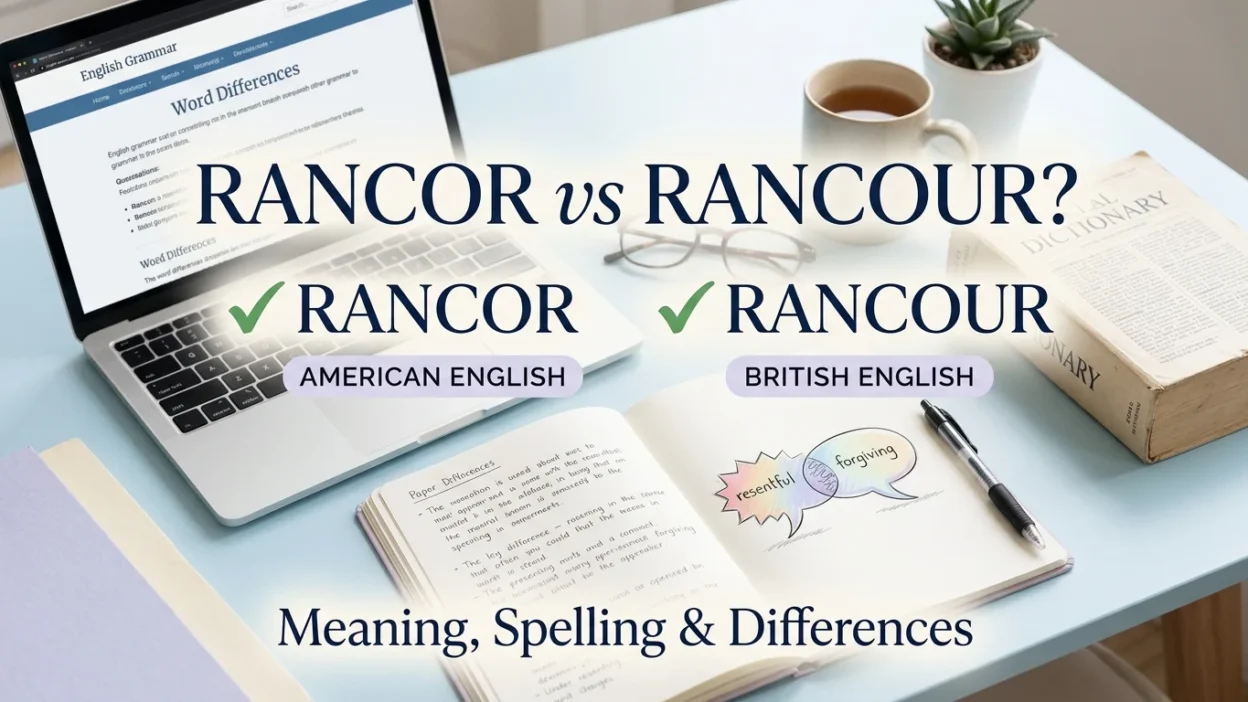
Have you ever come across the words rancor and rancour and wondered whether they have different meanings? Both spellings refer to the same powerful negative emotion: deep-seated bitterness, resentment, or lasting hostility toward someone. Although they look slightly different, neither is grammatically incorrect.
The difference between rancor vs rancour comes down to regional spelling preferences. Rancor is the standard American English spelling, while rancour is commonly used in British English and other varieties that follow British spelling conventions. Understanding this small distinction can help you write more confidently, especially when preparing professional documents, academic work, or international content.
Quick Answer: Rancor or Rancour?
Both rancor and rancour are correct spellings of the same noun.
- Rancor: The preferred spelling in American English.
- Rancour: The preferred spelling in British English, Canadian English, and other varieties that follow British conventions.
Both words describe deep resentment, bitterness, ill will, or persistent hostility toward another person or group.
Examples:
- American English: She spoke about her former colleague without rancor.
- British English: Despite their disagreement, he showed no rancour toward his opponent.
Easy way to remember: Use rancor when writing for an American audience and rancour when following British English spelling conventions.
What Does Rancor Mean?
Rancor is a noun that describes a strong and persistent feeling of bitterness, resentment, or hostility toward someone. It usually develops after an unpleasant experience, personal conflict, betrayal, or disagreement.
Unlike temporary anger, rancor tends to remain for a long time. Someone experiencing rancor may continue feeling resentful even after the original disagreement has ended.
For example:
- She still felt rancor toward the friend who betrayed her trust.
- The political debate was filled with rancor and personal attacks.
- He decided to leave the company without any rancor toward his former employer.
In each example, the word expresses lasting bitterness rather than a brief moment of frustration.
Rancor: Meaning and Usage
The word rancor is generally used in formal, literary, journalistic, and conversational contexts when describing deep resentment or hostility.
It can refer to feelings between:
- Friends who have experienced a serious disagreement.
- Family members involved in long-standing conflicts.
- Political opponents with opposing views.
- Former business partners after a disagreement.
- Individuals who have experienced betrayal or unfair treatment.
Example: Years after their business partnership ended, the two entrepreneurs continued to speak without rancor.
Here, without rancor means without bitterness or hostility.
What Does Rancour Mean?
Rancour has exactly the same meaning as rancor. It is a noun referring to deep-rooted resentment, bitterness, ill will, or hostility.
The only difference is its spelling, not its definition, pronunciation, or grammatical function.
The additional letter u is a characteristic feature of British English spelling.
For example:
- She expressed her disappointment without rancour.
- The disagreement created considerable rancour between the two families.
- Despite their political differences, the candidates treated each other without rancour.
In these sentences, rancour communicates the same feeling that rancor expresses in American English.
Rancour: Meaning and Usage
British English writers generally prefer rancour in formal writing, newspapers, books, and everyday communication.
The word is particularly useful when describing:
- Long-lasting personal resentment.
- Bitter political disagreements.
- Hostility between competing groups.
- Unresolved family conflicts.
- Emotional bitterness following betrayal.
Example: The negotiations ended peacefully, without the rancour that had characterized earlier discussions.
The sentence describes an absence of lasting hostility during the negotiations.
Rancor vs Rancour: Key Differences
Although these two words look different, their meanings and grammatical uses are identical. Their distinction is based entirely on regional spelling conventions.
| Feature | Rancor | Rancour |
| Meaning | Deep resentment or bitterness | Deep resentment or bitterness |
| Word type | Noun | Noun |
| Preferred English | American English | British English |
| Spelling | Without u | With u |
| Pronunciation | /ˈræŋ.kər/ | /ˈræŋ.kər/ |
| Usage | US publications and writing | UK publications and writing |
| Correctness | Correct | Correct |
| Example | He felt no rancor. | He felt no rancour. |
Remember: Neither spelling is more grammatically correct than the other. Your choice should depend on the English variety you are following.
American English vs British English: Rancor or Rancour?
One of the most interesting aspects of English spelling is that the same word can have different accepted forms in different countries.
The rancor vs rancour distinction is a good example of this variation.
American English: Rancor
American English generally removes the letter u from certain words that retain it in British English.
Therefore, American writers use rancor as the standard spelling.
Examples:
- The conversation ended without rancor.
- The senator’s speech reflected years of political rancor.
- She refused to let personal rancor affect her professional decisions.
If you are writing for an American newspaper, university, website, or business, rancor is the appropriate choice.
British English: Rancour
British English retains the additional u, making rancour the preferred spelling.
Examples:
- The dispute was settled without rancour.
- There was considerable rancour between the rival organizations.
- He spoke about the incident without bitterness or rancour.
This spelling is also common in other English varieties influenced by British conventions, including Canadian and Australian English.
However, Canadian spelling practices can vary depending on the publication or style guide.
Rancor and Rancour in Example Sentences
Seeing both spellings in context makes it easier to understand how they work in everyday writing.
Here are some practical examples:
- The two colleagues resolved their disagreement without rancor.
- Years of competition had created considerable rancour between the organizations.
- She remembered the painful experience but held no rancor against anyone.
- The political discussion quickly turned into an exchange of rancor and accusations.
- Despite their separation, the former partners maintained a relationship without rancour.
- His apology helped reduce the rancor between the two families.
- The manager handled the difficult situation without expressing any rancour.
- Their friendship ended, but neither person carried lasting rancor.
- The election campaign was marked by hostility, personal attacks, and political rancour.
- He chose forgiveness instead of allowing rancor to control his life.
Notice that the spelling changes according to the preferred English variety, but the meaning remains exactly the same.
Common Mistakes When Using Rancor and Rancour
Even though both spellings are correct, writers sometimes make avoidable mistakes when choosing between them.
Here are some common problems to watch out for.
1. Thinking They Have Different Meanings
One frequent misconception is that rancor and rancour describe different emotions.
This is incorrect. Both words express deep resentment, bitterness, or hostility.
Incorrect assumption: Rancor means anger, while rancour means hatred.
Correct understanding: Both spellings have the same meaning and can describe lasting bitterness or ill will.
2. Mixing American and British Spellings
Using both spellings in the same article or document can make your writing appear inconsistent.
For example:
- The discussion ended without rancor.
- The disagreement created considerable rancour.
Neither sentence is incorrect individually. However, using both spellings in the same American English document is generally unnecessary.
Better approach: Choose one spelling convention and use it consistently throughout your writing.
3. Assuming Rancour Is Incorrect
Some American English writers may assume that the additional u makes rancour a spelling mistake.
That is not true. Rancour is the standard British English spelling and is widely accepted in British publications.
4. Confusing Rancor With Temporary Anger
Rancor usually describes a deeper and more persistent feeling than ordinary anger.
For example:
- Anger: She was angry about the late delivery.
- Rancor: Years later, she still felt rancor toward the person responsible for betraying her.
Understanding this difference helps you choose the word more accurately.
Synonyms of Rancor and Rancour
If you want to avoid repeating the same word, several synonyms can communicate similar feelings.
However, their meanings are not always identical, so choose one that fits your sentence.
| Synonym | Meaning |
| Resentment | Persistent displeasure over perceived unfair treatment |
| Bitterness | Deep and painful feelings of disappointment or anger |
| Hostility | Unfriendly or aggressive feelings toward someone |
| Animosity | Strong dislike or opposition |
| Ill will | An unfriendly or negative attitude |
| Antagonism | Active opposition or hostility |
| Malice | An intention or desire to cause harm |
| Enmity | Deep-seated hostility between individuals or groups |
| Grudge | Lasting resentment over a past incident |
| Acrimony | Bitterness or hostility, especially during disagreements |
Example: Instead of saying, “Their relationship was full of rancor,” you could write, “Their relationship was characterized by deep resentment and hostility.”
These alternatives can make your writing more expressive while helping you communicate the intended emotion.
Related Expressions: Without Rancor or Without Rancour
One of the most common expressions containing this word is without rancor or without rancour.
Both expressions mean acting or speaking without bitterness, resentment, or hostility.
Examples:
- She accepted the decision without rancor.
- The former business partners parted without rancour.
- He discussed their disagreement without any rancor.
- The two political leaders ended their meeting without rancour.
Another related expression is bitter rancor, which emphasizes particularly intense resentment.
For example:
The disagreement left bitter rancor between the two families.
Although bitter rancor is somewhat emphatic because rancor already implies bitterness, it is an acceptable expression used for emphasis.
FAQs
1. Is it rancor or rancour?
Both are correct. Rancor is the preferred American English spelling, while rancour is the standard British English spelling. They have identical meanings.
2. Is rancour British or American?
Rancour is primarily the British English spelling. It is also used in other English varieties that follow British spelling conventions, including Australian English.
3. Is rancor American English?
Yes. Rancor is the standard American English spelling. American dictionaries and publications generally use this version without the additional letter u.
4. Do rancor and rancour have different pronunciations?
No. Both words are generally pronounced /ˈræŋ.kər/ in standard British and American English. Their spelling differs, but their pronunciation and meaning remain essentially the same.
5. What is the meaning of rancor or rancour?
Both words mean deep-seated bitterness, resentment, hostility, or ill will toward another person or group. They typically describe negative feelings that continue over time.
6. Can I use rancour in American English?
Yes. American readers will generally understand rancour, but it is not the preferred American spelling. For consistency with American English, use rancor.
7. What is the opposite of rancor?
Common opposites include goodwill, forgiveness, friendliness, kindness, and goodwill toward others. The most appropriate opposite depends on the context.
8. Is without rancor grammatically correct?
Yes. Without rancor is a grammatically correct expression in American English. British English writers commonly use without rancour. Both mean without bitterness, hostility, or resentment.
Summary: Rancor vs Rancour
The difference between rancor vs rancour is simple: both words are correct, and both describe deep-rooted resentment, bitterness, or hostility. They function as nouns, share the same meaning, and are pronounced in essentially the same way. The only distinction is their regional spelling preference.
American English uses rancor, while British English generally prefers rancour. Neither spelling is incorrect, and neither carries a different emotional meaning. The important thing is to consider your audience and maintain consistent spelling throughout your writing.
Actionable takeaway: Remember this simple rule: Use rancor for American English and rancour for British English. When writing for an international audience, choose the spelling that matches your website’s established style guide and apply it consistently.