Have you ever wondered whether the correct spelling is persue or pursue? You are not alone. Many English learners and even experienced writers accidentally type “persue” when they mean “pursue.” Because the two spellings look similar, it is easy to overlook the extra letter and make a spelling mistake in an email, essay, application, or professional document.
The good news is that this spelling confusion has a simple solution. Pursue is the correct spelling in standard English, while persue is a misspelling. Whether you want to pursue a career, pursue your dreams, pursue a goal, or pursue an opportunity, understanding the correct spelling will help you write with greater confidence. In this guide, you will learn the meaning of pursue, explore practical examples, discover common mistakes, and find easy ways to remember the correct spelling.
Quick Answer: Persue vs Pursue
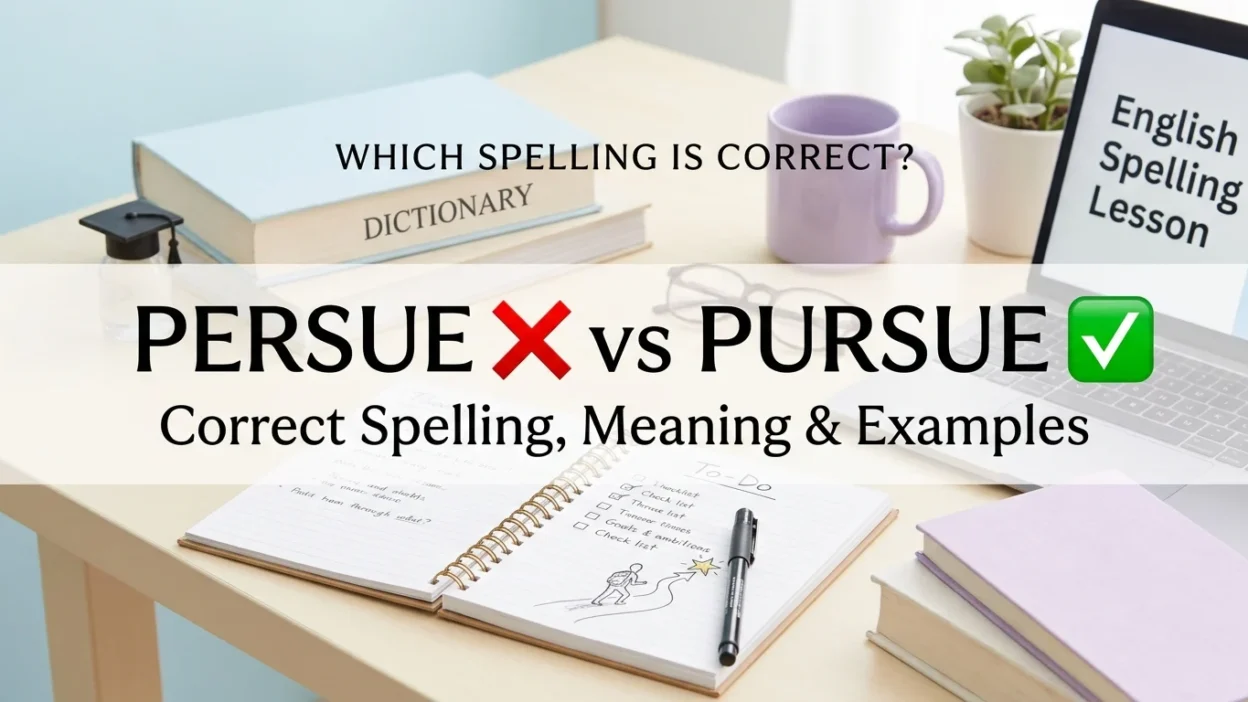
Pursue is the correct spelling. It means to follow, chase, work toward, or try to achieve something. Persue is an incorrect spelling and should not be used in standard English writing.
Examples:
- Correct: She wants to pursue a career in medicine.
- Incorrect: She wants to persue a career in medicine.
- Correct: The police continued to pursue the suspect.
- Incorrect: The police continued to persue the suspect.
Easy way to remember: Always write pursue with the letter u after the initial p: P-U-R-S-U-E.
What Does Pursue Mean?
The word pursue is a verb with several related meanings. It can describe physically following someone or something, working toward a goal, continuing an activity, or trying to achieve a particular result.
The meaning depends on the context. For example, a police officer may pursue a suspect, a student may pursue higher education, and an entrepreneur may pursue a business opportunity.
Pursue is a versatile word used in everyday conversation, academic writing, professional communication, and formal documents.
1. Pursue Means to Follow or Chase
One common meaning of pursue is to follow someone or something in an attempt to catch up with it.
Examples:
- The police pursued the suspect through several streets.
- The dog pursued the ball across the garden.
- The hunters pursued the animal through the forest.
- The journalist pursued the story until she discovered the facts.
- The runner pursued the leading athlete during the final lap.
In these sentences, pursue describes following or chasing someone or something. The action may be physical, as in chasing an animal, or figurative, as in investigating a story.
2. Pursue Means to Work Toward a Goal
Pursue is frequently used when discussing ambitions, dreams, education, and career plans. It suggests making an effort to achieve something important.
Examples:
- She decided to pursue her dream of becoming a writer.
- He wants to pursue a master’s degree abroad.
- They are pursuing new opportunities in digital marketing.
- I encourage you to pursue your goals with patience and determination.
- After years in sales, he decided to pursue a career in teaching.
This usage is especially common in motivational writing, career advice, personal statements, and professional conversations.
3. Pursue Means to Continue an Activity or Course of Action
The word can also mean to continue working on an activity, interest, plan, or investigation.
Examples:
- The company plans to pursue a new marketing strategy.
- The researchers will pursue further studies on the subject.
- She chose to pursue her interest in photography.
- The lawyer decided to pursue legal action.
- The team continued to pursue the project despite several setbacks.
In these examples, pursue emphasizes continuing an effort rather than abandoning it.
Why Is Persue Incorrect?
Persue is a spelling error, not a standard alternative to pursue. It is not accepted as the correct spelling in standard American or British English.
The mistake often occurs because English spelling does not always follow predictable sound patterns. When people type quickly or rely on how a word sounds, they may replace the u in pursue with an e.
For example, someone might write:
- “I want to persue my education.”
- “We will persue every available opportunity.”
- “She hopes to persue a career in law.”
All three sentences contain the same spelling mistake. The correct versions use pursue:
- “I want to pursue my education.”
- “We will pursue every available opportunity.”
- “She hopes to pursue a career in law.”
If you see persue in a draft, correct it to pursue. You do not need to change the sentence structure unless there is another grammatical issue.
Persue vs Pursue: Key Differences
Although people often search for both spellings, they do not have equal status in English. Pursue is the recognized verb, while persue is simply a misspelling.
| Feature | Persue | Pursue |
| Spelling status | Incorrect spelling | Correct spelling |
| Part of speech | Not a standard English word | Verb |
| Meaning | No standard meaning intended in this context | To follow, chase, or work toward something |
| Formal writing | Avoid | Use |
| Example | I will persue my goals. | I will pursue my goals. |
The key point is straightforward: use pursue whenever you mean to follow, continue, or try to achieve something. Do not treat persue as a different word with a separate meaning.
Common Phrases Using Pursue
Learning common expressions is one of the easiest ways to remember the correct spelling. Pursue frequently appears with nouns such as dreams, goals, careers, and opportunities.
Here are some useful phrases and their meanings:
- Pursue a dream: Make an effort to achieve something you deeply want.
- Pursue a career: Work toward entering or developing a profession.
- Pursue a goal: Take steps to achieve a specific objective.
- Pursue an opportunity: Try to take advantage of a promising possibility.
- Pursue higher education: Continue studying at an advanced academic level.
- Pursue legal action: Take steps toward resolving a matter through the legal system.
- Pursue a relationship: Make an effort to develop a romantic relationship.
- Pursue an interest: Spend time developing an activity or subject you enjoy.
- Pursue an investigation: Continue investigating a situation or suspected wrongdoing.
- Pursue a strategy: Continue following a planned approach to reach an objective.
For example, “She decided to pursue a career in journalism” sounds natural because pursue commonly describes working toward a professional ambition.
Synonyms of Pursue
Depending on your sentence, you can replace pursue with another word that expresses a similar idea. However, the best synonym depends on whether you mean chasing something, achieving a goal, or continuing an activity.
| Synonym | Meaning | Example |
| Chase | Follow to catch | The dog chased the ball. |
| Follow | Go after or move behind | The detective followed the suspect. |
| Seek | Try to find or obtain | They seek better opportunities. |
| Aim for | Try to achieve | She aims for a leadership position. |
| Strive for | Make a strong effort to achieve | He strives for excellence. |
| Continue | Keep doing something | They continued their research. |
| Undertake | Begin or take responsibility for an activity | The team undertook a new project. |
| Explore | Investigate or consider possibilities | We explored several career options. |
These words are related to pursue, but they are not interchangeable in every situation. For instance, chase often emphasizes physical movement, while strive for focuses on effort toward a goal.
Common Mistakes to Avoid When Using Pursue
Even after learning the correct spelling, it helps to understand a few related writing mistakes.
1. Writing Persue Instead of Pursue
Incorrect: He wants to persue a degree in engineering.
Correct: He wants to pursue a degree in engineering.
The correction is simply a spelling change. Remember that pursue contains a u immediately after p.
2. Confusing Pursue With Purpose
Incorrect: She plans to purpose a career in medicine.
Correct: She plans to pursue a career in medicine.
Purpose is usually a noun meaning an intention or reason, although it can also be a verb meaning to intend or plan. Pursue means to follow or work toward something. They have different meanings.
3. Using an Awkward Verb Form
Incorrect: She is pursue her dream of becoming a doctor.
Correct: She is pursuing her dream of becoming a doctor.
After is in a continuous tense, use the -ing form: pursuing.
4. Forgetting the Past-Tense Form
Incorrect: He pursue his dream last year.
Correct: He pursued his dream last year.
Pursue is a regular verb. Its past tense and past participle are both pursued.
- Present: I pursue my goals.
- Past: I pursued my goals.
- Present perfect: I have pursued my goals.
- Continuous: I am pursuing my goals.
5. Using Pursue When Another Word Is More Natural
Although pursue is correct in many contexts, it can sound overly formal in casual conversation.
For example:
- Formal: I intend to pursue further research into the issue.
- Simpler: I plan to study the issue further.
Choose the word that fits your audience and purpose. Correct spelling matters, but clear and natural phrasing matters too.
Is Pursue Spelled Differently in American and British English?
No. Pursue is spelled the same way in American and British English. The misspelling persue is incorrect in both varieties.
| Expression | American English | British English |
| Pursue a career | Correct | Correct |
| Pursue a goal | Correct | Correct |
| Pursued an opportunity | Correct | Correct |
| Pursuing an interest | Correct | Correct |
| Persue a dream | Incorrect | Incorrect |
There may be differences in pronunciation depending on regional accents, but there is no standard spelling difference between the United States and the United Kingdom.
Whether you are writing a college application, a business proposal, a blog post, or a personal statement, always use pursue.
How to Remember the Correct Spelling of Pursue
If you frequently type persue by mistake, a simple memory technique can help you avoid the error.
- Break it into letters: P-U-R-S-U-E.
- Connect it with a goal: You pursue your dreams and ambitions.
- Practice a sentence: “I will pursue my goals with confidence.”
- Use spell-check: Add a proofreading step before submitting important writing.
One useful trick is to remember the word’s ending: pursue ends in U-E, not S-U-E after an initial P-E-R. Practicing the correct spelling in familiar phrases makes it easier to recall naturally.
Frequently Asked Questions About Persue vs Pursue
1. Is persue or pursue correct?
Pursue is correct. Persue is a misspelling and should be corrected in standard English writing. Pursue means to follow, chase, or work toward something.
2. What does pursue mean in simple English?
Pursue means to try to get something, achieve a goal, or follow someone or something. For example, “She wants to pursue her dream” means she wants to work toward achieving her dream.
3. How do you spell pursue correctly?
The correct spelling is P-U-R-S-U-E: pursue. Remember the letter U after P and the final U-E.
4. What is the past tense of pursue?
The past tense is pursued. For example, “He pursued his education overseas.” The past participle is also pursued, as in “She has pursued several career opportunities.”
5. Can pursue be used for a career or education?
Yes. Pursue is commonly used when talking about careers, academic studies, and personal ambitions. Examples include “pursue a career in medicine,” “pursue higher education,” and “pursue a professional qualification.”
6. Is pursue a formal word?
Pursue can be used in both formal and informal English, although it is particularly common in professional and academic writing. In casual conversation, you might use simpler alternatives such as follow, try for, or work toward.
7. Is pursue the same as follow?
Not exactly. Follow can mean to go behind someone or pay attention to instructions. Pursue often suggests actively chasing, seeking, or working toward something. For example, you can follow a recipe, but you pursue a career.
8. Does American English use persue?
No. American English uses pursue, just like British English. Persue is not an accepted alternative spelling in either variety.
Summary: Persue vs Pursue
When comparing persue vs pursue, the answer is simple: pursue is the only correct spelling in standard English. It is a verb meaning to chase, follow, seek, or work toward something. You can pursue a dream, pursue a career, pursue higher education, or pursue an opportunity. Persue is a common spelling mistake, not a separate word with its own meaning.
The easiest way to remember the distinction is to practice the correct spelling in everyday phrases and check your writing before submitting it. Whether you are preparing an academic assignment, a job application, a professional email, or an article, using pursue correctly helps your writing look polished and trustworthy.
Actionable takeaway: Memorize P-U-R-S-U-E and write one sentence using the word today. For example, “I will pursue my goals with patience and determination.” A little practice can help you avoid this spelling mistake in the future.